Le marché du gaz naturel liquéfié (GNL), actuellement très recherché en Europe comme alternative au gaz russe, est marqué par un « déséquilibre structurel » entre la demande et l’offre, note l’association professionnelle du secteur dans un rapport publié jeudi.
Dominion Cove Point, terminal de gaz naturel liquéfié à Lusby, dans le Maryland (en 2014)
Les importations mondiales de GNL ont atteint 372,3 millions de tonnes en 2021, en croissance de 4,5% par rapport à 2020, indique le Groupe international des importateurs de gaz naturel liquéfié (GIIGNL) dans son rapport annuel.
L’Asie, notamment la Chine qui est devenue première importatrice mondiale devant le Japon, a fortement encouragé la demande. « Ces importations record ont été tirées par une reprise économique robuste ainsi que par la croissance du gaz pour la production d’électricité et la transition du charbon vers le gaz », explique le GIIGNL.
Mais depuis l’invasion de l’Ukraine par la Russie fin février, l’Europe cherche aussi à augmenter massivement ses importations de GNL pour réduire sa dépendance au gaz russe, qui arrive essentiellement par gazoduc. Le GNL peut, lui, être transporté par bateau de n’importe quel endroit du monde. « Le marché du GNL se développe rapidement et les récentes hausses de prix indiquent un déséquilibre structurel entre la demande et la croissance de l’offre », juge le président du GIIGNL, Jean Abiteboul.
Côté offre, la production mondiale ne progresse en effet que modestement malgré cet enthousiasme renouvelé pour le gaz liquéfié. Les États-Unis font figure de locomotive, ayant commercialisé l’an dernier 22,3 millions de tonnes supplémentaires. La volatilité des prix « a été exacerbée par le conflit russo-ukrainien, et la crise énergétique européenne actuelle s’avère être un rappel brutal du rôle vital du GNL pour assurer la sécurité énergétique et la stabilité économique », ajoute Jean Abiteboul.
En Europe, l’Allemagne a débloqué récemment une enveloppe de trois milliards d’euros pour se doter de terminaux flottants d’importation de GNL, dont le pays ne dispose pas pour le moment.
Pour sa part, la France dispose déjà de quatre terminaux méthaniers et envisage d’installer en plus une installation flottante.
This war is about the balance of power between the West and Russia. Russia says it had to go into the war in Ukraine because the West has threatened it: NATO creeps ever further east, and the government in Kyiv is NATO’s puppet. Incidents in the past – such as that involving United States Assistant Secretary of State Victoria Nuland and the U.S. ambassador to Ukraine, who in 2014 discussed on an open line phone call who should and who should not be in Kyiv’s new government following the Maidan revolution – fed the Kremlin’s paranoia. Washington has been involved in Ukraine’s affairs.
Emphatically, there is no justification for Russia’s brutal invasion and the atrocities that accompany it. I mention the U.S. role in Ukraine to remind us that the Russia-West contest is a fact of life, part of geopolitical reality.
After the Soviet Union imploded in the early 1990s, only a few European politicians capable of a long-term view, such as Otto von Habsburg, argued that if the European Union meant to become a political union, it needed immediately to bring liberated Ukraine, one of Europe’s biggest countries, into its fold. This would have prevented resurgent Russia’s attempts to reintegrate it. Now, it is too late.
What Europe needs badly now, regardless of the outcome of the Ukraine fighting, is a new general security framework. An important caveat: this will not emerge at the EU level. Brussels is hopeless in foreign policy and defense. However, on the state level, the strongest European countries such as Germany, France and the United Kingdom could develop and implement such a powerful and effective framework.
While NATO must help Ukraine resist the present invasion, one cannot assume that Russia will be eradicated militarily or reduced to a pariah state. After the retreat of the invading force, Russia will remain a significant, recognized member of the international community.
What works and what does not work
But for now, what should the West’s policy be? Which of the measures taken so far hurt the Putin regime, and which ones do not cause actual harm?
For one, the practice of “shaming” Western companies to force them to stop doing business in Russia on very short notice is wrongheaded.
A telling example involves Nestle. The company is under pressure to close its operations in Russia. What would that bring? Factories and staff would remain there and continue operating under the Russian state administration. There are precedents for this. German automaker Opel was acquired by General Motors before World War II. When the U.S. joined the war in Europe, GM had to write off its investment while the company continued to manufacture vehicles under government-appointed management. Certainly, Nestle can (and does) refrain from new investments in Russia and technology transfers.
The same goes for the big Western accounting companies that operate in Russia. Their personnel will continue as usual with local partners if they pull out. The only practical difference will be that the license payments to the headquarters in the West will stop flowing.
Are such business dramas hurting Russia? We beg to differ.
On the political front, banning visits by Russian Foreign Minister Sergey Lavrov or declaring sanctions on President Vladimir Putin is ineffective. The West must denounce the barbarian actions of the Russian regime but cannot base its policy on the assumption that the Putin regime is sure to collapse anytime soon. The political process to end the war and build new relationships will require talking to whoever is in the Kremlin.
The effectiveness of sanctioning the oligarchs is also likely overestimated. The Kremlin does not depend on the oligarchs; they depend on Mr. Putin and are useful for financing projects that should not go through official state channels. (Not so long ago, France had a similar system for political interventions executed outside the official institutions and financed through its state-owned companies.)
Curbs on know-how transfers that facilitate the long-term transition to sustainable energy will hurt Russia badly.
The drive to silence Russian disinformation and its propaganda outlets in the West may also prove counterproductive. When you seek to shut down pro-Russian media, their audience will take it as a sign of the West’s weakness and believe more, not less, in the programs broadcasted from Moscow.
So, what should the West do to press the Russian regime effectively?
Blocking Russia’s access to cutting-edge technologies, especially in defense and energy areas, is critical. In particular, ending knowledge transfers that facilitate the long-term transition to sustainable energy will hurt Russia badly. Also, cyberwarfare is crucial to the regime; any limiting of its capabilities in that area of technology will matter. Western cyberattacks against sensitive Russian infrastructure, precisely targeted but deniable, may prove effective too.
Post scriptum
As a result of Russia’s aggression, Sweden and Finland are discussing joining NATO soon, and there will be ramping up of defense expenditure in Europe. Both would be good things. There are questions, though. We hear impressive numbers – German leaders, for example, talk of creating a special fund worth 100 billion euros and allocating more than 2 percent of the country’s gross domestic product (GDP) to defense – but little on specifics. What needs to be prioritized in the military buildup? And where will the money come from? The public is assured that it will be borrowing, not new taxes. However, borrowing is delayed taxation.
If Germany boosted its defense spending and made the Bundeswehr an effective fighting force in response to the 2014 seizure of Crimea, it would have made a big difference. Most possibly, we would not be in the perilous situation we are in today. Unfortunately, under Angela Merkel’s watch, Germany chose to overlook the danger, as it did in several other foreign policy and economic areas.
No matter what happens next in Ukraine, there can be no return to the status quo before February 24. A dangerous new era has dawned, confronting Europeans with the urgent task of building their own defensive, technological, and nuclear deterrence capabilities.
BERLIN – Although spring is coming to Europe, the continent seems to be experiencing a flashback to some of the iciest moments of the Cold War. In fact, Russia’s invasion of Ukraine has brought an end not only to a prolonged period of peace in Europe but also to the European security order on which peace has depended.
Of course, the end didn’t come suddenly. Nearly eight years before sending tens of thousands of troops into Ukraine on February 24, Russia annexed Crimea and launched a shadow war in the Donbas region. People have been fighting and dying in the violence in eastern Ukraine ever since, while the world looked on as the Kremlin sought to “fillet” a sovereign state by shaving off provinces.
Ali Rashid Al Nuaimi, président de la commission de la défense, de l’intérieur et des affaires étrangères du Conseil fédéral des Emirats Arabes Unis.
Ali Rashid Al Nuaimi, président de la commission de la défense, de l’intérieur et des affaires étrangères du Conseil fédéral des EAU : ” L’UE fait partie du problème et non de la solution. Elle aborde toujours le conflit avec le même discours, malgré les changements intervenus au Moyen-Orient.”
Dr Ali Rashid Al Nuaimi, président de la commission de la défense, de l’intérieur et des affaires étrangères du Conseil national fédéral des EAU : ” Après avoir conclu les accords d’Abraham, j’ai rencontré un fonctionnaire de l’UE. Il m’a dit : ‘Pourquoi ne nous avez-vous pas dit que vous négociiez avec les Israéliens au sujet des accords d’Abraham ? J’ai été très ouvert avec lui et je lui ai dit : Parce que nous pensons que vous faites partie du problème et que vous ne faites pas partie de la solution.”
”Au lieu d’encourager les Palestiniens à venir à la table des négociations, les Européens traitent les Palestiniens comme ils l’ont fait au cours des 70 dernières années. Mon conseil aux Européens : l’UE est la principale institution de financement des Palestiniens, ils devraient dire : écoutez, nous allons vous financer, nous allons vous aider, mais vous devez venir à la table des négociations. Vous devez cesser de promouvoir la haine et l’incitation à l’encontre des Juifs. Vous devez changer vos programmes d’enseignement, vous devez changer votre discours, votre politique afin d’ouvrir la voie et de préparer le peuple palestinien à la paix.”
‘‘Malheureusement, l’Union européenne traite toujours la région du Moyen-Orient de la même manière qu’elle l’a fait au cours des quarante ou cinquante dernières années”, a déploré un haut responsable des Emirats arabes unis, plus d’un an et demi après la signature des accords d’Abraham qui ont normalisé les relations entre plusieurs pays arabes et Israël.
Dans une interview accordée à European Jewish Press (EJP) et à Europe Israel Press Association (EIPA) à Abu Dhabi, le Dr Ali Rashid Al Nuaimi, président de la commission de la défense, de l’intérieur et des affaires étrangères du Conseil national fédéral des Emirats Arabes Unis, a déclaré que les Européens “ne reconnaissent pas les changements qui se sont produits dans la région. Ils ne comprennent pas vraiment la région, le type de région auquel ils ont affaire maintenant.”
”La région a changé. Je vous donne un exemple. Les EAU ont signé les accords d’Abraham avec Israël. Il y a 30 ans, vous auriez vu des manifestations de rue et de nombreuses capitales arabes contre ces accords. Maintenant, lorsque nous l’avons fait, nous n’avons vu que quelques centaines de partisans du Hamas et des Frères musulmans qui ont appelé à manifester. La majorité des Arabes, en particulier dans les Émirats Arabes Unis, ont accepté les accords et les ont soutenus. Ils ont vu qu’il y avait une lumière au bout du tunnel. Parce qu’ils croient en un pays au sein d’un monde arabe, de diversité, de coexistence et de développement.”
” Vous savez, après les Accords d’Abraham, j’ai rencontré un fonctionnaire européen. Il m’a dit : “Pourquoi ne pas nous avoir dit que vous négociez avec les Israéliens au sujet des Accords d’Abraham ? J’ai été très ouvert avec lui et je lui ai répondu : Parce que nous pensons que vous faites partie du problème et que vous ne faites pas partie de la solution.”
Le responsable émirati a souligné que l’UE aborde toujours le conflit avec le même discours. Il a ajouté : ”Ce dont nous avons besoin maintenant, c’est d’ouvrir la voie à la paix et d’encourager les Palestiniens à s’asseoir à la table des négociations”.
”Au lieu de faire cela, les Européens traitent les Palestiniens comme ils l’ont fait au cours des 70 dernières années. Mon conseil aux Européens : l’UE est la principale institution de financement des Palestiniens. Ils devraient dire : ‘Ecoutez, nous allons vous financer, nous allons vous aider, mais vous devez venir à la table des négociations. Vous devez cesser de promouvoir la haine et l’incitation à l’encontre des Juifs. Vous devez changer vos programmes scolaires, vous devez changer votre discours, votre politique afin d’ouvrir la voie et de préparer le peuple palestinien à la paix”.
Il a poursuivi : ”La paix n’est pas un papier que vous allez signer. C’est quelque chose à laquelle vous devez préparer la nouvelle génération et travailler pour elle. C’est exactement ce que nous avons fait aux Émirats Arabes Unis parce qu’au cours des 30 dernières années, dans notre système éducatif, dans nos récits religieux, nous avons encouragé la coexistence, l’acceptation des autres, le respect, la tolérance…. ce qui ne se passe pas dans les écoles palestiniennes, dans les camps de réfugiés, en Cisjordanie, à Gaza, en Jordanie ou au Liban ou en Syrie… Non, c’est toujours un récit de haine, une incitation et c’est là que l’UE peut et doit jouer un rôle.”
”Si l’UE ne le fait pas, nous n’irons nulle part dans la question d’amener les Palestiniens à la table des négociations. Nous devons les amener. Ils doivent négocier pour leurs droits. Nous ne pouvons pas négocier en leur nom”, a conclu le Dr Ali Rashid Al Nuaimi.
While hard military power will decide the outcome of Russia’s war in Ukraine, the power of values, persuasion, and attraction are hardly irrelevant. Though soft power tends to operate more subtly and over a longer time horizon, it has nonetheless emerged as a key feature of Ukraine’s defense.
As Russian missiles pound Ukrainian cities, and as Ukrainians fight to defend their country, some avowed realists might say, “So much for soft power.” But such a response betrays a shallow analysis. Power is the ability to affect others to get the outcomes you want. A smart realist understands that you can do this in three ways: by coercion, by payment, or by attraction – in other words, the proverbial “sticks, carrots, and honey.”
In the short run, sticks are more effective than honey, and hard power trumps soft power. If I want to steal your money using hard power, I can threaten to shoot you and take your wallet. It does not matter what you think, and I get your money right away. To take your money using soft power, I would need to persuade you to give me your money. That takes time, and it does not always work. Everything depends on what you think. But if I can attract you, soft power may prove a far less costly way to get your money. In the long term, honey sometimes trumps sticks.
CHRONIQUE. La vie démocratique et les politiques publiques n’ont pas le même tempo. Il faut parfois longtemps pour que les promesses politiques se concrétisent.
Au cours de la semaine qui précédait le second tour de l’élection présidentielle, le candidat président Emmanuel Macron déclarait vouloir « faire de la France la première grande nation à sortir du gaz, du pétrole et du charbon » et, pour y parvenir, nommer un Premier ministre « directement chargé de la planification écologique » secondé par un ministre de la « planification énergétique » et un ministre « chargé de la planification écologique territoriale », rien de moins. En l’écoutant, je ne pouvais pas m’empêcher de penser au discours martial du président Richard Nixon qui, en 1971, devant le Congrès américain, s’engageait solennellement à vaincre le cancer dix ans plus tard, soit donc en 1981 !
CHRONIQUE – Qu’il y ait indéniablement de la surenchère verbale du côté russe ne rend pas pour autant intelligent d’en faire du côté occidental.
Le général Lloyd Austin a, le 25 avril 2022, effectué une visite à Kiev. Elle fut tenue secrète jusqu’au dernier moment, pour des raisons évidentes de sécurité. Il est tout à fait normal que le secrétaire américain à la Défense se rende en personne sur le territoire d’un pays ami, ayant été agressé militairement, et que les États-Unis ont décidé d’aider par tous les moyens, à l’exception de la guerre. Il a témoigné du soutien de la première puissance militaire du monde aux Ukrainiens, tout en recensant leurs besoins en équipements militaires modernes, en formations, en renseignements. Le président Joe Biden a annoncé qu’il solliciterait du Congrès le financement d’un nouveau train d’aides à l’Ukraine. Vingt milliards de dollars sont prévus pour la fourniture d’armes. C’est considérable. Il faut remonter à la guerre du Kippour, lancée en octobre 1973 par les États arabes contre Israël, pour trouver un pont aérien militaire américain aussi important.
ENTRETIEN. Ancien conseiller durant la campagne d’Emmanuel Macron en 2017, l’économiste se penche sur les conditions de réussite du nouveau quinquennat.
Il avait assumé le rôle de chef économiste de la campagne d’Emmanuel Macron pendant la campagne de 2017. Professeur d’économie à Sciences Po et à l’Institut universitaire européen de Florence et chercheur à l’Institut Bruegel, Jean Pisani-Ferry explique comment le président réélu peut en appeler aux électeurs venus de la gauche, qui ont contribué à sa réélection, sans se renier.
Le Point : Emmanuel Macron promettait de réconcilier les Français par sa politique du « en même temps ». Qu’a-t-il raté au cours de ce premier quinquennat ?
Jean Pisani-Ferry : Ses déconvenues tiennent tantôt à sa politique, tantôt à son comportement. S’agissant de sa politique, la baisse de la fiscalité du capital a imprimé une image très forte…
War underscores urgency of buttressing nation’s defense system and alliances
Russia’s invasion of Mariupol and other parts of Ukraine has given Japanese Prime Minister Fumio Kishida three important lessons. (Source photos by Uichiro Kasai and Reuters)
HIROYUKI AKITA, Nikkei commentator
Russia’s unprovoked military aggression against Ukraine has come as a dire security warning for many countries. The horrifying destruction and huge casualties Ukraine has suffered have prompted political leaders around the world to start rethinking their security policies and strategies.
Quand l’ascenseur social ne fonctionne pas, le vote populiste prospère. Autrement dit, une mobilité intergénérationnelle en baisse a un effet délétère sur les sociétés. Des chercheurs ont étudié, en Afrique, les déterminants d’une meilleure mobilité sociale.
Le déclassement est source de désespoir. Il rend plus probable le vote populiste, l’ascension des extrêmes et la violence. (Tommy Trenchard/PANOS-REA)
Par Hélène Rey
Publié le 28 avr. 2022
Une mobilité intergénérationnelle en baisse a un effet délétère sur les sociétés. Le déclassement, et pire encore le déclassement de ses enfants, est source de désespoir. Il rend plus probable le vote populiste, l’ascension des extrêmes et la violence. Les chercheurs en sciences sociales, bénéficiant de données de plus en plus détaillées arrivent à documenter le degré de mobilité sociale intergénérationnelle.
Les travaux de certains économistes ont montré que le degré de mobilité sociale était plus élevé en France qu’aux Etats-Unis, mais dans les deux cas moins élevés qu’en Suède. Le degré de mobilité perçu par la population est plus faible dans l’Hexagone , avec des effets sur les comportements électoraux.
Letter signed by former European officials says it would be a ‘grave mistake’ to let opportunity to defuse the nuclear crisis slip
Delegation members from the parties to the Iran nuclear agreement – Germany, France, Britain, China, Russia and Iran – attend a meeting in Vienna as they try to restore the deal, on 1 May 2021 (AFP)
More than 40 former European diplomats urged the United States and Iran to reach an agreement on the Iran nuclear deal, warning that ongoing talks were heading to a « corrosive stalemate devolving into a cycle of increased nuclear tension ».
In an open letter published on Tuesday, the 46 former diplomats, including former Sweden Prime Minister Carl Bildt and former UK Foreign Secretary Jack Straw, said US President Biden and Iranian President Ebrahim Raisi needed to demonstrate more flexibility to defuse the crisis.
« At a time when transatlantic cooperation has become all the more critical to respond against Russia’s unprovoked invasion of Ukraine, for US and European leaders to let slip the opportunity to defuse a nuclear crisis in the Middle East would be a grave mistake, » the letter said.
The former diplomats said there were two possible scenarios. In one, the US shows « decisive leadership and requisite flexibility » to resolve the issues with the disagreement with Tehran. And in the second, both parties « enter a state of corrosive stalemate ».
« For its part, Iran should not expect a nuclear deal to address broader areas of disagreement between Tehran and Washington. Both sides must approach this final phase of negotiation with an understanding that the strategic implications of failure would be grave and profound. »
On Tuesday, US Secretary of State Antony Blinken told the Senate Foreign Relations Committee that returning to a nuclear deal was the best path with Iran.
« We continue to believe that getting back into compliance with the agreement would be the best way to address the nuclear challenge posed by Iran and to make sure that an Iran that is already acting with incredible aggression doesn’t have a nuclear weapon, » Blinken said.
« We’ve tested the other proposition, which was pulling out of the agreement, trying to exert more pressure. »
The open letter comes just a week after more than 40 leading nonproliferation experts and former US officials called on the White House to quickly revive the nuclear deal with Iran, raising the likelihood that the Islamic Republic is edging closer to a nuclear-threshold state.
Indirect negotiations between Washington and Tehran in Vienna have stalled for the past month, as the two countries have come to odds with each other over several final points within the agreement.
One of the main issues of contention is the terrorist designation of Iran’s Islamic Revolutionary Guard Corps (IRGC).
The IRGC is a powerful faction in Iran that controls a business empire as well as elite armed and intelligence forces, which Washington accuses of carrying out global terror campaigns.
The group was designated a foreign terror organisation (FTO) by the Trump administration in 2019 after the former US president walked away from the Iran nuclear deal – known officially as the Joint Comprehensive Plan of Action (JCPOA) – and reimposed sanctions on the country.
« Based on our long experience in diplomacy and statecraft, we see a deal as eminently possible, » the letter said.
« Having come within touching distance, we urge President Biden and the Iranian leadership to demonstrate flexibility in tackling an issue of vital significance to the global non-proliferation regime and regional stability and see these negotiations through to a successful conclusion. »
Aucune guerre n’est gratuite. Pour l’Europe, l’invasion de l’Ukraine est un choc économique de premier ordre. Dans cette pièce de doctrine, Olivier Blanchard et Jean Pisani-Ferry articulent une réponse macroéconomique.
Personne ne peut prédire avec certitude comment évoluera la guerre en Ukraine et quelles seront ses conséquences géopolitiques sur les prochains mois, a fortiori sur les prochaines années. Néanmoins, les responsables politiques doivent dès aujourd’hui penser les conséquences de la guerre et les réponses à y apporter, en sachant qu’elles devront être adaptées au fil des évolutions de la situation. Par ailleurs, ils doivent réfléchir à la cohérence de leurs actions conjointes, qu’il s’agisse des sanctions contre la Russie ou des subventions et transferts à leurs propres citoyens. C’est ce que nous essayons de faire dans ce texte, en nous concentrant sur les problèmes macroéconomiques les plus pertinents pour l’Europe.
Nous commençons par envisager les implications potentielles de la guerre et passons en revue les différents canaux par lesquels elle affecte les perspectives macroéconomiques. Il en ressort essentiellement que, même si les canaux de la demande et de la finance entrent tous en jeu, et même si les implications budgétaires directes de la guerre sont importantes – en raison de l’augmentation des dépenses de défense et du coût de la protection des réfugiés -, l’impact le plus fort de la guerre en Europe se fera probablement sentir sur les prix de l’énergie et, dans une moindre mesure, sur les prix des denrées alimentaires.
Nous analysons ensuite les déterminants du prix de l’énergie. Tout dépend à la fois des décisions de la Russie, quand bien même il n’y aurait pas de sanctions, et de l’effet de potentielles sanctions sur ses décisions. À cet égard, il faut distinguer pétrole et charbon d’une part, et le gaz d’autre part. Concernant le pétrole et le charbon, la Russie doit plus ou moins aligner son prix sur celui du marché mondial et concurrentiel, sur lequel elle est confrontée à une demande très élastique. Pour le gaz, dont le commerce repose sur des infrastructures spécifiques faisant de l’Union européenne un marché à part, la demande est plutôt inélastique et la Russie peut donc être considérée comme en quasi-monopole.
Il aura fallu attendre la publication des bilans démographiques de l’année 2021 pour pouvoir apprécier objectivement la gestion de l’épidémie du Covid-19 par les États de la planète. Les statistiques en la matière sont en effet simples et fiables, même si certaines ne sont encore, dans certains pays, que des estimations pour 2021. Grâce à elles, au-delà de la seule évolution de la santé des populations, l’on peut mesurer l’ampleur des inégalités et le degré de cohésion sociale.
Nous avions déjà souligné dans ces colonnes l’importance que nous attachons à ces données et à un indicateur qui en est issu : l’espérance de vie à la naissance.
D’autres pays dépendants du gaz russe pourraient-ils eux aussi s’en voir privés? Philippe Chalmin, professeur d’histoire économique à l’université Paris-Dauphine, répond à cette question.
The European Commission on Monday called for Eurojust’s mandate to be strengthened to facilitate investigations into possible war crimes in Ukraine.
The European Union’s executive branch wants the agency — which coordinates judicial cooperation between member states’ national authorities to prosecute transnational criminal activities including human trafficking, smuggling, terrorism and cybercrime — to be able to collect and store evidence of alleged war crimes in Ukraine.
It would also be able to process the data including videos, audio recordings and satellite images, and share the evidence with the relevant national and international authorities, including the International Criminal Court.
« Since the start of the Russian invasion, the world has been witnessing the atrocities committed in Bucha, Kramatorsk and other Ukrainian cities. Those responsible for the war crimes in Ukraine must be held accountable, » Didier Reynders, EU Commissioner for Justice, said in a statement.
« To this end, we must ensure that evidence is safely preserved, analysed and exchanged with national and international authorities, including the International Criminal Court, » he added.
Marialena Pantazi, research assistant at the European Policy Centre at the Brussels-based European Policy Centre think tank, explained to Euronews that Eurojust’s general mandate « adapts accordingly to ongoing crises » with the agency cracking down on a migrant smuggling network in 2020 or on crimes including fraud and smuggling during the pandemic.
The Commission’s proposal to extend its mandate over its work pertaining to alleged crimes in Ukraine « would enable Eurojust to collect and store evidence on the crimes committed by Russia and share this information with other authorities. »
« Evidence is already being gathered by national authorities but the situation will not allow their safe storage in Ukraine, therefore, here is where the Eurojust’s mandate changes. Although they can provide support to the investigation and prosecution of crimes initiated by other member states, up to now, Eurojust was not able to preserve and analyse such evidence. Another innovation proposed is that the Agency would probably be able to directly cooperate with the International Criminal Court, » she underlined.
The head of the agency, Ladislav Hamran, welcomed the proposal in a statement, arguing that « the mandate to store and preserve evidence related to war crimes and other core international crimes will further bear witness to the European Union’s commitment to the rule of law, including in war situations, and to Eurojust’s mission of getting justice done across borders. »
The Commission’s proposal will need approval from the Parliament and European Council.
Eurojust supported the creation on 25 march of a Joint Investigation Team (JIT) into international crimes committed in Ukraine under the impulsion of Lithuania, Poland, and Ukraine.
The JIT was joined on Monday by the International Criminal Court’s (ICC) Prosecutor Karim A.A. Khan QC, in what he described as a « landmark step ».
« The JIT aims to facilitate investigations and prosecutions in the concerned states as well as those that could be taken forward before the International Criminal Court. Through its participation in the JIT, my Office will significantly enhance its ability to access and collect information relevant to our independent investigations, » he said.
« Critically, we will be able to conduct rapid and real-time coordination and cooperation with the JIT partner countries, » he added in a statement.
Après la réélection d’Emmanuel Marcon à l’Elysée, les relations franco-marocaines sont face au défi du renouveau après cinq ans de vicissitudes. Détails.
Comme prévu par les sondages, le président français Emmanuel Macron a pu se faire réélire. Le locataire de l’Elysée a pu s’imposer face à sa rivale du Rassemblement National (RN), Marine Le Pen, au second tour de l’élection présidentielle en obtenant 58,5% des suffrages. Le candidat de la République en Marche a pu ainsi succéder à lui-même, fait inédit depuis la fin du mandat de Jacques Chirac étant que ni Nicolas Sarkozy ni François Hollande n’ont pu faire de même. Au Maroc, pays qui abrite la plus grande communauté française en Afrique, les ressortissants français ont voté massivement pour le président sortant, en lui accordant 87,44% des voix.
En obtenant un nouveau mandat à l’Elysée, le président français est confronté à une mission de taille sur le plan diplomatique : rétablir le prestige de la France sur la scène internationale d’autant que son quinquennat précédent a été émaillé de revers, dont la crise avec le Mali et le retrait des troupes françaises de ce pays historiquement sous influence française est l’exemple le plus marquant.
Sur l’échiquier africain, le Maroc occupe une place importante aux yeux de la France qui considère le Royaume comme un « pays ami ». Une appellation qui date de l’époque de l’indépendance et qui demeure d’actualité malgré les crises qui ont pu surgir. Les spéculations abondent de toutes parts pour tenter d’entrevoir ce à quoi ressembleront les relations entre Rabat et Paris durant le second mandat d’Emmanuel Macron, surtout que les relations bilatérales n’ont pas été si prospères récemment. Les malentendus ont été nombreux.
Flashback : le président français n’a pas visité le Maroc depuis le 15 novembre 2018, date de l’inauguration du TGV Tanger-Kénitra où il a accompagné SM le Roi. Une autre visite a été prévue en juin 2019 pour l’inauguration de l’Usine PSA à Kénitra mais elle a fini par être annulée. Malgré les justifications d’agenda avancées par l’Elysée, de nombreux commentateurs ont estimé que cette annulation n’a pas été fortuite et serait due à des divergences sur plusieurs sujets dont celui de la ligne TGV Agadir-Marrakech.
Depuis lors, le dialogue entre Rabat et Paris est moins chaleureux, sachant que des visites ont été effectuées par les ministres de l’Intérieur, de la Justice et des Affaires étrangères au Maroc mais pour régler des problèmes qui persistent toujours. La question migratoire demeure l’un des points épineux, la décision de Paris de réduire de moitié les visas accordés aux Marocains a été accueillie avec agacement par les autorités marocaines qui, pourtant, coopèrent de façon proactive dans le dossier des mineurs isolés. Aussi, la crise du Covid-19, la guerre en Ukraine ont-elles éloigné les deux pays l’un de l’autre, laissant le vide s’installer entre eux.
Macron plutôt que Le Pen ?
L’élection de Macron demeure préférable aux yeux du Maroc, estime Jawad Kerdoudi, président de l’Institut marocain des Relations internationales qui estime que la candidate du RN, Marine Le Pen, aurait été plus dure sur la question migratoire si elle était élue. Notre interlocuteur juge que la France est un appui précieux du Maroc dans l’affaire du Sahara. « Dans les cinq prochaines années, le Maroc doit profiter de la présidence française de l’Union Européenne pour obtenir une position plus audacieuse de l’UE sur la question du Sahara », a-t-il précisé.
En plus de la question migratoire, l’affaire Pegasus n’a pas été de nature à réchauffer les relations. Le gouvernement français n’a pas réagi aux accusations mensongères d’espionnage émises contre le Maroc, tellement grotesques comme de hautes personnalités françaises le reconnaissent.
Pour autant, l’attitude de la Justice française, qui a jugé irrecevables les poursuites engagées par le Maroc contre les médias français ayant relayé ces accusations, a interloqué l’opinion publique marocaine. À quoi s’ajoute une question beaucoup plus complexe : l’Afrique de l’Ouest où la présence économique de plus en plus importante du Maroc est vue avec méfiance en France qui préfère ne pas avoir un concurrent supplémentaire dans sa zone d’influence traditionnelle.
La diplomatie des coulisses en ordre de bataille
En dépit de tous les soucis qui puissent subsister, les relations entre Paris et Rabat sont très enracinées. La France est le deuxième partenaire commercial et le premier investisseur étranger au Maroc avec un réseau de 1000 entreprises implantées. Raison pour laquelle les deux pays sont condamnés à coopérer.
Comme ses anciens soutiens traditionnels au sein de la classe politique française (Jean Louis Borloo, Dominique De Villepin, Jack Lang…) ne sont plus politiquement actifs, le Maroc mise sur le réseautage pour réactiver ses réseaux à Paris. Mission qui incombe au nouvel Ambassadeur du Royaume, Mohammed Benchaâboun. Ce dernier multiplie les rencontres avec le groupe d’amitié Maroc-France au Sénat, dont le président, Christian Cambon, est l’uns des fervents défenseurs de l’amitié franco-marocaine.
In this special episode, Why It Matters follows up with CFR President Richard Haass to hear his insights on the war in Ukraine.
The war in Ukraine continues to rattle the world. As the conflict drags on, the West faces serious questions about how to proceed. Why It Matters Host Gabrielle Sierra sits down with CFR President Richard Haass to discuss the current situation and the global repercussions, including alleged Russian war crimes, the refugee crisis, and the energy debate.
Our rapidly changing world raises questions about what is happening this minute, this week, this year and beyond.
So often, we read headlines on the impact of technology in our lives and could be forgiven for feeling a sense of doom, gloom and resistance to change. People have a lot to say about the fear and risks of what new technologies might take away from us as humans, particularly when it comes to AI and data security and privacy. These are valid concerns. But I think we risk missing the point.
Radical new technology offers up so many opportunities to do good. It can be a democratiser, an enabler and a source of sustainable change for businesses as they undertake digital transformation. It can also be a powerful force for social good too. We need to change the narrative around technology. We must reframe the conversation to focus less on the elimination of jobs, and instead more on how we can enable meaningful work – and to share more widely the ways in which technology can be harnessed for good and at scale.
From Data to Wisdom
New technology affords us a huge opportunity to make a difference. It can widen access to data – quality data, data at scale – and improve our ability to mine that data for meaningful and actionable insights. This is a significant capacity that has been lacking in the past. How do we find out the information we really need to go from data to wisdom? How can we cut through the immense volume of data to find meaning, and how can we reuse data from the past?
At the moment, about 90% of the data we archive is never ever touched again, but there could be incredible information at hand – a potential treasure trove, in fact – which could be repurposed in the future for the benefit of humankind.
Getting Smart with Healthcare
Let’s think about the role of data in the healthcare sector – the most precious, personal and sensitive data there is: our DNA. It’s valuable to both the owner of that data and those who want to study it for the insights it could hold. There are many conditions for which we are yet to identify a cause, much less a cure – particularly those affecting ethnic minority groups – because researchers have not yet got a bank of high-quality high-volume data to work with. And it’s a massive problem. One that, ultimately, comes down to trust in both how that data is stored and what an organisation will do with it.
But, when we draw the capabilities of blockchain into the mix to ensure the owner’s control and that this precious data remains secure and immutable, there is a huge potential to build back trust and encourage people to donate to clinical trials. Add in the incredible data-mining capabilities of AI and Machine Learning to draw insights from that DNA and we have an opportunity to make a transformational difference to healthcare that can not only transform lives, but actually save lives in the future.
Enacting Social Change
These are the types of gains possible when human intelligence and AI work in complementary partnership rather than at odds. It’s also the reason why changing the narrative is key so we can share the potential of this partnership with a broader audience.
By empowering people with education, giving them an opportunity to learn and get involved in the technology industry and showcasing the real-life case studies that are making a difference, the potential for enacting social change for the good of us all is massive.
For me, none of this is an either/or between meeting business goals and achieving social impact. Using technology for good is a global imperative. It should be embedded in everything we do. Digital transformation and social transformation can go hand in hand, and that’s really the genesis of creating shared value.
Not only does this approach empower the individual but, in a business sense, I see it as the biggest catalyst for sustainable competitive advantage.
Getting Smart with Storage
As many organisations are beginning to realise, collecting data is only the start. By getting smart about how we store and manage the data we hold – and the smart technologies we have at hand to reduce costs and infuse our data with intelligence – we build important foundations for the potential value we can draw from it.
ISTANBUL, April 24 (Reuters) – Ecumenical Patriarch Bartholomew, the spiritual head of Eastern Orthodox Christians worldwide, called overnight for the opening of humanitarian corridors in Ukraine where he said « an indescribable human tragedy is unfolding ».
Bartholomew, who has previously called for an end to war in Ukraine, said that he hoped this year’s Easter would be « the impetus to open humanitarian corridors, safe passages to truly safe areas for the thousands of people surrounded in Mariupol. »
« The same applies to all other regions of Ukraine, where an indescribable human tragedy is unfolding… We call once again for an immediate end to the fratricidal war, which, like any war, undermines human dignity, » Bartholomew said after an Easter service in Istanbul, where he is based.
The leader of the Russian Orthodox Church, whose backing for Moscow’s « special military operation » in Ukraine has dismayed many fellow Christians, said on Saturday he hoped it would end quickly but again did not condemn it.
In 2019, Bartholomew, the spiritual head of some 300 million Eastern Orthodox Christians worldwide, granted autocephaly to the Orthodox Church of Ukraine, making it independent, in a historic split strongly opposed by Russia.
Reporting by Murad Sezer Writing by Daren Butler Editing by Raissa Kasolowsky
Voters cast their ballots in the second round of the presidential election in Paris on Sunday, April 24, 2022. The New York Times
There were sighs of relief throughout the European Union after President Emmanuel Macron beat back a serious challenge in France from populist far-right champion Marine Le Pen.
Then another populist went down, in Slovenia, where the country’s three-time prime minister, Janez Jansa, lost to a loose coalition of centrist rivals in parliamentary elections Sunday.
Those two defeats were widely seen as a reprieve for the EU and its fundamental principles, including judicial independence, shared sovereignty and the supremacy of European law. That is because they dealt a blow to the ambitions and worldview of Viktor Orban, Hungary’s prime minister, who avidly supported both Le Pen and Jansa in an effort to create a coalition of more nationalist, religious and anti-immigration politics that could undermine the authority of the EU itself.
“Europe can breathe,” said Jean-Dominique Giuliani, chair of the Robert Schuman Foundation, a pro-European research center.
After his own electoral victory earlier this month, Orban declared: “The whole world has seen tonight in Budapest that Christian democratic politics, conservative civic politics and patriotic politics have won. We are telling Europe that this is not the past: This is the future. This will be our common European future.”
Not yet, it seems.
With Russia’s invasion of Ukraine, Orban, who has been close to both former US President Donald Trump and Russian President Vladimir Putin, is more isolated in Europe than in many years. He has been a model for the Polish government of the Law and Justice party, which has also challenged what it considers the liberal politics and the overbearing bureaucratic and judicial influence of Brussels. But Law and Justice is deeply anti-Putin, a mood sharpened by the war.
“The international environment for Orban has never been so dire,” said Peter Kreko, director of Political Capital, a Budapest-based research institution.
Orban found support from Trump, former Prime Minister Benjamin Netanyahu of Israel and Italian populist leader and former Deputy Prime Minister Matteo Salvini. But they are all gone, as Jansa is expected to be, and now Orban “has fewer friends in the world,” Kreko said.
Le Pen’s party was given a 10.7 million-euro loan (about $11.5 million) in March to help fund her campaign from Hungary’s MKB bank, whose major shareholders are considered close to Orban. And Hungarian media and social media openly supported both Le Pen and Jansa.
Le Pen’s strong showing was a reminder that populism — on both the right and the left — remains a vibrant force in a Europe, with high voter dissatisfaction over rising inflation, soaring energy prices, slow growth, immigration and the bureaucracy emanating from EU headquarters in Brussels.
But now Macron, as the first French president to be reelected in 20 years, has new authority to press his ideas for more European responsibility and collective defence.
After the retirement late last year of Angela Merkel, the former chancellor of Germany, Macron will inevitably be seen as the de facto leader of the EU, with a stronger voice and standing to push issues he cares about. Those include a more robust European pillar in defence and security, economic reform and fighting climate change.
“He is going to want to go further and faster,” said Georgina Wright, an analyst at the Institut Montaigne in Paris.
But Wright and other analysts say he must also learn lessons from his first term and try to consult more widely. His penchant for announcing proposals rather than building coalitions at times annoyed his European counterparts, leaving him portrayed as a vanguard of one, leading with no followers.
“Europe is central to his policy and will be in his second term, too,” said Jeremy Shapiro, research director for the European Council on Foreign Relations in Berlin. “In the first term, he underachieved relative to his expectations on Europe — he had a lot of grand plans but failed to create the coalitions he needed, with Germany and the central European states, to implement them.”
The Dutch, too, as the Netherlands and Germany together lead Europe’s “frugal” nations, are sceptical about Macron’s penchant to spend more of their money on European projects.
Macron “knows that lesson and is making some efforts in the context of the Russian war against Ukraine,” Shapiro said. “But he’s still Emmanuel Macron.”
In his second term, Macron “will double down” on the ideas for Europe that he presented in his speech to the Sorbonne in 2017, “especially the idea of European sovereignty,” said Alexandra de Hoop Scheffer, director of the Paris office of the German Marshall Fund.
But in his second term, she predicted, he will be more pragmatic, building “coalitions of the willing and able” even if he cannot find unanimity among the other 26 EU members.
France holds the rotating presidency of the bloc until the end of June, and one of Macron’s priorities will be to push forward an oil embargo on Russia, de Hoop Scheffer said, a move that has been complicated by the fact that many in the bloc are dependent on Moscow for energy.
The climate agenda is important for him, especially if he wants to reach out to the angry left and the Greens in France. And to get much done in Europe, he will need to restore and strengthen the Franco-German relationship with a new, very different and divided German government.
“That relationship is not easy, and when you look at the Franco-German couple, not a lot keeps us together,” de Hoop Scheffer said.
There are differences over Macron’s desire for more collective debt for another European recovery plan, given the effects of war. There is also a lack of consensus over how to manage the response to Russia’s aggression, she said — how much to keep lines open to Putin and what kinds of military support should be provided to Ukraine in the face of German hesitancy to supply heavy weapons.
Germany is much happier to work in wartime within NATO under US leadership than to spend much time on Macron’s concept of European strategic autonomy, she noted. And Poland and the other front-line states bordering Russia have never had much confidence in Macron’s goal of strategic autonomy or his promise to do nothing to undermine NATO, a feeling underscored by the current war.
If Macron is clever, “French leadership in Europe will not be followership by the other EU countries, but their empowerment, by their commitment to a new European vision,” said Nicholas Dungan, a senior fellow of the Atlantic Council. “Macron can do this.”
L’arrêt des exportations en raison de l’invasion de l’Ukraine par la Russie risque de faire basculer le monde dans une crise alimentaire
Dès le début du xviii e siècle, l’Ukraine acquiert le surnom de grenier à blé de l’Europe. Une part importante de l’alimentation mondiale – blé, maïs, huile de tournesol, soja et orge en particulier, mais aussi volailles et œufs – provient aujourd’hui encore de ce pays: environ 15 % du marché alimentaire mondial. Un rôle qui est remis en cause du fait de l’invasion du pays par Vladimir Poutine. Mais c’est avant tout la production de blé qui pâtit de cette guerre qui l’oppose à la Russie – autre producteur majeur du céréale.
En Russie aussi les exportations de blé se réduisent sensiblement. “En ces temps où les prix montent partout dans le monde, le Kremlin fait en sorte que le prix des aliments n’augmente pas trop en Russie même. Cela monterait la population contre le régime et Poutine n’a vraiment pas besoin de ça en ce moment”, note Martin Qaim, professeur d’agroéconomie à l’université de Bonn. “Il a donc un intérêt réel à ne pas exporter afin de garder des prix bas dans son pays”.
Pour tous les pays qui dépendent du blé russe et ukrainien, c’est une très mauvaise nouvelle. Les deux pays réalisent ensemble plus de 30% de la production mondiale de blé. Il s’agit principalement de pays arabes et du Maghreb. L’Egypte dépend ainsi à 80% d’exportations venues de ces deux pays, la Libye 75%. Plus largement, l’Afrique dépend à 44% de ces exportations.
Une crise aux causes multiples
En mars la tonne de blé dépassait les 400 euros sous l’effet de l’offensive russe en Ukraine. Elle se situe désormais à 364 euros, contre 207 l’an dernier – un prix déjà élevé du fait des ralentissements du commerce mondial induit par le Covid. La fermeture des frontières avait alors désorganisé les marchés agricoles et il était devenu plus difficile d’acheminer les productions vers les lieux de consommation. La guerre n’a rien arrangé.
“La faim dans le monde risque de s’aggraver de façon spectaculaire” prévient Andriy Dykun, président du Conseil agricole ukrainien. Mais si la guerre en Ukraine perturbe la chaîne d’approvisionnement, elle n’explique pas à elle seule la flambée des prix. S’y ajoute bien sûr la pandémie, mais aussi l’inflation, qui influe sur le pouvoir d’achat et le dérèglement climatique, qui menace les récoltes via notamment l’augmentation des phénomènes extrêmes.
“Cette fois, la situation est assez exceptionnelle : la guerre éclate alors même que les cours avaient connu un extraordinaire rebond en 2021, après la pandémie. La crise ukrainienne intervient comme une étincelle supplémentaire sur un baril prêt à exploser”, résume Philippe Chalmin, économiste, professeur à l’université Paris Dauphine, président du cercle CyclOpe et de l’Observatoire de formation des prix et des marges des produits alimentaires.
Le risque d’un effet domino
Les prix alimentaires dans le monde ont bondi de près de 13% en mars, selon la FAO. Une augmentation qui affecte déjà de nombreux pays, et en particulier les plus pauvres déjà fragilisés par la pandémie de Covid-19. Le Sri Lanka a ainsi annoncé être dans l’incapacité de payersa dette en 2022. Des mouvements de protestation contre la hausse des prix des produits alimentaires se sont par ailleurs déclenchés dans plusieurs pays, comme la Tunisie et l’Egypte ou plus de la moitié du revenu est en moyenne dépense pour se nourrir.
166 millions de personnes sont déjà chroniquement sous-alimentées d’après l’ONU. La hausse des prix alimentaires pourrait alors plonger 10 millions de personnes dans la pauvreté, a estimé mardi la secrétaire au Trésor américain Janet Yellen. “Des initiatives sont en cours pour éviter que la spéculation et les famines ne déstabilisent des sociétés dépendantes des céréales russes et ukrainiennes qui pourraient être amenées à manquer cette année, mais surtout dans un an ou deux” précise le geopolitologue Pierre Haski.
Mais devant cette crise en puissance, certains pays ont pris des mesures de protection, contribuant à leur tour à cette hausse. La Chine a ainsi emboîté le pas à Moscou et a cessé ses exportations à son tour pour sécuriser son propre approvisionnement. Si Pékin n’est absolument pas dépendante de ces deux pays, les fortes intempéries qui ont touché le pays l’an dernier ont en effet largement réduit la production de blé d’hiver, semé à partir de la mi-septembre et récolté à partir de la mi-mai.
La Chine, qui a doublé ses achats de céréales, est devenue le premier importateur mondial – un approvisionnement qui vient principalement d’Europe et d’Amérique. Une hausse que Philippe Chalmin explique par une autre crise : “En 2019, près de la moitié du cheptel porcin chinois avait dû être éliminé, touché par la peste africaine. L’empire du Milieu a ensuite relancé la production et profité de la reconstitution de son cheptel pour revoir son modèle d’élevage avec des structures beaucoup plus intensives.” Structures de production qui impliquent des besoins accrus en blé et contribuent à leur tour à la crise.
The world’s sixth-largest oil producer still suffers from fuel shortages and power outages.
By Mina Al-Oraibi, a columnist at Foreign Policy and the editor in chief of the National.
A long line of cars stretches down a city street from a gas station.
Motorists wait in line to fill their cars with petrol in Mosul, Iraq, on Feb. 18. ZAID AL-OBEIDI/AFP VIA GETTY IMAGES
As Iraq marks 19 years since the U.S.-led invasion and the fall of former Iraqi President Saddam Hussein’s regime this month, the country hasn’t turned into the stable, prosperous democracy that the United States and its allies promised and Iraqis hoped it would. Militias roam the country, corruption is rife, basic services are still lacking, and the country’s politicians have been unable to form a government in the six months that have passed since the last national election.
But nothing better symbolizes Iraq’s dysfunction than the absurd fact that the world’s sixth-largest oil producer still suffers from fuel shortages and power outages as it struggles to supply its own population with fuel and electricity.
On average, a household in Baghdad gets six hours of electricity a day from the national grid. Those who can afford it pay for private generator providers to cover the shortfall. For the millions of people who cannot afford the exuberant prices, power can be out for hours on end daily. In addition to daily suffering without power, much of Iraq’s economic activity is affected. Businesses cannot flourish when electricity sources are unreliable.
While Iraqi politicians are quick to point to the fact that energy demand in the country more than quadrupled in the past two decades, the reality is that Iraq would be capable of producing enough electricity to meet that demand if sufficient planning were put in place and corruption weeded out. Experts point to losses in transmission and Iraq’s electricity distribution being among the worst in the world—a matter that could be solved with investment and effective governance in the sector.
Furthermore, private electricity generators are a source of income for some militant groups and influential businessmen who often work behind the scenes to disrupt electricity provision. Extremist groups also regularly target the electricity sector. In 2014, Islamic State militants captured and destroyed the Baiji power plant, located approximately 150 miles north of Baghdad. Today, seven years after Baiji’s liberation from Islamic State control, the plant’s reconstruction has yet to begin, despite projects having been awarded—proof once again of the many problems with governance in Iraq. In December 2020, a parliamentary committee declared that $81 billion had been spent on the sector in the past 15 years, with little to show for it.
Electricity is just one dimension of a complex energy dilemma in Iraq. As oil prices increase, a number of Iraq’s cities face increased fuel shortages. Motorists in the city of Mosul can sit in line for up to an hour to fill their cars. Part of the shortage is due to the smuggling of fuel to Iraq’s Kurdistan region, where fuel prices are double those in other parts of the country, where fuel is more heavily subsidized. Some is smuggled to Syria, reflecting the wider crises in the region.
Iraq’s dysfunctional energy sector also impacts its environment. Private generators, which make up approximately 20 percent of Iraq’s electricity provision, run on diesel fuel, adding to Iraq’s pollution. Gas flaring, the burning of natural gas that is a byproduct of oil extraction, is among the worst polluters, yet Iraq continues to flare more than half the natural gas its oil fields produce.
Solutions are readily available, such as projects overseen by the Basrah Gas Co.—a joint venture between Iraq’s South Gas Co., Shell, and Mitsubishi—that work to capture gas for domestic use. Developing gas capture, in which Iraq is meant to invest $3 billion over the next five years, will be vital to reducing Iraq’s illogical dependence on Iran for gas imports—reaching up to 50 million cubic meters per day at their peak.
If the $3 billion investment is spent on gas capture projects and a reduction of gas imports from Iran, the benefits would be a reduction of the extortionate bills paid to Iran for gas and an improvement in Iraq’s environment. In February, Iraq’s acting electricity minister, Adel Karim, said Iraq is $1.6 billion in arrears on payments for imports of Iranian gas. Ironically, Iraq is gas rich in a number of locations, including in the Kurdistan region, but political wrangling blocks its proper development.
Another layer of complexity in the energy mix is the lack of a hydrocarbons law in the country that can regulate this and other matters. That has allowed for an increased politicization of the energy issue, including Iraq’s federal court deciding that the Kurdistan region’s oil exports were unconstitutional—after years of not passing a judgment on the matter.
The Kurdistan Regional Government (KRG) has been extracting and selling crude oil, independent of the federal government and Iraq’s Oil Ministry, for years and in 2007 passed its own oil law. In February, Iraq’s supreme court handed a win to the federal government by decreeing that oil should be administered at the federal level, in line with the constitution. The ruling also forfeited the KRG’s contracts with foreign companies, without which the Kurdistan region would struggle to maintain its energy sector.
The energy portfolio is at the heart of Iraq’s political, security, and economic crises. Smuggling of Iranian oil through Iraq has helped Tehran circumvent sanctions, and it is keen to maintain that lifeline, especially as nuclear talks falter. Iran has tried to influence Iraq’s oil sector, particularly in the south, but is meeting increased resistance.
Furthermore, the corruption that hamstrings Iraq’s public life is tied to the energy sector, from private generator gangs to oil contracts divvied out among different political groupings. Since elections last October, the country’s political parties have worked themselves into political gridlock.
Meanwhile, Iran is working furiously to influence the next government formation, fearing the exclusion of its proxies. Iraqi Shiite cleric Moqtada al-Sadr, whose candidates won 73 seats in Iraq’s 329-seat parliament, has the right to form the next government as part of a majority coalition. Sadr has been the most vocal of Iran’s critics among the Islamist Shiite parties in Iraq and has joined forces with the Kurdistan Democratic Party (KDP), led by Masoud Barzani, and the Sovereign coalition, led by the speaker of the parliament, Mohammed al-Halbousi. Some Kurdish officials believe the court’s ruling is part of efforts to pressure the KRG to acquiesce on government formation.
As Iran and its proxies fight the formation of a government that excludes their influence, the energy sector in the Kurdistan region has come under increased attack. In addition to the federal court’s decision to stop oil exports, there have been physical attacks on the energy sector. On March 13, Iran publicly claimed responsibility for a series of missile strikes on the home of Baz Karim Barzinji, the CEO of the KAR Group, an Iraqi Kurdish oil company. While Tehran claimed the attack was against Israeli “Mossad agents,” an assertion both the Iraqi government and the KRG denied, the message was that Iran wants to exert maximum pressure on the KDP and show its ability to strike vital lifelines. An attack on a KAR-owned oil refinery three weeks later further reinforced that message.
If not for all this dysfunction, with the global rise in oil prices, Iraq would be well positioned to capitalize on its energy resources going forward. In March, Iraq’s oil revenues were $11 billion, the highest in half a century, according to the Oil Ministry. With Iraq’s budget based on oil prices at $55 per barrel, the windfall from high prices could provide a rare opportunity to invest in the country’s infrastructure, particularly in its energy sector.
However, the reality is much more complex. Iraq’s overreliance on oil, with its revenues accounting for 92 percent of government budget revenues, means that little is done to diversify Iraq’s economy. With higher oil prices, what little incentive exists to resuscitate Iraq’s industrial and agricultural sectors dissipates as officials fall back on oil as the main revenue driver. Furthermore, divisions between Baghdad and Erbil over oil become more complicated as higher revenues are at stake.
Without a government in place and with ongoing political infighting, chances for reforms are slim. As Iraq heads into another heated summer, with temperatures frequently surpassing 50 degrees Celsius (122 degrees Fahrenheit), the fear is that more revenue will simply mean more corruption and the continued siphoning off of Iraq’s riches.
Dans une économie où les choix de chacun pèsent sur tous, il faut repenser le rôle de la puissance publique. Et donc oui, planifier. La question est de savoir comment, considère l’économiste dans sa chronique.
Publié le 22 avril 2022 à 22h00 – Mis à jour le 22 avril 2022 à 22h00 | Lecture 4 min. Article réservé aux abonnés
Chronique. A défaut d’accéder au second tour, Jean-Luc Mélenchon a réussi à imposer son thème-phare, la planification écologique, qu’Emmanuel Macron a repris à son compte en annonçant qu’il en chargerait directement le premier ministre.
L’expression surprend : le dernier plan français a pris fin en 1992. Mais, surtout, on a longtemps dit que la transition écologique reposerait sur le marché. Les économistes répétaient que le rôle des gouvernements n’était pas de jouer les chefs d’orchestre, mais de donner un prix au carbone. Le reste– choix des technologies, spécialisation sectorielle, consommation, modes de vie – serait du ressort des agents privés. L’Etat serait l’ampleur et le rythme de la transformation, le marché en déterminerait les modalités. Cette belle architecture s’est défaite. En France, la hausse de la fiscalité carbone est suspendue depuis fin 2018 ; aux Etats-Unis, Joe Biden a renoncé à cet instrument ; dans le reste du monde, les recettes correspondantes sont neuf fois inférieures aux subventions aux énergies fossiles, selon les calculs de l’Institut d’économie pour le climat. Certes, le marché européen des quotas fonctionne, et l’UE envisage de l’étendre. Mais ce ne sera, au mieux, qu’un instrument partiel. La raison première de cet échec est une hostilité sociale profonde à la tarification du carbone. Celle-ci n’est pas sans fondement : en France, en 2019, un quart seulement du produit des nouvelles taxes devait être redistribué aux ménages. Mais même une restitution intégrale, pour un montant égalitaire, est perçue comme injuste. Pour celles et ceux que le prix des combustibles contraint à se restreindre, l’équité commande d’obliger les plus aisés à renoncer à leurs week-ends à Rome. Pas d’en augmenter le prix.
Modèles de jadis
Il y a pire. Si l’on veut qu’entreprises et ménages investissent pour réduire leurs émissions, il ne suffit pas de fixer le prix du carbone pour aujourd’hui, il faut aussi le programmer pour dans vingt ans. Or, les gouvernants ne peuvent pas lier les mains de leurs successeurs. Et quand ils le font, cela n’empêche pas l’Etat de se dédire : en 2013, l’abandon de l’écotaxe poids lourds lui a coûté 1 milliard d’euros en indemnités. Ce manque de crédibilité affaiblit grandement l’instrument. Toujours nécessaire, le prix du carbone ne sera donc plus la pierre angulaire de la stratégie climat. L’Etat va agir davantage par la réglementation, la subvention, l’investissement, et assumer la responsabilité de choix technologiques, territoriaux ou sociaux. C’est, au fond, normal : entre nucléaire et renouvelables, entre mobilité électrique et hydrogène, entre métropolisation et renaissance des villes moyennes, la décision appartient à la société. Dans une économie où les choix de chacun pèsent sur tous, il faut repenser le rôle de la puissance publique. Et donc, oui, planifier. La question est comment. En Allemagne, la nouvelle coalition a créé un ministère de l’économie et du climat, confié au dirigeant vert Robert Habeck. C’est une bonne solution dans un pays fédéral où chaque département ministériel est une grande féodalité. Mais, en France, l’économie sans les finances est aussi faible que l’écologie. Les rapprocher ne permettrait ni de convertir un monde agricole majoritairement crispé sur les modèles de jadis, ni d’organiser la difficile transition entre les emplois d’hier et ceux de demain, ni de décider si les investissements climatiques doivent être financés par l’impôt ou par la dette. Mieux vaut, comme le projette Emmanuel Macron, traiter le sujet au niveau interministériel et, pour deux ans, donner au premier ministre la tâche prioritaire de mettre la transition sur de bons rails.
Clivage écologique
Mais cela ne suffira pas à fixer les choix sociaux. En France, il n’y a plus guère de climatosceptiques, mais nombreux sont ceux auxquels la transformation à venir donne le vertige. C’est à eux que Marine Le Pen s’est adressée en appelant à «ralentir la transition». Le clivage écologique recouvre et amplifie les clivages générationnels, éducationnels et territoriaux qui fracturent le pays. Et même si le choix est tranché par l’élection, restera à y associer les Français, aussi largement et de manière aussi décentralisée que possible. Il n’y aura de transition réussie que si les citoyens se reconnaissent dans un projet collectif, y voient la possibilité d’un avenir désirable et en deviennent les acteurs. Vient enfin la programmation économique. La méthode reste à construire. D’abord pour assurer la cohérence et faire en sorte que d’un décret à l’autre, le coût de la tonne de carbone évitée ne varie pas du simple au triple. Ensuite pour mobiliser l’innovation : la bataille pour la planète n’oppose pas planification et marché, mais plutôt capitalisme brun et capitalisme vert. Sur ce plan, l’Europe est paradoxalement en retard sur les Etats-Unis. Enfin, pour prendre la pleine mesure de l’impact économique de la transition. Aujourd’hui, légitime, l’optimisme sur son aboutissement ne justifie pas qu’on se berce de contes de fées. Le changement de modèle économique va dévaloriser des équipements, renverser des positions établies, bouleverser les modes de vie. Il va demander d’investir plus et donc d’épargner plus pour produire différemment à peu près la même quantité. C’est seulement si elle regarde cette réalité en face que la France réussira une mutation analogue par son ampleur à la modernisation de l’après-seconde seconde mondiale.

Planifier, c’est nécessaire. Mettre le premier ministre en responsabilité, c’est bien. Mais, pour réussir, il faudra beaucoup d’écoute, beaucoup de réalisme et beaucoup de persévérance.
Jean Pisani-Ferry est professeur d’économie à Sciences Po et à l’Institut universitaire européen -de Florence, et chercheur à l’Institut Bruegel.
Rasmus Paludan, a politician in Sweden who has failed to gather enough signatures to run in parliamentary elections in September, has gained notoriety by visiting Muslim neighborhoods during Ramadan to burn copies of the Qur’an.
Of course, such despicable behavior generated a backlash, and a violent one. A politician trying to make a name for himself is one thing, but the deeper question we should be asking ourselves is where the far right wants to take Europe.
Freedom of expression is sacred to Europeans, but this freedom has been abused to create polarization and hate speech. Police in Malmo, Sweden’s third-largest city, have filed a case against Paludan for incitement.
The far right thrives on Islamic fundamentalism by hyping up the fear of “the other” — who comes from Africa or the Middle East, looks different, and has different habits and a different faith. They portray “the other” as athreat to Europe’s culture. They say Islam is incompatible with the European way of life and that Muslim immigrants will change the face of their countries, destroy their identity and impose an alien culture. A threat is a great tool to rally people, and the far right have used it skillfully.
However, Europe did not open its doors to migrants out of charity, but rather out of necessity. Its population is aging, and Europe needs a young workforce. Those who view these newcomers as intruders seem to forget the economic value of immigration.
Now, however, immigration is an issue because immigrants are starting to organize; they want to integrate, not to assimilate, and they are no longer as invisible as the far right wants them to be. The straightforward argument of politicians such as the French hard-liner Eric Zemmour is that migrants must transform into Europeans and forget their backgrounds: “When in Rome, do as the Romans do.” Zemmour has totally embraced the supposedly “French” way of life and rejected his own background as the offspring of Algerian immigrants, and he believes all migrants must do the same in order to be accepted. But in liberal democracies, a “way of living” cannot be imposed. The far right have not yet perpetrated the excesses of Adolf Hitler, but they are laying the foundation for a new wave of fascist thinking. Where will it lead?
We need an in-depth discussion about what it means to be European
Dr. Dania Koleilat Khatib
During last week’s French presidential election debate, incumbent Emmanuel Macron warned his right-wing challenger Marine Le Pen that if she delivered on her promise of banning the Muslim headscarf she woulddrive the country into civil war. Would she have police in the streets to arrest women who wore a veil, he asked? Her answer was vague, leaving us guessing what kind of social policies she would impose. Le Pen spoke of defending everything that made the soul of France — but what does that mean, and who decides what it is? Is it about the decision whether to wear a hijab, or the rights of individuals to freedom and dignity?
Behind the slogans of the far right there is no real substance. Do Le Pen and her supporters want to run Chinese-style “re-education” camps to teach immigrants how to become “truly” French? Will those who cannot be molded be kicked out and sent back to their country of origin? What would this make of France? What would it make of Sweden if the likes of Paludan ever gained a majority in parliament?
It is valid to ask whether Europe is reliving the horrors of antisemitism, but this time with a new victim.Europeans should think twice and examine the far right. It is not immigrants, but far-right extremists who are the real threat to the European way of living and the liberal order that is the foundation of Western societies.
To make this point clear, we need an in-depth discussion about what it means to be European. A good starting point would be the concept of the European Muslim introduced into public discourse by Afzal Khan — who came to the UK from Pakistan at the age of 11, became the first Muslim Lord Mayor of Manchester, served in the European Parliament, was honored by Queen Elizabeth for his race relations work, and is now a British MP. Prominent public figures such as Khan are the key because they can streamline the relationship between Muslim communities and larger European societies, a reconciliation that would deliver a knockout blow to the far right once and for all.
• Dr. Dania Koleilat Khatib is a specialist in US-Arab relations with a focus on lobbying. She is co-founder of the Research Center for Cooperation and Peace Building, a Lebanese nongovernmental organization focused on Track II.
Disclaimer: Views expressed by writers in this section are their own and do not necessarily reflect Arab News’ point of view
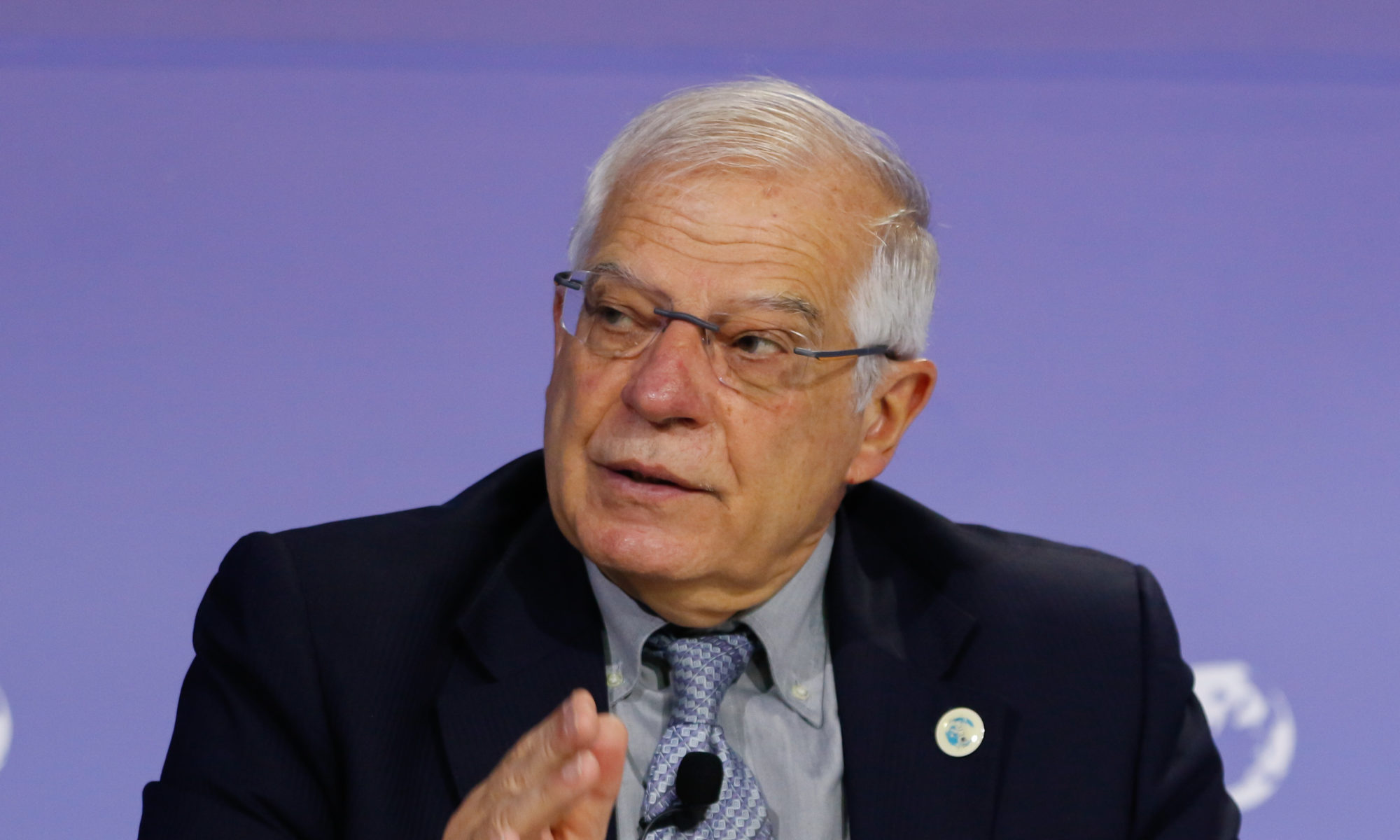
Le Haut représentant de l’Union européenne, Josep Borrell, qui revient d’Ukraine, s’exprime sur la guerre menée par Vladimir Poutine. Il réaffirme le soutien politique et militaire de l’Europe aux Ukrainiens et insiste sur les conséquences économiques et énergétiques de cette offensive.
Selon Josep Borrell, chef de la diplomatie européenne, Vladimir Poutine « ne souhaite pas de négociations, mais veut continuer la guerre ». Le Haut représentant de l’UE insiste sur l’importance des sanctions : « Il faudrait aller très rapidement vers un embargo sur le pétrole ». Selon lui, il faut aussi diversifier les achats en pétrole et en gaz et chercher des alternatives. Il ajoute qu' »en ce moment, l’Europe reçoit plus de gaz naturel liquéfié que provenant des gazoducs ». Il n’exclut pas que Vladimir Poutine soit condamné pour crimes de guerre dans l’avenir, mais, pour l’heure « c’est une guerre pour l’existence de l’Ukraine » et ce sont les Ukrainiens qu’il faut soutenir.
D’un point de vue diplomatique, il faut « contrecarrer le narratif russe » qui accuse les sanctions occidentales d’être cause de famine et qui veut dissuader certains pays d’Afrique, d’Asie ou d’Amérique du Sud de soutenir le point de vue des Occidentaux : « Ce sont les Russes qui bloquent les exportations ukrainiennes de blé vers l’Afrique ». Selon lui, il va y avoir « une diplomatie de la nourriture, comme il y a eu une diplomatie des masques et des vaccins. »
La crise économique et énergétique est la conséquence de l’agression russe en Ukraine et non des sanctions occidentales.
French President Emmanuel Macron and his far-right challenger Marine Le Pen went head-to-head in a televised debate days before a run-off in the presidential election. CNN’s Jim Bittermann reports.
To prevent the sustainability agenda from becoming a casualty of Russia’s war on Ukraine, policymakers and citizens must recognize the imperatives raised by the crisis and adjust their strategies accordingly. That means making our approach to environmental, social, and governance issues both more holistic and more granular.
PARIS – Beyond the immense tragedy which Russian President Vladimir Putin’s war has brought upon Ukraine and its people, we are starting to grasp its potentially devastating consequences for the global sustainability agenda.
Already, the COVID-19 pandemic redirected global attention and resources away from the targets enshrined in the 2015 Paris climate agreement, as countries focused on their immediate public-health needs. Now, Putin’s war is intensifying the economic, social, and geopolitical pressures countries face, while deepening divisions among them. This does not bode well for efforts to address the shared challenge of climate change.
Ukrainian service members unpack Javelin anti-tank missiles, delivered by plane as part of the U.S. military support package for Ukraine, in Kyiv on Feb. 10. | REUTERS
BY STEVEN ERLANGER, ERIC SCHMITT AND JULIAN E. BARNES
THE NEW YORK TIMES
As columns of Russian troops began pouring into Ukraine nearly two months ago, the United States and its allies started supplying Kyiv with weapons and equipment for what many expected to be a short war: sniper rifles, helmets, medical kits, encrypted communications, lots of bullets and the portable, shoulder-held Stinger and Javelin missiles that quickly became icons of the conflict.
Defying the odds, Ukraine held on to its capital and pushed Russia from the north. Now, as the Kremlin switches gears and begins a concerted effort to capture eastern Ukraine, Washington and its allies are pivoting as well, scrambling to supply Ukraine with bigger and more advanced weapons to defend itself in a grinding war.
The West is focused on sending longer-range weapons like howitzers, anti-aircraft systems, anti-ship missiles, armed drones, armored trucks, personnel carriers and even tanks — the type of arms that President Joe Biden said were tailored to stop “the wider assault we expect Russia to launch in eastern Ukraine.”
“The steady supply of weapons” has helped “ensure that Putin failed in his initial war aims to conquer and control Ukraine,” Biden said last week. “We cannot rest now.”
Then, after a video call with allies on Tuesday, Biden told reporters that the United States would send more artillery to Ukraine. He is expected to announce a new military aid package for Ukraine in the coming days, according to a person briefed on his plans. The aid amount will be on par with the $800 million package of weapons and artillery that was announced last week, the person said.
But the strategy comes with a notable risk: antagonizing Russia so much that it ignites a wider, international conflict.
Russia recently sent a formal warning to the United States, saying that Western deliveries of the “most sensitive” weapons systems to Ukraine could bring “unpredictable consequences.”
U.S. officials say the warning shows that the weapons being sent are making a big difference on the battlefield. So, for Washington at least, concerns about supplying arms that Russia might consider “escalatory” have ebbed — as has the initial worry that Ukraine will use longer-range weapons, like jet fighters, to attack Moscow itself and set off a bigger war.
Officials in Washington are now grappling with how much intelligence to give the Ukrainians about bases inside Russia, given that the Ukrainians have already made small helicopter raids on Russian fuel depots. The White House has also held back on supplying some weapons that could strike Russian forces across the border, like rocket artillery, ground attack planes and medium-range drones.
Some argue the Americans are being too cautious.
“Seven weeks ago, they were arguing over whether to give Stinger missiles — how silly does that seem now?” said retired Lt. Gen. Frederick B. Hodges, the former top U.S. Army commander in Europe. “We have been deterred out of an exaggerated fear of what possibly could happen.”
Anxiety about provoking a wider war persists among some NATO allies, most visibly in Germany, which worries that supplying Marder infantry-fighting vehicles, considered one of the world’s best armored vehicles, could be perceived by Russia as making Berlin and NATO parties to the war.
Robert Habeck, an influential minister in Germany’s new government, has said that supplying tanks would be an escalation and should be a matter of consensus within NATO and the European Union. “Heavy weapons are synonymous with tanks, and all NATO countries have so far ruled this out to not become targets themselves,” he said.
But these are sovereign — not alliance — decisions, and Washington and numerous allies are shipping such weapons anyway, concentrating on supplying Soviet-era weapons that the Ukrainians know how to use, along with Western arms the Ukrainians can absorb fairly easily.
Russia is striking Ukraine with abandon, complicating the flow of these newer weapons from Ukraine’s western borders with Poland, Romania and Slovakia to the battle in the east. That presents another risk: that Russian attacks could also stray across the Ukrainian border and hit NATO countries, “every inch” of which Biden has vowed to defend militarily.
How this logistical race goes could well shape the outcome of the war.
Russian forces, having suffered an embarrassing retreat from northern Ukraine and the suburbs of the capital, Kyiv, are repositioning for what the Kremlin and Ukrainian officials call a pivotal offensive to take eastern Ukraine.
Unlike many of the earlier battles, this one is expected to feature more tank battles on open ground, more long-range artillery and more weaponized drones.
The Western effort is both sprawling and expensive, with as many as 30 countries, not all of them members of NATO. The push now is to get countries with Soviet-era tanks, artillery and perhaps even fighter planes to provide them to Ukraine, with the promise that the United States will replenish them with more modern, Western-made arms in return. There is an especially acute need for Soviet-bloc standard 152-millimeter howitzer shells, since NATO uses a different, 155-millimeter shell.
The United States has also agreed to provide some 155-millimeter howitzers, along with 40,000 matching rounds, while trying to buy Soviet-standard ammunition from countries that use it, including nations outside Europe, like Afghanistan and even India, a long-standing buyer of Russian arms.
But that is not enough, Hodges argued. “We are still not thinking big,” he said. “We are still not thinking in terms of Ukraine winning.”
An apartment building that was destroyed by Russian missiles in the first days of the invasion in Vasylkiv, Ukraine, on March 30. | IVOR PRICKETT / THE NEW YORK TIMES
Unlike the early part of the war, when many countries seemed to compete to announce what they were providing Ukraine, the current race is being run largely in secret.
Much of the coordination, including how to get materiel into Ukraine, is being handled through the United States European Command, or EUCOM, based in Stuttgart, Germany, and through a blandly named International Donors Coordination Center set up with the British.
The command said that it established a “control center” to coordinate weapons and humanitarian assistance “from around the world” for Ukraine in early March. But it declined to discuss the details.
The Pentagon gave a hint, saying that the State Department had authorized transfers to Ukraine of American-provided defensive equipment from more than 14 countries this year.
But nations are trying not to advertise to Moscow exactly what is being provided. France says it has supplied 100 million euros of military equipment to Ukraine, without specifying what it has sent. Some countries have no desire to goad the Russian bear.
A clear example was the confusion over reports that Poland had supplied more than 100 Soviet-era T-72 and T-55 tanks to Ukraine. Poland refuses to confirm any such shipment.
Not all nations are being coy. The Czech government says it has supplied Ukraine with T-72 tanks and BMP-1 armored vehicles, while the Slovak government has made a big show of supplying a Soviet-era S-300 anti-aircraft missile system.
As for Germany, part of the problem is that its own supply of working armor is so low that it has little to spare. Beyond that, learning to operate a modern British, American or German tank can take up to six months, while Ukrainian fighters would have little difficulty operating familiar Soviet-era armor.
“We don’t really have time to get a lot of heavy American armor into Ukraine, and there isn’t time to train the Ukrainian military,” said Robert Gates, a former U.S. defense secretary. “But there is a lot of former Soviet military equipment still in the arsenals of the East European states.”
The United States, he said, “ought to be ransacking the arsenals” of former Warsaw Pact countries for armor and anti-aircraft systems, “with a promise from the U.S. to backfill over time with our equipment to our NATO allies.”
That is exactly what the United States is racing to do, Pentagon officials said, describing their own efforts to persuade the Slovaks to provide the S-300 missile system to Ukraine. On March 9, Defense Secretary Lloyd Austin began speaking with their defense minister, Jaroslav Nad, and has agreed to send in Patriot batteries to replace it.
Ukrainian troops and armored vehicles roll through the recently recaptured town of Bucha, northwest of Kyiv, on April 6. | IVOR PRICKETT / THE NEW YORK TIMES
Similar conversations are taking place with other allies that have Soviet-era weapons and ammunition, the officials said. The Americans say they are also speaking several times a day with their Ukrainian counterparts about what Ukraine wants and needs, and what Western countries think they can best provide.
Ukrainian President Volodymyr Zelenskyy repeatedly expresses gratitude for the aid but wants more, sooner. He admitted to being fed up with listing the same set of requirements over and over again to different national interlocutors, telling The Atlantic in Kyiv: “When some leaders ask me what weapons I need, I need a moment to calm myself, because I already told them the week before. It’s Groundhog Day. I feel like Bill Murray.”
There are also supply issues with Western weapons, like the older Stinger anti-aircraft missile or the Javelin anti-tank missile.
The Pentagon has urged manufacturers to ramp up production. So far, some 7,000 Javelins have been given to Ukraine, about a third of the total American inventory, which will probably take three or four years to replace, wrote Mark F. Cancian of the Center for Strategic and International Studies in Washington.
Last week, the Pentagon met with leaders of eight large military contractors, like Raytheon Co. and Lockheed Martin Corp., to discuss how to overcome any supply problems – both to replenish American weapons stocks that have been drawn down to help Ukraine and to keep Kyiv in the fight. The two companies together make the Javelin, and Raytheon makes the Stinger.
The United States alone has spent or allocated some $2.6 billion worth of such materiel since the war began Feb. 24, and the European Union has provided €1.5 billion ($1.6 billion). But there is no prospect of U.S. or NATO troops going to the aid of Ukraine, officials say. The West is providing the weapons and intelligence — and cheerleading from behind.
The known list of what has been provided already is long, and there is little doubt that supplies from NATO countries — and the training of Ukrainian forces after Russia seized Crimea in 2014, not to mention Ukraine’s tenacity and adaptability — have surprised the Russians, badly damaged their morale and extended the war.
In the months leading up to the war and afterward, the United States and its allies have sent Ukraine 25,000 anti-aircraft weapons and 60,000 anti-tank weapons, including 10,000 provided by Washington, Gen. Mark A. Milley, chairman of the Joint Chiefs of Staff, told Congress last week.
The United States has also provided more than 50 million rounds of ammunition, 7,000 small arms, 75,000 sets of body armor and helmets, and night-vision goggles, encrypted radios, armored trucks and personnel carriers, largely drawn from pre-positioned U.S. military stockpiles, much of it in Europe, according to the latest public list from the Pentagon.
Since the invasion, the Pentagon has cranked up its vast logistical and transportation network. Within four to six days after the White House approves a transfer of weapons from American military stockpiles, the Pentagon has been able to load the materiel onto cargo planes and fly it to about half a dozen staging bases in countries near Ukraine, chiefly Poland and Romania.
From there, U.S. officials say, the weapons and equipment are loaded onto hundreds of trucks and shipped into western Ukraine using a variety of overland routes. John Kirby, the Pentagon spokesperson, said it takes about 24 to 48 hours for the weapons to make their way from the staging areas into the hands of Ukrainian troops.
“Eight to 10 flights a day are coming into the region, not just from the United States, but from other nations as well,” Kirby said. “That stuff isn’t sitting around.”
Despite repeated threats to do so, the Russians have rarely tried to stop this flow of Western materiel into Ukraine. Pentagon officials say the Russians have been busy fighting in other parts of the country and fear Ukraine’s air defenses. “That flow still continues,” Kirby said.
Britain, which has been more public about its contributions in the post-Brexit period, has supplied about $588 million of materiel, including anti-tank and anti-ship missiles and long-range artillery.
Training the Ukrainians on new equipment in the middle of a war is a challenge, though. About a dozen Ukrainian soldiers were already training in the United States, and the Pentagon has taught them to use modern armed drones, like the 700 or so Switchblade drones that Washington is now providing.
Military officials call the weapon, which is carried in a backpack, the “kamikaze drone,” because it can be flown directly at a tank or a group of troops and is destroyed when it hits the target and explodes.
Bigger armed drones, like American-made Predators or Reapers, would be difficult for Ukrainians to fly and would be easily destroyed by Russian fighter planes. But Pentagon officials said the small, portable kamikaze drones could prove more cost-effective and elusive against Russian armored convoys.
After the White House announced the latest $800 million tranche of weapons for Ukraine last week, Kirby said that American soldiers would train Ukrainian forces in neighboring countries to use some of the newer, more sophisticated equipment Washington is providing, like radar systems, as well as the 155-millimeter howitzers and 11 Mi-17 helicopters.
“We’re aware of the clock, and we know time is not our friend,” he said.
A group #DiasporaSupport4Adesina has said that with former President Olusegun Obasanjo reportedly endorsing the President of African Development Bank (AfDB), Dr Akinwumi Adesina in 2021 for the number one seat in the country, means that Nigeria will experience transformation under Adesina led government.
The group in a statement signed by Dr Tony Bello, Chairman and Founder, Shine Bridge Global Inc., Chesapeake-Virginia, USA, said they were not surprised that Chief Obasanjo would endorse Dr Adesina for the highest office in the land because of the achievements he recorded as Nigerian Minister of Agriculture and Rural Development and as the President of AfDB.
“On May 2, 2021, an article came out in a national newspaper, the Vanguard, attributed to Chief Olusegun Obasanjo signalling Dr Akinwumi Adesina as the best person to occupy the position of President of the Federal Republic of Nigeria.
“If you conduct a poll today asking Nigerians who the cap of Nigeria’s leadership best fits, we are certain that most will support Chief Obasanjo’s choice of Dr. Akinwumi Ayodeji Adesina, President of Africa Development Bank (AfDB) and one-time Minister of Agriculture.
“This is one of the many reasons why we, in the Diaspora, are giving support to the efforts being made to co-opt Adesina into the forthcoming Presidential race. We have examined his contributions and personal commitment towards a better Nigeria, and Africa at large.
“As Nigeria’s political barometer, Chief Obasanjo’s residence has become a beehive of activities for politicians and political groups seeking his endorsement! Obasanjo is not shy to quick criticisms of leaders for non-performance in office, especially leaders who came to elective positions through his support.
“We are therefore not surprised that Chief Obasanjo would endorse Dr. Adesina for the highest office in the land. However, we are certain that Adesina’s presidency will not suffer any shortcomings to face the criticism of “Baba”, as Chief Obasanjo is fondly called in Nigeria”, the statement said.
The group further said that recognizing the urgent need for economic resurgence, President Muhammadu Buhari invited Adesina to articulate a roadmap for Nigeria’s economic resurgence at the 2021 Midterm Ministerial Performance Review Retreat.
The retreat according to the group had all the Nigerian government functionaries, including the Executive, Legislature as well as State governors.
The group therefore expressed hope that Adesina’s presidency will usher in a robust economic resurgence that will, in addition, put an end to our children drowning in the high seas of Africa and Europe in their quest for a better life.
The group also recalled how Obasanjo has successfully identified and supported the candidacy of the incumbent President Muhammadu Buhari in 2015, Former President Goodluck Ebele Jonathan in 2011 and Late President Umaru Musa Yar’Adua in 2007.
Dr Bello through the statement, said when Dr Adesina was given the opportunity to serve as Minister of Agriculture and Rural Development, he distinguished himself as a selfless servant to all Nigerians.
“He worked tirelessly with his team to transform the mindset of millions of smallholder farmers and the youth that “agriculture is a business, not a development program.” He advocated for policy and institutional reforms that attracted private sector investment commitments of over $5 billion into Nigeria’s Agricultural Transformation Agenda (ATA).
The statement further stated that Dr. Adesina had recently engaged with President Joe Biden’s Administration and his top-officials including Vice President Kamala Harris, and the Secretary of Treasury on climate financing among other global economic challenges facing Africa and Africans at home and in the United States.
“It is therefore not surprising, that Chief Obasanjo, himself, a globally recognized leader in domestic and international politics, has gone so far as to beckon on Dr. Adesina as one best prepared and fit for the job of the President of Nigeria after the incumbent, President Buhari,” the statement added.
Bill Dudley, Bloomberg Opinion & Former New York Fed President, argues that the slower the Fed moves, the harder the landing will be. John Lipsky, Johns Hopkins University School of Advanced International Studies Distinguished Scholar and former IMF First Deputy Managing Director, says the war in Ukraine has the potential for very serious and long-lasting disruptions in grain markets. Daniel Skelly, Morgan Stanley Wealth Management Head of Market Research & Strategy, says he’s seeing mixed messages from the stock and bond markets. Michelle Meyer, MasterCard Chief U.S. Economist, says consumer spending is still strong in the U.S. Alina Polyakova, Center for European Policy Analysis President & CEO, says Mariupol is the only thing standing in the way of Russia connecting its land and naval forces in Ukraine.
BERLIN – Although spring is coming to Europe, the continent seems to be experiencing a flashback to some of the iciest moments of the Cold War. In fact, Russia’s invasion of Ukraine has brought an end not only to a prolonged period of peace in Europe but also to the European security order on which peace has depended.
Of course, the end didn’t come suddenly. Nearly eight years before sending tens of thousands of troops into Ukraine on February 24, Russia annexed Crimea and launched a shadow war in the Donbas region. People have been fighting and dying in the violence in eastern Ukraine ever since, while the world looked on as the Kremlin sought to “fillet” a sovereign state by shaving off provinces.
Read the entire article on Project Syndicate.