Russia is weaker — but no less dangerous
Putin steps up cyber and other hybrid attacks against US allies in Europe
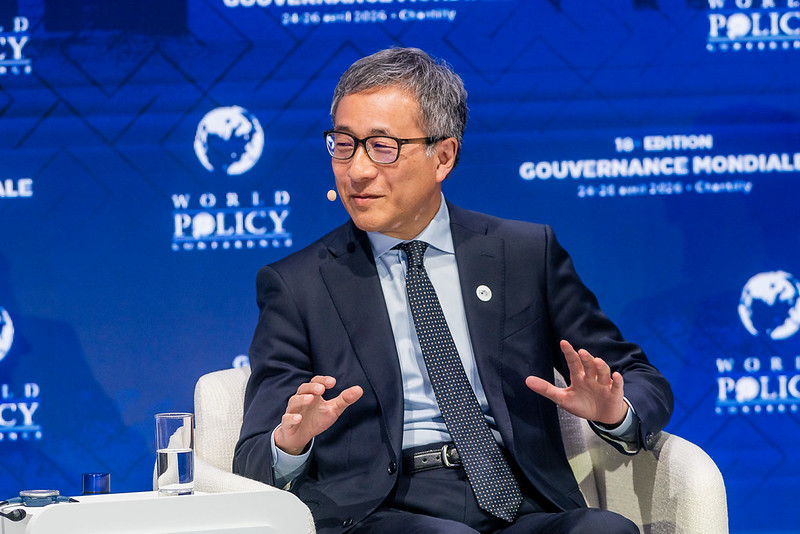
Hiroyuki AKITA, chroniqueur Nikkei
31 mai 2026
TALLINN, Estonia — Russian President Vladimir Putin must have left Beijing in a sour mood, quietly nursing frustration and disappointment.
During his two-day visit to the Chinese capital through May 20, Putin failed to clinch a final agreement from Chinese President Xi Jinping on Power of Siberia 2, a long-awaited pipeline that would carry Russian natural gas to China through Mongolia.
Xi dashed Putin’s hopes of winning a firm Chinese commitment on the project. For Moscow, the pipeline is central to its effort to redirect gas exports from Europe to Asia after Western sanctions and the war in Ukraine shattered its access to European markets. But Beijing was in no hurry, fully aware of its leverage. It appears to still be pressing for discounted gas supplies.
Putin faces tightening headwinds on several fronts. Russia’s economy is showing signs of strain, while on the battlefield in Ukraine, Russian forces continue to suffer heavy casualties even as the front lines remain deadlocked.
It would be dangerously ill-advised, however, to assume that a weakened Russia is necessarily less dangerous. History offers little comfort on this point: A declining autocrat does not always become more restrained. Russia may grow more reckless, more brutal and more unpredictable precisely because it is under pressure.
That risk was not lost on experts who attended two recent security conferences in Europe in mid-May: PISM Strategic Ark in Warsaw, Poland, and the Lennart Meri Conference in Tallinn, Estonia. At both gatherings, officials, analysts and other security specialists delivered a consistent warning: The Russian threat is growing, not receding.
European and NATO participants particularly emphasized that, despite worsening conditions, Russia is pressing ahead with the reconstitution of its military. According to the International Institute for Strategic Studies, a London-based think tank, Russia’s active-duty troop strength, roughly 900,000 before its invasion of Ukraine in February 2022, had grown to about 1.13 million by early 2025. Putin has ordered a further expansion to 1.5 million personnel.
The buildup is not aimed solely at Ukraine. Lithuanian intelligence and other security services report that since the invasion began, Russia has steadily reinforced troop concentrations along the borders of NATO member states.
At PISM Strategic Ark, Lt. Gen. Nicole Schilling, deputy inspector general of the German Armed Forces and the country’s second-highest-ranking military officer, warned that Russia should not be viewed as having exhausted its military capacity in Ukraine. Moscow, she suggested, is maintaining separate forces along the NATO front.
Perhaps most alarming is a recent line of analysis suggesting that Russia may be preparing for a possible attack on U.S. allies in Europe. In December, NATO Secretary-General Mark Rutte issued a dire warning, saying, « Russia could be ready to use military force against NATO within five years. »
At first glance, the idea may seem implausible. A Russia struggling to subdue a single, smaller country could hardly expect to prevail against NATO, an alliance of more than 30 members.
According to senior European military officers and security experts who attended the conferences in Poland and Estonia, the scenario Russia is most likely to be contemplating is a localized, short operation designed to paralyze the transatlantic alliance.
For example, one gambit Putin may be considering would proceed roughly along the following lines: Russian forces, or proxy troops operating without insignia, suddenly cross into part of the Baltic states or other neighboring territories. They destroy infrastructure, kill or wound civilians, and then withdraw, while leaving Russia in control of a narrow strip of land along the frontier.
NATO would then face an agonizing choice: invoke collective defense and risk full-scale war with Russia, or waver. The alliance would soon splinter, and over time NATO’s unity would begin to unravel.
If Putin is seriously entertaining such a plan, it could prove suicidal for Russia itself. Even if NATO as a whole failed to act, individual member states might retaliate. The result could be an all-out war Moscow neither wanted nor planned for.
Lt. Gen. Andrus Merilo, commander of the Estonian Defence Forces, told me that the danger lies in the way Putin may assess the confluence of factors. Merilo said it is hard to believe such a Russian gambit could succeed, but Putin may not see it that way and that could make the situation very dangerous.
Meanwhile, Russia is already waging war in the gray zone. Across Europe, hybrid operations are intensifying: infrastructure sabotage, arson attacks, drone provocations, cyberattacks and assassination plots.
According to a 2025 paper by Bart Schuurman, a professor of terrorism and political violence at Leiden University’s The Hague campus in the Netherlands, Russian hybrid attacks against Europe reached 44 incidents in 2024, more than seven times the number recorded in 2022.
What could further embolden Moscow is the widening rift between the U.S. and Europe. In May, Washington announced the withdrawal of about 5,000 troops from Germany, while leaving open the possibility of further reductions in Italy and Spain.
Europe has responded to the risk of a declining U.S. presence with a rearmament drive. In 2025, defense spending across Europe and Canada rose roughly 20% from the previous year.
But the picture is murkier than the headline figures suggest. Some of the new military equipment being acquired overlaps with purchases already being made by neighboring countries. Increased defense spending does not automatically result in greater military strength. Europe remains far from capable of mounting a credible defense without American support, including the U.S. nuclear umbrella.
The pressure and sense of urgency among NATO members were palpable at the Lennart Meri Conference.
Thomas Rowekamp, chairman of the German Bundestag’s defense committee, made the case for reintroducing conscription. He argued that Germany needs to increase its active-duty force from about 180,000 to 260,000 personnel, and said he doubted this could be achieved through a purely voluntary system alone. He called for a national debate on the possible return of conscription.
All that said, the West must also guard against the opposite error: overestimating Russian capabilities and allowing fear to harden into paralysis.
« There is nothing they admire so much as strength, and there is nothing for which they have less respect than for weakness, especially military weakness, » Winston Churchill said about the Russians in a 1946 speech, offering insight into how to deal with them.
The West must not grow complacent about Russia’s waning power, nor flinch in the face of its provocations. To do so would be to hand Putin what he wants. Intimidation is his preferred instrument, and it works only if the other side allows itself to be intimidated.
Lisez l’article sur le site de Nikkei.