Ambassadrice extraordinaire et plénipotentiaire de la République de Moldova auprès de la République française, fonctions qu’elle exerce depuis avril 2026. Elle a entamé sa carrière professionnelle en qualité de rédactrice au sein de publications culturelles en République de Moldova. De 1992 à 1998, elle a occupé les fonctions de directrice de la Fondation Soros Moldova, avant d’être nommée, en 1998, directrice du groupe de presse Medialog. Établie à Paris depuis 2000, elle y a développé des activités professionnelles dans le domaine du design d’intérieur et y a fondé sa propre marque de bijoux. Auteure de plusieurs recueils de poésie, traduits en plusieurs langues, elle a publié en 2023 le roman Legată cu funia de pământ (Cette corde qui m’attache à la terre), également traduit en français et en allemand.Elle est diplômée de l’Institut de littérature Maxime Gorki à Moscou ainsi que de l’Université de Dijon (France).
Thomson Pauline
Head of Data Science et Managing Director au sein de l’équipe Infrastructure d’Ardian. Depuis son arrivée en 2011, elle joue un rôle clé dans l’intégration de la data science au cœur des stratégies d’investissement et de création de valeur. Elle a notamment lancé les premières initiatives de data science pour accompagner les équipes d’investissement et, plus récemment, Gaia, la plateforme interne d’intelligence artificielle générative déployée à l’échelle du groupe. Elle a également contribué à la création d’Ardian Opta, une plateforme dédiée au soutien des investissements dans les énergies renouvelables, ainsi qu’Ardian AirCarbon, un outil propriétaire permettant de mesurer les émissions des aéroports. À travers ces initiatives, elle développe des approches technologiques visant à améliorer la performance des investissements tout en accélérant la décarbonation des infrastructures. Elle est membre du conseil d’administration de Mila, opérateur télécom en Islande, et de Verne, plateforme paneuropéenne de centres de données basée au Royaume-Uni. Son expertise à l’interface entre technologie, investissement et transition climatique illustre son rôle moteur dans l’évolution des stratégies d’investissement en infrastructures.
Arman Khachatryan
Ambassadeur extraordinaire et plénipotentiaire de la République d’Arménie en France depuis 2024. Diplomate de carrière, il a auparavant été Représentant permanent de l’Arménie auprès du Conseil de l’Europe entre 2021 et 2024, après avoir occupé plusieurs fonctions au ministère des Affaires étrangères, notamment directeur du département de la politique multilatérale et de la coopération au développement et secrétaire général de la Commission nationale pour l’UNESCO. Auparavant, il a servi au sein de la représentation de l’Arménie auprès de l’Union européenne et du Conseil de l’Europe, ainsi qu’au secrétariat du ministère des Affaires étrangères. Spécialiste des affaires européennes et du multilatéralisme, il a également enseigné à l’Université d’État d’Erevan et publié plusieurs travaux sur la diplomatie et les négociations internationales. Diplômé de l’Université d’État d’Erevan et formé notamment au Collège d’Europe, au Collège de défense de l’OTAN et à l’Institut Clingendael, il parle arménien, anglais, français et russe.
Vahan Kostanyan
Vice-ministre des Affaires étrangères de la République d’Arménie depuis janvier 2023. Il a auparavant occupé plusieurs fonctions de conseiller au sein de l’Assemblée nationale et du ministère des Affaires étrangères, notamment comme conseiller du ministre des Affaires étrangères et du président de l’Assemblée nationale. Il a également été porte-parole du parti Civil Contract et chef du bureau du premier vice-Premier ministre. Il a étudié à la faculté des études orientales de l’Université d’État d’Erevan et a suivi des formations complémentaires en administration publique, conflictologie et droits de l’homme. Sa carrière est centrée sur la politique étrangère, les affaires parlementaires et la communication stratégique. Il parle anglais, russe et persan.
Ian Sielecki
Ambassadeur de la République argentine en France depuis mai 2024. Diplomate, il a consacré sa carrière au développement du dialogue transatlantique et à la promotion de débats internationaux de haut niveau entre responsables publics, universitaires et leaders d’opinion. Avant sa nomination, il a cofondé et présidé Polemix (2020-2023), une plateforme dédiée à la génération de débats entre grandes figures intellectuelles mondiales et leurs communautés, réunissant notamment des penseurs et responsables politiques de premier plan. Il a également été chef du discours et de la stratégie du ministre des Affaires étrangères de la République argentine, où il a contribué à la conceptualisation de la politique étrangère et au suivi de la relation bilatérale avec la France. Auparavant, il a été conseiller du président de la République argentine pour les discours internationaux. Il a collaboré à la campagne présidentielle d’Emmanuel Macron en 2016-2017 et a co-organisé l’Athens Democracy Forum du New York Times, où il a dirigé les divisions « Débat » et « Jeunesse ». Fondateur de la Transatlantic Debating Association, il a organisé des échanges entre grandes universités occidentales sur les enjeux transatlantiques. Diplômé de Sciences Po Paris et de l’Université de Cambridge, il publie régulièrement sur les relations franco-argentines et parle couramment espagnol, français, anglais, italien et portugais.
Gulsara Arystankulova
Ambassadrice extraordinaire et plénipotentiaire de la République du Kazakhstan auprès de la République française depuis juillet 2022. Diplomate de carrière, elle possède plus de vingt ans d’expérience dans les affaires internationales et la conduite des politiques publiques. Sa carrière diplomatique l’a conduite à servir au sein des ambassades du Kazakhstan en Belgique et en France, ainsi qu’au ministère des Affaires étrangères. Elle a également occupé plusieurs fonctions stratégiques à l’Administration présidentielle, notamment dans le domaine de la politique extérieure et des relations internationales. Avant sa nomination à Paris, elle a contribué à l’élaboration et à la mise en œuvre de la stratégie diplomatique du Kazakhstan. En parallèle de ses fonctions en France, elle est également représentante permanente de son pays auprès de l’UNESCO. Elle est diplômée de l’Université kazakhe des langues du monde et de l’Université des sciences humaines de Strasbourg, où elle a obtenu un diplôme de troisième cycle en relations internationales. Elle est également titulaire d’un doctorat en relations internationales délivré par l’Académie de la fonction publique auprès du Président du Kazakhstan.
Paul Maurice
Secrétaire général du Comité d’études des relations franco-allemandes (Cerfa) depuis septembre 2024. Il a été chef de la Mission de l’Allemagne, de l’Europe alpine et adriatique à la Direction de l’Union européenne du Ministère de l’Europe et des affaires étrangères, de septembre 2022 à août 2024. Il était auparavant chercheur au Cerfa à l’Institut français des relations internationales (Ifri) de mars 2020 à août 2022, où il a travaillé en particulier sur les questions de politique intérieure allemande et les relations franco-allemandes dans le cadre de la construction européenne. Paul Maurice est titulaire d’un doctorat d’Histoire contemporaine et d’Études germaniques de Sorbonne Université, mené en cotutelle franco-allemande avec l’Universität des Saarlandes et dans le cadre de l’UMR Sirice (Sorbonne, Identités, relations internationales et civilisations de l’Europe). Il a étudié l’histoire contemporaine et les relations internationales à l’Université Paris-Sorbonne et à la Freie Universität de Berlin. Il enseigne également à Sciences Po dans le cadre du Master de l’École d’Affaires Publiques. Il est membre du comité de rédaction de la revue Allemagne d’aujourd’hui.
Thomas Courbe
Directeur général des entreprises au ministère de l’Économie, des Finances et de la Souveraineté industrielle et numérique. Ingénieur général de l’Armement, il a construit une carrière au croisement des politiques industrielles, économiques et internationales. Il débute en 1995 au ministère de la Défense, où il est en charge de programmes d’avions de combat en service, avant de devenir chef de cabinet du directeur des programmes aéronautiques. En 2002, il rejoint la Direction générale du Trésor, où il occupe plusieurs fonctions stratégiques, notamment dans les domaines géographiques et sectoriels, avant d’être secrétaire général du Club de Paris et sous-directeur des relations économiques bilatérales. En 2010, il est nommé directeur de cabinet du secrétaire d’État chargé du Commerce extérieur, puis directeur adjoint de cabinet des ministres de l’Économie et des Finances. Il retrouve la Direction générale du Trésor en 2012 comme secrétaire général, avant d’en devenir directeur général adjoint en 2015. Depuis 2018, il pilote la Direction générale des entreprises, au cœur des politiques industrielles et de compétitivité. Il est chevalier de la Légion d’honneur et commandeur de l’Ordre national du Mérite.
Balabanova-Ruleva Radka
Ambassadrice de Bulgarie en France depuis février 2024 et Déléguée permanente de la Bulgarie auprès de l’UNESCO. Diplomate de carrière, elle a rejoint le ministère bulgare des Affaires étrangères en 1997. Elle a occupé de nombreuses fonctions liées aux affaires européennes, notamment à la Mission permanente de la Bulgarie auprès de l’Union européenne à Bruxelles, ainsi qu’au sein des directions en charge de l’intégration européenne et des politiques de l’Union. Elle a également été Premier secrétaire à l’Ambassade de Bulgarie à Paris. Elle a exercé des responsabilités de direction au ministère, notamment en tant que directrice des relations économiques extérieures et de la coopération au développement, ainsi que coordinatrice spéciale pour la coopération avec l’OCDE. Elle a également été chef de mission adjoint à Bruxelles. Titulaire de deux masters en relations économiques internationales et en intégration européenne de l’Université d’économie nationale et mondiale et de l’Université de Sofia, elle parle couramment français et anglais.
Nkulikiyimfura François
Ambassadeur de la République du Rwanda en France depuis 2022, avec accréditation auprès de l’Espagne, du Portugal, ainsi qu’Ambassadeur désigné auprès de l’Italie et de Monaco. Il est également Délégué permanent auprès de plusieurs organisations internationales, dont l’UNESCO, l’OIF et l’OCDE. Économiste de formation, il cumule 18 ans d’expérience dans l’économie du développement et la gestion des finances publiques. Il a notamment travaillé au ministère rwandais des Finances et de la Planification économique, où il a occupé les fonctions de Directeur du Trésor puis de Directeur général des services généraux. Il a ensuite rejoint la Banque africaine de développement, où il a exercé comme expert en gouvernance et gestion des finances publiques pour plusieurs pays d’Afrique de l’Est, supervisant des réformes économiques majeures. Il a également été Ambassadeur du Rwanda au Qatar. Il est diplômé de l’Université Paris XIII en économie industrielle.
Miklós Tromler
Ambassadeur agréé de Hongrie en France depuis décembre 2025, il possède une solide expérience diplomatique. Il a exercé en tant qu’ambassadeur auprès du Royaume du Maroc et de la République islamique de Mauritanie. Il a également été doyen du groupe européen du corps diplomatique au Maroc. Auparavant, il a occupé plusieurs fonctions au ministère hongrois des Affaires étrangères et du Commerce, notamment dans les domaines du protocole et des relations avec l’Asie-Pacifique. Il a débuté sa carrière dans l’organisation de congrès internationaux. Parallèlement à sa carrière diplomatique, il est issu du sport de haut niveau. Ancien joueur professionnel de water-polo, il a évolué en France, en Italie et en Hongrie, remportant notamment une Coupe d’Europe LEN et sept titres de champion de France. Titulaire d’un Executive MBA de l’Université Corvinus de Budapest, il est également diplômé en management et expert en santé et sécurité au travail. Il parle hongrois, français, italien et anglais.
Brian Kingston
Président-directeur général de l’Association canadienne des constructeurs de véhicules (CVMA). La CVMA représente les principaux fabricants canadiens de véhicules automobiles lourds et légers. Ses membres comprennent Ford Motor Company of Canada, Limited, General Motors of Canada Company et Stellantis (FCA Canada). Avant de rejoindre la CVMA, Brian était vice-président des politiques (fiscales et internationales) au Business Council of Canada, où il dirigeait les priorités en matière de politique économique et l’engagement international du Conseil. Entre 2009 et 2012, il a exercé diverses fonctions au sein du gouvernement fédéral, notamment au ministère des Finances, aux Affaires mondiales Canada et au ministère de l’Innovation, des Sciences et du Développement économique. Il est également actif dans le secteur à but non lucratif, notamment en tant qu’ancien président de l’Ottawa Economics Association et ancien président du Banff Forum. Il est titulaire d’une licence en économie de l’Université Carleton, d’une maîtrise en affaires internationales de la Norman Paterson School of International Affairs et d’un MBA de la Ivey Business School.
How Trump’s war with Iran is alienating the Global South
19 mars 2026
US must not let Iran distract it from China
Hiroyuki AKITA, chroniqueur Nikkei
8 mars 2026
Yunus Demirer
Ambassadeur de la République de Türkiye en France depuis septembre 2023. Diplomate de carrière, il a occupé de nombreuses fonctions de haut niveau au sein du ministère des Affaires étrangères. Il a été ambassadeur en Iraq (2011–2013), en Arabie saoudite (2013–2018) et en Slovaquie (2021–2023). À Ankara, il a notamment exercé les fonctions de directeur général pour le Moyen-Orient et l’Afrique du Nord ainsi que de directeur général adjoint en charge des relations avec l’Iraq, contribuant activement à la politique régionale de la Türkiye. Au cours de sa carrière, il a été en poste dans plusieurs missions diplomatiques majeures, notamment à Bagdad, Bruxelles (OTAN), Bucarest, Washington et Beyrouth. Il a également été chef de cabinet du sous-secrétaire d’État et du ministre des Affaires étrangères, acquérant une solide expérience en coordination diplomatique de haut niveau. Il a débuté sa carrière en 1989 au ministère des Affaires étrangères, d’abord dans le domaine des affaires maritimes, puis sur les questions liées au Caucase. Diplômé de la Faculté des sciences politiques de l’Université d’Ankara, il parle français et anglais.
Wiesław Tarka
Wiesław Tarka est Chargé d’affaires a.i. et Ambassadeur titulaire de la République de Pologne en France. Diplomate de carrière, il a occupé de hautes fonctions au sein du ministère des Affaires étrangères et à l’étranger. Il a été ambassadeur de Pologne en Croatie (2008–2012) puis en Suède (2015–2018). Il a également exercé les fonctions de secrétaire d’État adjoint au ministère de l’Intérieur et de l’Administration, où il était en charge de la coopération européenne et internationale, de la politique migratoire et des questions transfrontalières. Au ministère des Affaires étrangères, il a notamment été directeur de l’Inspection du service diplomatique et directeur adjoint du département de la politique européenne, contribuant aux initiatives régionales telles que le groupe de Visegrád et l’Initiative d’Europe centrale, ainsi qu’à la coordination du sommet des Balkans occidentaux. Il a débuté sa carrière à l’ambassade de Pologne à Stockholm et a également exercé des fonctions dans l’administration culturelle à Varsovie. Diplômé de philologie moderne de l’Université de Varsovie, il possède une formation en linguistique. Il parle plusieurs langues, dont l’anglais, l’allemand, le suédois, le croate, le français, l’ukrainien et le russe. Il est décoré de la Croix de chevalier de l’Ordre Polonia Restituta et de l’Ordre du prince Branimir.
Andrew Haines
Professeur de changement environnemental et de santé publique à la London School of Hygiene & Tropical Medicine, Sir Andy Haines est un expert de premier plan des questions de santé et de changement climatique. Il est co-responsable scientifique de l’initiative Pathfinder pour un avenir neutre en carbone et favorable à la santé, financée par le Wellcome Trust, conseiller scientifique principal auprès de la Commission paneuropéenne sur le changement climatique et la santé, et vice-président du Groupe indépendant des Nations unies sur les effets d’une guerre nucléaire. Il a précédemment été directeur de la London School of Hygiene & Tropical Medicine (2001–2010). Auparavant, il a été professeur de soins de santé primaires à l’University College London, médecin généraliste à Londres, et épidémiologiste consultant au Medical Research Council. Il a également exercé des fonctions de conseil et de direction auprès de l’Organisation mondiale de la santé, du Groupe d’experts intergouvernemental sur l’évolution du climat et de nombreux organismes internationaux de recherche. Le professeur Haines a publié de nombreux travaux sur la santé publique, le changement climatique et la santé planétaire. Il est diplômé en médecine du King’s College London et titulaire d’un doctorat (MD) en épidémiologie de l’Université de Londres.
Jean-Paul Bouttes
Ingénieur et économiste, membre du Conseil Scientifique du Haut-Commissariat à la Stratégie et au Plan. Il a été Chef Économiste et Directeur de la Stratégie, de la Prospective et des Relations Internationales du Groupe EDF (Électricité de France), après avoir été Délégué à la Stratégie Industrielle de la Branche Production et occupé plusieurs postes au sein des Études Économiques Générales d’EDF. Il a exercé des responsabilités dans les organisations internationales des énergéticiens, en particulier comme membre du Comité des Etudes du Conseil Mondial de l’énergie ainsi que dans le cadre du WBCSD. Il a également été professeur chargé de cours en sciences économiques à l’École Polytechnique où il a participé à la création et au pilotage de la Chaire Développement Durable, et professeur à la North China Electricity University à Pékin. Jean-Paul Bouttes est l’auteur de plusieurs ouvrages dont Energie publié aux PUF (2023), Souveraineté, maîtrise industrielle et transition énergétique aux éditions Fondapol (2023) et Les déchets nucléaires, une approche globale (2022). Jean-Paul Bouttes est diplômé de l’École Polytechnique et de l’ENSAE.
Étienne Grass
Global Chief AI Officer de Capgemini Invent, essayiste, ancien haut fonctionnaire français. Il est chroniqueur pour le journal Les Échos. Spécialiste des questions de santé et des transformations organisationnelles liées à l’IA, il enseigne à l’Institut d’Études Politiques de Paris. Ancien élève de l’École nationale d’administration et membre de l’Inspection générale des Affaires sociales, il a été le directeur adjoint du cabinet du Haut-commissariat aux solidarités actives contre la pauvreté (2007-2009) et le directeur de cabinet de la Ministre des droits des femmes, de la ville, de la jeunesse et des sports (2012-2014). Depuis novembre 2017, Étienne Grass a rejoint le groupe Capgemini. Il a dirigé les équipes Citizen Services, puis piloté le projet de cloud souverain (« BLEU ») du groupe. Il a été le directeur général de Capgemini Invent en France de 2023 à 2025. Depuis le 1er juillet 2025, il pilote les activités IA du groupe à l’échelle mondiale. Il est l’auteur de plusieurs ouvrages, dont L’Europe sociale (La Documentation française, 2013), Les Inégalités de santé (Presse de Sciences Po, 2016) et Génération réenchantée (Calmann-Lévy, 2016).
Margaret Chan
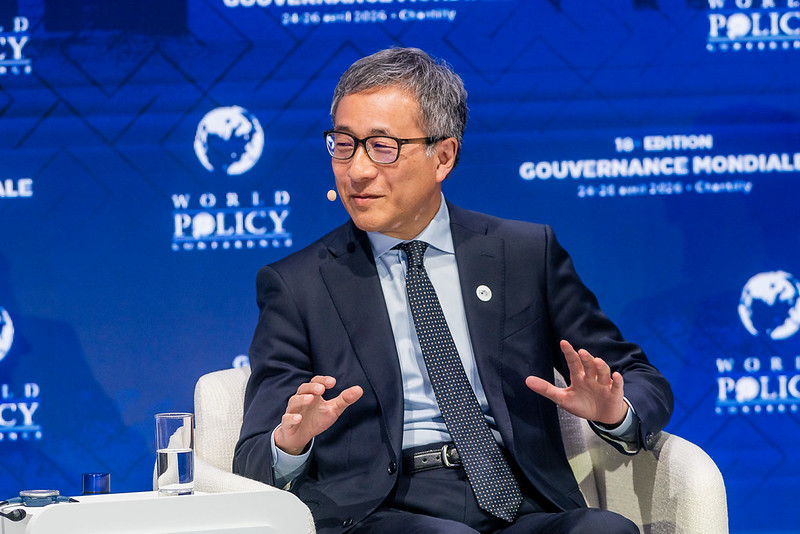
Directrice générale émérite de l’Organisation mondiale de la santé (OMS), Dr Margaret Chan est doyenne de la Vanke School of Public Health de l’Université Tsinghua. Elle débute sa carrière en santé publique en 1978 au sein du Département de la santé de Hong Kong, dont elle devient directrice en 1994, première femme à occuper ce poste. Durant son mandat, elle renforce les dispositifs de prévention, de surveillance et de réponse aux maladies, et gère notamment les épidémies de grippe aviaire et de SRAS. Le Dr Chan rejoint l’OMS en 2003 et est élue directrice générale en 2006, fonction qu’elle occupe pendant deux mandats jusqu’en 2017. Elle est titulaire d’un diplôme de médecine de l’Université de Western Ontario, au Canada.
Andreas Schaal
Directeur des relations mondiales et de la coopération de l’OCDE ainsi que sherpa de l’OCDE auprès du G7, du G20 et de l’APEC. Il soutient et coordonne les contributions de l’OCDE à la gouvernance mondiale sous la direction de Mathias Cormann, Secrétaire général de l’OCDE. Lui et son équipe mettent en œuvre la Stratégie de relations mondiales, en s’engageant avec plus de 100 pays partenaires dans le monde entier au niveau ministériel et en établissant des règles du jeu équitables à l’échelle mondiale en renforçant l’adhésion aux Normes et politiques de l’OCDE. Avant de rejoindre l’OCDE, il a occupé plusieurs fonctions au sein du gouvernement fédéral allemand, notamment celles de directeur adjoint du bureau du Sherpa allemand pour le Sommet du G8 au ministère fédéral de l’Économie et de la Technologie ; Conseiller économique auprès de la délégation permanente de l’Allemagne auprès de l’OCDE à Paris ; Vice-président du Comité d’examen des économies et du développement (EDRC) de l’OCDE de 2005 à 2006 ; ainsi que Conseiller politique et chef de cabinet du secrétaire d’État parlementaire Siegmar Mosdorf au ministère de l’Économie et de la Technologie. Andreas Schaal est également Senior Fellow non résident au Chongyang Institute for Financial Studies de l’Université Renmin de Chine (RDCY). Il est titulaire d’un Master en politiques publiques et management public de l’Université de Konstanz, en Allemagne.
Angel Prieto
Chef du bureau en charge de la décarbonation de l’industrie au Ministère de l’Économie. Il y pilote la définition et la mise en œuvre des politiques publiques visant à décarboner l’industrie française (élaboration des stratégies par filière et par technologie, conception des dispositifs de soutien, négociations budgétaires, influence européenne). Auparavant, il a été Chef du service économique de l’État pour la région Auvergne-Rhône-Alpes et conseiller économique du Préfet, et contribué au développement économique et à la décarbonation des entreprises en région. Il a également travaillé chez McKinsey & Company, où il a accompagné des gouvernements africains et des banques de développement sur les enjeux de transition énergétique et de décarbonation industrielle, ainsi que chez ENGIE, où il a contribué à la définition de la stratégie climat du groupe. Engagé de longue date sur les enjeux écologiques, Angel Prieto est cofondateur du mouvement Pour un réveil écologique et a dirigé la délégation française au G7 Youth Summit en 2024, tout en étant en charge des négociations sur les sujets environnementaux. Il est ingénieur du Corps des Mines, diplômé de l’École polytechnique.
Hugo Pouzet
Haut fonctionnaire français, adjoint chef du bureau Finance durable, droit des sociétés, comptabilité et gouvernance d’entreprise à la Direction générale du Trésor, au ministère de l’économie, des finances et de la souveraineté industrielle, énergétique et numérique. Ingénieur du Corps des Mines, il a exercé, au cours de sa formation, des responsabilités dans des environnements publics et privés, en France et à l’international. Il a notamment été chef de projet transformation chez L’Oréal à Tokyo, et ingénieur en charge de la décarbonation chez Orano Mining. Ancien élève de l’École normale supérieure et diplômé de Mines Paris – PSL, il est par ailleurs co-auteur d’un ouvrage consacré aux pénuries de médicaments, analysant les vulnérabilités structurelles des chaînes de production pharmaceutiques.
Baptiste Poterszman
Adjoint à la cheffe du service prévention des risques à la direction régionale de l’environnement d’Île-de-France, il contribue à la mise en œuvre des politiques de prévention des pollutions et risques industriels. Avant de rejoindre les services de l’État, il a notamment travaillé pour Neoen, un producteur d’énergies renouvelables, en Suède, ainsi que pour la compagnie ferroviaire Eurostar, à Londres. Il a par ailleurs travaillé sur les enjeux associés aux pénuries de médicaments sous l’angle des politiques publiques et de la résilience des chaînes d’approvisionnement. Ingénieur du Corps des mines, il est également diplômé de l’École polytechnique.
Mark Malloch-Brown
Mark Malloch-Brown est Professeur invité à la London School of Economics (LSE) et Distinguished Visiting Fellow au Perry World House de l’Université de Pennsylvanie. Il a été anobli pour sa contribution aux affaires internationales. Mark Malloch-Brown a mené une longue carrière dans les domaines des affaires internationales, du développement et de la communication. En tant qu’Administrateur du Programme des Nations Unies pour le développement (PNUD), il a dirigé la promotion mondiale des Objectifs du Millénaire pour le développement. Au sein du PNUD, et auparavant en qualité de vice-président chargé des affaires extérieures à la Banque mondiale, il a conduit d’importantes réformes visant à renforcer l’efficacité et l’impact de ces deux institutions et est actuellement en congé de la Chambre des Lords du Royaume-Uni. Il a ensuite exercé les fonctions de chef de cabinet du Secrétaire général des Nations Unies, Kofi Annan, puis de Vice-Secrétaire général de l’ONU, avant de rejoindre le gouvernement britannique du Premier ministre Gordon Brown en tant que ministre chargé de l’Afrique et de l’Asie de 2007 à 2009. Plus récemment, il a présidé l’Open Society Foundations, première fondation privée mondiale finançant des organisations indépendantes engagées en faveur de la justice, de la gouvernance démocratique et des droits humains.
Integrated Water Resource Management is Key to 21st Century Climate Resilience
Jeremy FAIN, Directeur général de BWI.
2 mars 2026
PARIS – Since mid-2022, I have had the privilege of leading Blue Water Intelligence, a newspace technology company that designs, develops, and markets a river behavior forecasting service powered by proprietary artificial intelligence technology, operating across four continents. This vantage point offers a unique observatory on the water crises punctuating river basins worldwide. Basin by basin, my journey accross continents has forged a core conviction that shapes our client vision: low-flow tensions are not the root cause of these crises but their stark revealer. In this era of accelerating climate change, such strains stem from a triple dynamic—demographic, economic, and agricultural—resting on a freshwater resource long deemed infinite, now proven finite.
Population Growth and Water Volatility
The paradox is stark: regions with the fastest population growth—especially South Asia and Africa—face the most unpredictable water availability. Megacities sprawl, secondary urban centers boom, and essential needs (drinking, hygiene, mobility, production) cluster in already climate-stressed basins.
In these areas, the dry season has evolved from a mere cyclical low to a moment of reckoning. Falling river flows threaten not just ecosystems but social cohesion, institutional strength, governance quality, and anticipatory capacity. With millions more relying on the same hydro-meteorological uncertainties, even minor supply disruptions risk escalating into major local social and political crises.
Surging Demands in Food and Energy
Demographic shocks extend beyond potable water to fuel consumption economies: essentials, durables, services (health, logistics, digital). Every value chain hinges, directly or indirectly, on water availability—often globally sourced.
Agriculture dominates, claiming nearly 70% of global freshwater withdrawals. Feeding growing urban populations demands higher yields, harvest security, and agro-industries that both consume and pollute water. Meanwhile, energy thirst rises: thermal and nuclear plants require cooling water, hydrocarbon extraction and refining vast volumes, and hydropower ties directly to flows.
This reveals systemic strain: food and energy decisions ripple through water balances, often unaccounted for. Growth and infrastructure carry an implicit « water budget » we have yet to tally. Crises arise not from isolated « water wars » but from development models treating water as a mere input, not the structuring variable.
Irrigation as Demographic Shadow
Facing erratic rainfall from climate disruption, the instinctive response to feeding more mouths is expanded irrigation. States, driven by fiscal urgency, import risks, and food sovereignty, promote irrigated perimeters—via grand hydraulic works (canals supporting arable expansion) or private aquifer drilling. Irrigation peaks in dry seasons, when rivers and groundwater are scarcest.
Each additional irrigated hectare mortgages future river flows or aquifer volumes. Upstream withdrawals starve downstream cities, biodiversity, and energy in low-flow periods. In transboundary basins, this breeds resentment—flow drops seen as upstream hoarding, often from uncoordinated decisions.
Visible disputes over dams, canals, or quotas are late symptoms of unmanaged trajectories. The question shifts: not whether to over-irrigate, but whether irrigation aligns with current and future resource realities.
Water Governance as Resilience Pillar
Positioning freshwater as the 21st century’s most strategic resource is no slogan; it is a clear-eyed assessment of this triple pressure. Demographics, food, energy—legitimate progress drivers—converge on one bottleneck.
Sharing scarcity is insufficient. Freshwater must anchor basin-level arbitrages, transcending administrative borders (that water beautifully ignores) and sectoral silos (water serves all). Practically, basin authorities must balance cities, agriculture, energy, and ecosystems via robust hydrological scenarios, not crisis firefighting.
This demands two quiet revolutions: long-term water governance as systemic regulator, and fine-grained basin digitalization turning uncertainty into manageable risk. Rive basin digitization enables hydrological forecasting to pre-discuss dry-season impacts—days or weeks ahead—for critical uses: potable water, irrigation, energy, ecosystems. Innovative forecasting services emerged precisely from this digitization gap.
From Endurance to Agency
Many basins view low flows as fate—a recurring « crisis season. » Tomorrow’s resilient basins will treat water as strategically as energy or digital infrastructure, aligning demographics, land use, food systems, and energy matrices to realistic water budgets.
Dry-season tensions are neither surprises nor curses, but outcomes of underestimating water’s role in socioeconomic stability. Elevating water as a public policy and investment cornerstone is essential—not to defy low flows, but to avert the chaos they unleash absent root-cause action.
The true divide will pit nations steering freshwater as a long-term strategic asset against those enduring it seasonally, lacking integrated resource governance and basin digitalization.
Why Trump’s solo Yalta is so sinister
Hiroyuki AKITA, chroniqueur Nikkei
7 février 2026

Is this the end of the Western-led world order?
Widening transatlantic rift benefits Russia and China in Asia
Hiroyuki AKITA, chroniqueur Nikkei
31 janvier 2026
TOKYO — The first anniversary of U.S. President Donald Trump’s second term unfolded under the shadow of sharply escalating transatlantic discord, exacerbated by his hard-edged campaign to bring Greenland, a Danish territory, into the American fold.
At this year’s World Economic Forum, held from Jan. 19 to Jan. 23 in Davos, Switzerland, Trump effectively climbed down from his earlier threats of using military force to acquire Greenland, yet he remained adamant about securing control of the world’s largest island, most of it buried beneath an ice sheet.
Seeking to curb Washington’s ambitions, major European countries, including the U.K., France and Germany, sent personnel to Greenland for joint military exercises, further inflaming tensions. Instead of behaving like long-standing partners, the U.S. and Europe are drifting into a semi-adversarial posture.
A « world without the West » is taking shape. That may sound like hyperbole, but the era in which the U.S.-European partnership sets the rules and others simply follow them has receded into history. After consecutive trips to Europe and the U.S. last December, I came away convinced the world is undergoing a drastic shift.
Since the end of World War II, the U.S. and Europe have worked in lockstep to build and steward the global order. The unraveling of that system marks a profound turning point in the postwar era.
Today’s transatlantic rift goes far beyond territorial disputes or strategic disagreements; it cuts to the heart of how each side sees the nation and the world itself.
If this were a human relationship, it would resemble a partnership in which differences in values have grown so deep that trust no longer binds the two sides. Conflicts of interest can be negotiated, but a clash of values is far harder to bridge. As a world sans the West takes shape, the resulting shockwaves could spread, leaving international politics even more unmoored. It is a trajectory that casts a long, unsettling shadow over the global future.
The National Security Strategy, released by the Trump administration on Dec. 5 to guide Pentagon policy, crystallized this divide. Its language toward Europe was so caustic that it no longer sounded as if Washington were addressing an ally.
The document argued, for example, that Europe’s traditional communities and values are being eroded by a rapid influx of immigrants. « Should present trends continue, the continent will be unrecognizable in 20 years or less, » it warned. It also cast doubt on the future of the alliance, asserting that « it is far from obvious whether certain European countries will have economies and militaries strong enough to remain reliable allies. »
With far-right and right-wing populist parties clearly in mind, the strategy went on to praise « the growing influence of patriotic European parties, » which it said « gives cause for great optimism » — a thinly veiled signal of Washington’s support.
Why does Trump harbor such deep hostility toward Europe today and attack it so relentlessly? According to foreign-policy experts and former U.S. officials familiar with the administration’s internal thinking, three primary factors are driving this stance.
First, the administration’s strategy aims to bring a swift end to Europe’s dependence on U.S. military power. The goal is to jolt Europe into accelerating its own defense self-reliance.
The second reason runs deeper. The Trump administration is fortifying U.S. borders through tighter immigration controls and higher tariffs, an effort to reinforce the basic architecture of the sovereign state. From Washington’s viewpoint, Europe is moving in the opposite direction, with individual nations weakening the very concept of sovereignty. The administration fears that continued immigration from the Middle East and Africa into Europe, and the resulting dilution of what they view as Europe’s Western civilizational core, will ultimately erode U.S. interests with serious consequences.
Third, Trump and his inner circle nurse a deep resentment of the European elites who, in their view, treated them with condescension during the first Trump term.
Viewed in this light, far-right and other parties advocating anti-immigration policies and fortified borders are natural allies.
« Trump’s team views the essence of a nation as its borders and sovereignty, » said Walter Russell Mead, a distinguished fellow at the Hudson Institute, a Washington-based think tank. « From this perspective, the European Union, an entity that blurs national borders and pushes political integration, appears to him as a project that dissolves real statehood. »
In the postwar era, shaped in part by the lessons of devastation, the EU pursued integration by lowering borders and enabling the free movement of people and goods. Successive U.S. administrations broadly endorsed this direction.
Trump’s team has upended that consensus, however, moving in a direction that directly repudiates the European model. Predictably, this has triggered fierce backlash across the continent. What angers European politicians and pundits most is Washington’s open encouragement of far-right and right-wing populist parties — forces they regard as existential threats to Europe’s values and political foundations. These parties typically champion anti-immigration and anti-EU agendas, and some carry a noticeable pro-Russian tilt.
« Trump sees Europe’s large-scale acceptance of migrants from the Islamic world as eroding the cultural foundations of Western civilization, » Mead said.
The rise of far-right populist movements across Europe has been striking. In Germany, Alternative for Germany, or AfD, surged to become the second-largest party in the February 2025 general election. In France, Jordan Bardella of the National Rally party now leads polling for the 2027 presidential race, while in the U.K., the hard-right Reform UK is posting record support, outpacing both the Conservative and Labour parties in many surveys.
For leaders in London, Berlin and Paris, a Trump administration that openly bolsters such forces looks less like an ally than a potential adversary. A Labour member of the British Parliament long known for his pro-American stance, captured this sentiment when he told me that, under Trump, the U.S. has shifted from an ally to a hostile nation.
As the Hudson Institute’s Mead said: « In Trump’s view, a Europe that weakens itself both politically and culturally becomes a less valuable ally and increases America’s strategic burden. »
For two days, ending Dec. 12, senior officials and policy experts from the U.S., Europe and other regions convened in the Romanian capital of Bucharest to discuss Ukraine’s future in a forum titled « Rebuilding Ukraine: Security, Opportunities, Investments, » organized by Romania’s New Strategy Center. Several European participants voiced serious concern about the implications of Washington’s changing strategic posture, with one remarking that the newly released National Security Strategy makes clear that Europe must speed up its drive for strategic self-reliance.
With Washington and Europe now embracing national and global worldviews as incompatible as oil and water, the transatlantic fissure is poised to widen this year. In the run-up to this autumn’s midterm elections, the Trump administration is expected to raise its border « walls » even higher and impose still stricter immigration controls.
Meanwhile, Britain, Germany, France and other major European nations face a series of pivotal elections between now and 2029. As far-right and right-wing populist parties continue to expand their influence, Europe’s sense of alarm over the Trump administration is almost certain to intensify.
Compounding the strain on U.S.-Europe relations is a growing divergence in their approaches to Russia. While European governments remain acutely aware that their security is at risk unless Russia’s invasion of Ukraine ends in failure, Trump views China — not Russia — as the primary geopolitical threat. Consequently, the White House has been advocating for a ceasefire between Russia and Ukraine and is considering the possibility of improving ties with Moscow. The strategic trajectories of the U.S. and Europe are, in effect, moving in opposite directions.
If this schism continues to deepen, the consequences for Asia will be profound. Japan, Australia and South Korea have been pushing for closer alignment with NATO in response to the security challenges posed by China and Russia. Their strategy rests on the assumption that China and Russia’s accelerating military cooperation requires deeper, globe-spanning coordination with NATO to contain Beijing and Moscow and reinforce deterrence.
But if the divide widens, cooperation between NATO and the three U.S. allies in the Asia-Pacific could begin to deteriorate. Russia and China, long wary of growing NATO-Asia coordination, would feel emboldened and act more aggressively, further destabilizing the Taiwan Strait and the South China Sea. Strains in U.S.-India ties, caused by the Trump administration’s stance on Pakistan and tariff disputes, come as welcome news to China and Russia, which have been uneasy about the deepening partnership between Washington and New Delhi.
Preventing such an outcome makes it all the more urgent for Japan and other U.S. allies in Asia to sustain close coordination with both the U.S. and Europe.
America’s backyard war: Global lawlessness looms, aiding rival powers
Trump’s Venezuela strike may signal to Moscow and Beijing that force pays
Hiroyuki AKITA, chroniqueur Nikkei
10 janvier 2026
TOKYO — At first, U.S. President Donald Trump seemed genuinely intent on securing a place in history as a formidable peacemaker, remembered for a remarkable record of conflict resolution. Yet his Jan. 3 strike on Venezuela and the ensuing capture of its leader, Nicolas Maduro, leave little doubt that Trump can no longer restrain his contrary impulses and is veering toward a far more radical course.
For years, Maduro has suppressed human rights and dismantled democratic institutions under his authoritarian rule, triggering the exodus of millions of Venezuelans. Even within Western democracies, some voices have expressed tacit support for regime change in the South American nation. Still, it is unclear if Trump has a coherent strategy for how events should unfold in the months ahead.
Last December, I met with U.S. foreign policy and security experts familiar with the inner workings of the Trump administration to inquire about the objectives behind its escalating military pressure on Venezuela. Based on those discussions, Trump’s strategy appears set to unfold in two stages.
The first stage aims to expel « hostile forces, » perceived as threats to the U.S. mainland, from strategic locations such as Venezuela. This vision extends beyond the Maduro regime and criminal networks.
« Trump also sees China’s growing presence in Venezuela, which possesses the world’s largest proven oil reserves, as a serious concern, » said a security expert, speaking on condition of anonymity. China is already Venezuela’s largest purchaser of crude oil.
The second stage, as envisioned by the Trump White House, is to significantly weaken the regime in Cuba, which has long been defiant toward Washington. The administration believes that toppling the Maduro government, which maintains close ties with Havana and supplies it with heavily subsidized oil, would effectively isolate Cuba and erode its resilience.
China’s shadow also looms over Washington’s intensified pressure on Cuba. Intelligence suggests that Beijing has established surveillance facilities on the island, a concern that first gained traction during the previous Joe Biden administration and has since grown more acute.
At the same time, Trump is seeking to curb Chinese influence in other strategic zones, including the Panama Canal and Greenland, as part of a broader effort to assert U.S. dominance across the Western Hemisphere.
These strategic imperatives did not emerge in a vacuum; they were already articulated in the U.S. National Security Strategy released last December. Nevertheless, seizing a sovereign nation’s leader by force, along with the potential installation of a U.S.-backed interim administration, defies the imagination of any reasonable observer.
Trump has justified the operation by citing Maduro’s alleged role in trafficking narcotics into the U.S. But that rationale appears tenuous.
« Venezuela is not a major drug-producing country, and much of the narcotics transiting through its territory are bound for Europe, » said another security expert.
The U.S. intervention in Venezuela carries a profound risk: It may accelerate the erosion of international legal norms and push the world closer to a state of lawlessness. At least two dangers stand out.
First, it lends dangerous momentum to the notion that the world’s great powers are entitled to intervene militarily in other sovereign states. Many observers argue that Trump’s action constitutes a clear violation of international law and the United Nations Charter, which forbids the use of force without Security Council authorization or a legitimate self-defense justification. Though Trump asserts he is acting to avert a third world war, his moves might instead be hastening it.
Of particular concern is how this precedent may shape the behavior of China and Russia, both of which have reacted sharply to the U.S. assault on their ally Venezuela. The overthrow of the Maduro regime would entail significant practical losses for China and Russia, which have security and economic interests in the country. While their outrage seems genuine, it also likely masks a calculated expectation of medium-term strategic benefits.
If the U.S. claims the right to intervene militarily in its « backyard » to defend national interests, then Beijing and Moscow may feel emboldened to assert the same prerogative in their respective spheres of influence. It is not hard to imagine Russian President Vladimir Putin seizing on Washington’s actions as propaganda fodder, justifying the invasion of Ukraine with the same rhetoric of national interest and historical precedent.
Beijing could similarly rely on this logic to justify its aggression. China asserts sweeping claims over the South China Sea and regards the Taiwan Strait as part of its « backyard ». There is growing concern that it could escalate its use of force to obstruct the passage of foreign naval vessels in these contested waters.
The second concern is that the recent strategic tilt toward the Americas could dilute U.S. strategic focus and overstretch its defense commitments in the Indo-Pacific and Europe.
Over the past two decades, the U.S. has failed in its attempts to build pro-American regimes in Afghanistan and Iraq following its invasions. This failure has severely eroded U.S. credibility, leaving both Afghanistan and much of the Middle East mired in instability and conflict.
To avoid this failure, the Trump administration intends not to be directly involved in Venezuela’s national reconstruction, but rather to remotely control it by using the remaining forces. But, key figures in the pro-Maduro government and military remain entrenched, and the country harbors numerous anti-American guerrilla groups. Dismantling the Maduro regime may prove far easier than establishing a stable successor government.
For 20 years, as Washington was absorbed by the wars in Iraq and Afghanistan, it failed to craft a coherent strategy to counter China’s rise. In that vacuum, Beijing accelerated its military modernization, and the strategic balance in Asia has shifted decisively in its favor.
Against this backdrop, Trump condemned the Iraq invasion in February 2016. « Going into Iraq, it may have been the worst decision anybody has made, any president has made, in the history of this country, » said the then-Republican presidential candidate at a CNN town hall event. Although the situation differs from the wars in Iraq and Afghanistan, if the Trump administration’s security and diplomatic energy is consumed by the Americas, it will be unable to devote sufficient focus to its China strategy, ultimately risking a « new lost era » for that strategy.
How, then, should responsible powers respond to rising geopolitical risks? The most urgent task is for key U.S. allies, including Japan, European partners, South Korea and Australia, to coordinate their efforts to contain the spread of global disorder.
First, these nations must work to prevent emerging and developing countries from drifting en masse toward blocs led by China and Russia, such as BRICS or the Shanghai Cooperation Organization. To do so, Western democracies must offer compelling alternatives — trade frameworks, technology and climate policy that deliver tangible benefits to the countries of the Global South.
« Japan and other U.S. allies should lessen strategic reliance on Washington by prioritizing intelligence sharing and defense-industrial cooperation, while building stronger regional partnerships and sustaining support for Ukraine, » said Giulio Pugliese, director of the EU-Asia Project at the European University Institute. « Even as these allies shift their strategic focus to their own theaters, coordinated action — including in diplomacy — among like-minded partners will be an important factor to preserving a rules-based order despite U.S. structural power. »
Moreover, to safeguard stability in both the Indo-Pacific and Europe, U.S. allies and like-minded nations must deepen security and economic ties. Expanding joint military exercises and interoperability will be essential to strengthening broad-based cooperation and partnership as well as promoting free trade. Emma Chanlett-Avery, deputy director of the Asia Society Policy Institute’s Washington, D.C. office and the director for political-security affairs told Nikkei, « Japan should deepen bilateral ties with partners like South Korea, Australia and Europe, while taking a more proactive role in multilateral frameworks such as the Quad, G7 and G20. Priorities include advancing security agreements, strengthening defense collaboration, and expanding trade networks through CPTPP and RCEP. »
In the 1930s, the collapse of the rules-based international order had catastrophic consequences, culminating in World War II. We cannot afford to repeat the same mistake.
How a US war in its ‘backyard’ could unsettle Asian security
As priorities shift, Washington may struggle to contain China
Hiroyuki AKITA, chroniqueur Nikkei
8 novembre 2025

U.S. President Donald Trump’s shift in defense focus to the country’s « backyard, » particularly the Caribbean, could potentially upend Asia’s security order. (Nikkei montage/Source photos by Reuters)
TOKYO — Rarely do events in the faraway Caribbean send ripples across Asia’s security landscape. Yet beneath those turquoise waters, an unlikely development is unfolding — one that demands serious attention.
Late last month, U.S. President Donald Trump visited Japan and South Korea on an Asian tour, reaffirming the strength of the alliances with the key partners in the region. A sense of relief spread through Tokyo and Seoul, but the future of U.S. military engagement in Asia remains uncertain. Optimism would be premature.
Meanwhile, in what Washington has long regarded as its own « backyard, » the Caribbean — and even parts of the Pacific — the Trump administration is militarizing its counter-narcotics policy like never before. Targeting Latin American drug cartels accused of funneling narcotics into the U.S., it has deployed military assets and conducted more than 10 airstrikes on vessels suspected of trafficking drugs, reportedly killing dozens.
To justify its « war on drugs, » the U.S. government has claimed the targeted vessels were transporting illegal narcotics, yet it has provided no clear evidence to support the allegation. Several American experts in international law have warned that such strikes may violate established legal norms.
Cracking down on drug smuggling is the sovereign right of any nation. What makes Trump’s approach perilous is his shift from law enforcement to a military campaign, one that could escalate into open conflict with Venezuela’s anti-U.S. government under President Nicolas Maduro, all under the pretext of narcotics control.
Trump has already authorized the CIA to conduct covert operations inside Venezuela, and on two occasions in October publicly declared that he might even launch a ground assault on the country.
This may not be mere bluster. According to the Washington think tank Center for Strategic and International Studies, by Oct. 27, the U.S. military had moved five surface combat ships, three amphibious assault vessels and one submarine into the Caribbean.
Some analysts estimate that more than 10% of the U.S. Navy’s globally deployed forces are now concentrated in the region. The Trump administration has also announced that the USS Gerald R. Ford carrier strike group will deploy to the Caribbean. The cutting-edge flattop, previously active in the Mediterranean, is expected to arrive off the coasts of Central and South America this month.
Military experts in the U.S. point out Washington has not dispatched such a large force to the area since the 1962 Cuban missile crisis, the tense 13-day standoff between the U.S. and the Soviet Union that brought the world to the brink of nuclear war. The current buildup even surpasses the U.S. deployment during the 1983 invasion of Grenada.
For U.S. allies such as Japan, South Korea and Australia, there is growing anxiety that a U.S. military entanglement in a « backyard war » with Venezuela could carry serious security repercussions for Asia.

Even as the world’s preeminent naval power, the U.S. faces clear limits. Of its 11 prized aircraft carriers, roughly two-thirds are typically tied up in training or maintenance, leaving only about three available for deployment at any given time.
The military balance in Asia, meanwhile, is already tilting toward China. The Chinese navy now fields more than 370 surface combatant ships and submarines, outnumbering the U.S. Navy in sheer vessel count.
Elbridge Colby, U.S. undersecretary of defense for policy and one of the principal architects of Washington’s defense strategy, has long contended that countering China’s expanding power will require scaling back America’s military commitments in Europe. If that proves true, Washington would have limited capacity to deepen its engagement in the Caribbean while preserving deterrence against China.
For Japan and South Korea, which are both confronting nuclear threats from China and North Korea, this prospect is nothing short of alarming. During a closed-door Japan-South Korea dialogue held in Seoul on Oct. 22 and 23 by the Japan Institute of International Affairs and a South Korean government-affiliated think tank, participants discussed the risks posed by a diminishing U.S. military presence in Asia.
How far does the Trump administration intend to maintain its defensive line in Asia? And what options would Japan and South Korea have if U.S. forces were to withdraw from the Korean Peninsula? Such questions surfaced during the discussions, even extending to the sensitive issue of whether nuclear options should be considered.
Ultimately, the U.S. and Venezuela may avoid a full-scale war, reaching a settlement in which the Maduro regime pledges to strengthen anti-narcotics measures. Alternatively, a political change in Venezuela that replaces the Maduro administration might help avoid war. Even if that is the case, Trump’s extensive naval deployment to the Caribbean would send a stark warning to U.S. allies: Trump’s fixation on « American First » extends beyond trade to the very core of U.S. military strategy.
In the early 19th century, President James Monroe declared the U.S. would steer clear of global entanglements, focusing on its backyard in the Western Hemisphere. This policy became known as the Monroe Doctrine. Some analysts have described Trump’s approach as a « new Monroeism, » though it remains unclear whether it rests on any coherent strategic framework.
Even so, there is little doubt that Trump’s instincts echo elements of Monroeism. In that sense, Washington’s aggressive posture in the Caribbean is both a source of the problem and, arguably, an inevitable consequence of those very instincts. U.S. allies in Europe and Asia should prepare for the possibility that American military presence in their regions could wane.
According to Zack Cooper, a senior fellow at the American Enterprise Institute, Washington appears to be pursuing three separate security strategies at once.
« The Trump administration is following three strategies simultaneously: a spheres of influence approach, prioritization of the China challenge, and retrenchment to the Americas, » Cooper said. « These do not meld together easily. »
Cooper observes that reconciling these conflicting directions is inherently difficult and could destabilize U.S. military engagement worldwide.
« As the military balance shifts towards China, the cost of defending Taiwan is rising, » Cooper said. « I worry that some Americans are rethinking whether defending Taiwan is worth the risk, and increasingly considering an offshore balancing strategy. »
Trump’s Asian tour wrapped up without incident. But for U.S. allies, the moment for vigilance is far from over.