First edition, to be attended by numerous Heads of state or government and opened by French President Nicolas Sarkozy October 6th-8th 2008, Evian, France
Globalization would have had us believe that we have reached “the End of History”. A new belief emerged, according to which “intelligent markets” would solve all the planet’s problems. Nearly twenty years after the fall of the Berlin Wall, we have to acknowledge that this belief was naive. Private actors are rediscovering the importance of politics and hope that states will exercise their responsibilities fully, within a framework which has to be redefined. But the states themselves are disoriented, and the feeling that “there is no pilot on board” is widespread on the planet. Bad governance is the major issue at the beginning of 21st century.
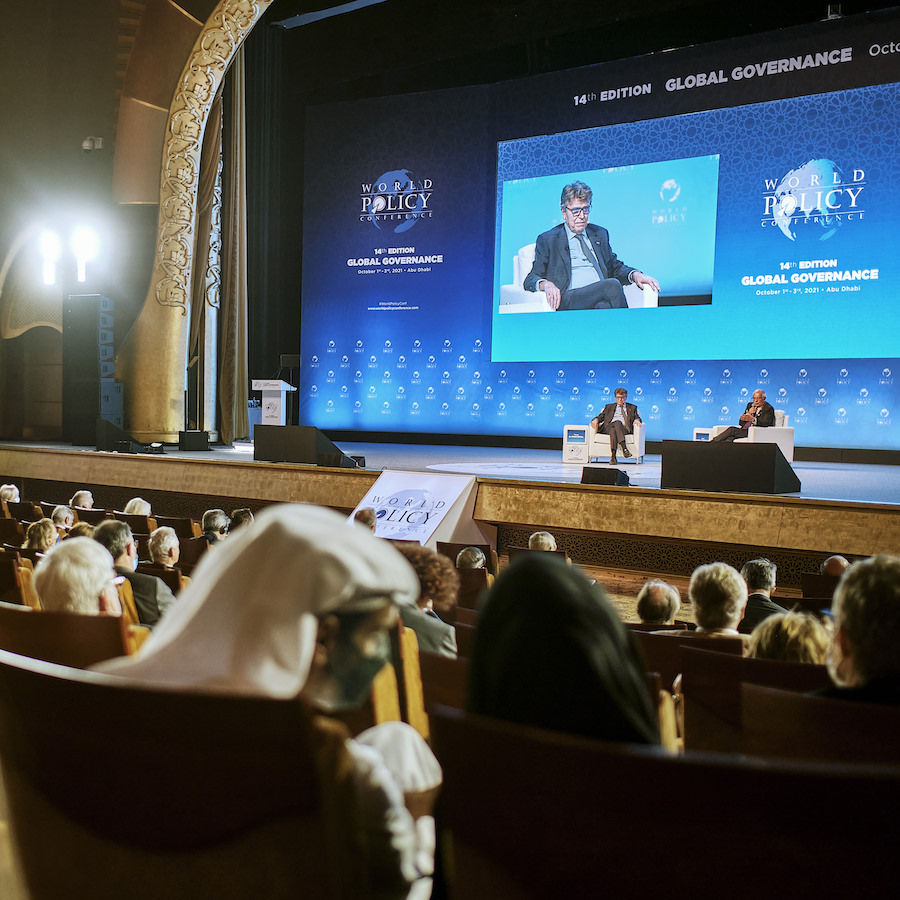
The World Policy Conference (WPC) aims to provide concrete answers to this question. The WPC will be convened each year around Heads of state or government from all continents, who are responsible for their own countries as well as “co-responsible” for the future of the planet. Their exchanges will be accompanied by workshops gathering the best experts and decision makers from the public and private sectors. Thus, the WPC is designed as a constructive process aiming to put politics back at the center of debate. A debate commensurate with the challenges of our time.
Thierry de Montbrial, President and founder
What is the state of the world? Where is the world going? What can be done to better the world?
Ifri (Institut français des relations internationales), a non-partisan European Research Institute with an international outreach, is launching a new type of dialogue, centered around heads of state and government from all regions of the world.
The world in 2008 has not lived up to the hopes generated by the end of the Cold War. The world of today has been neither pacified nor unified by a triumphant globalization. It is governed neither by “good multilateralism” nor by “citizen companies” but is faced with an increasing heterogeneity of vested interests. Badly-controlled diffusion of technology, cultural confrontations, unequal distribution of natural resources, financial disturbances, threats to health and the environment, movement of populations, are all problems perceived to be of great concern. The rise of new powers disrupts the former order. Since politics has not adapted to the rate of technological and economic transformations, the capacity of governments and international institutions to find solutions is called into question.
The over-riding feeling is that the world is not being governed. In the light of this statement, our Conference rests on four beliefs:
The world is a system which needs governance.
Globalization has contributed to multiply non-governmental actors (companies, market operators, NGOs…); governance and political choices must be based on a dialogue between these actors and states.
States must however regain a central role: their mission is to determine the orientation of the “world system”.
It is necessary to define a suitable framework to discuss governance of the “world system” with those who exercise political authority.
The only one of its kind, the World Policy Conference (WPC), will be organized annually around top-level political decision-makers:
The WPC aims to become a place where, through efficient dialogue, decision- makers will identify ways to design the future of the global system, ways to make the strategies of the actors compatible and ways to promote a shared vision of the general interest. Selected participants (politicians, heads of multilateral organizations, corporate managers, eminent experts and journalists) whose total number should not exceed a thousand, will be gathered around heads of state and government in order to develop a common political thinking process commensurate with the challenges of our time.
The President of France will participate at this Conference.