Brief US-China calm masks simmering anger and distrust
Trump’s Beijing visit highlights both countries’ dilemma in gaining upper hand
Hiroyuki AKITA, Nikkei commentator
May 17, 2026
TOKYO — Japan and other U.S. allies, long wary of U.S. President Donald Trump’s transactional approach to foreign policy, were uneasy as they watched his three-day visit to China, which yielded few tangible results.
The concern was that Washington might pursue a rapprochement with Beijing while leaving unresolved the flashpoints in the East and South China Seas and the Taiwan Strait. While such a risk remains and the full impact of his summit with Chinese President Xi Jinping is still unclear, genuine reconciliation appears unlikely.
One reason is that the U.S.-China cold war is deepening rather than easing, leaving both sides with shrinking room for compromise. Their rivalry for supremacy in high technology, military power and diplomacy has intensified, sharply narrowing the space for mutually beneficial deals.
There is little doubt that Trump would like to use his relationship with Xi as the basis for what he could tout as a “beautiful trade deal.” Yet his posture toward China cannot be reduced to a simple fixation on dealmaking.
According to a former senior U.S. official familiar with Trump’s thinking, the president has come to see China more clearly as America’s foremost adversary in advanced technology and security. He also appears to understand instinctively that any compromise on Taiwan could leave him vulnerable to accusations at home of being a “loser.”
Trump’s view of China is also colored by emotion. He harbors a deep grudge against the Chinese Communist Party, driven in part by the large U.S. trade deficit with China. But that is only part of the story. According to another former U.S. official, Trump strongly resents Beijing because he blames his failure to win reelection in 2020 on the coronavirus that spread from China and inflicted severe damage on the U.S. economy.
On the Chinese side, too, many factors stand in the way of U.S.-China reconciliation. Xi remains deeply suspicious that the U.S. is seeking to contain China and ultimately undermine Communist Party rule.
Xi wants stability in U.S.-China relations ahead of the Communist Party congress in autumn next year. But he has little incentive to make major concessions on key issues now. That is because he believes the global geopolitical landscape is shifting in China’s favor.
The Trump administration has withdrawn from one important international organization after another, while Washington’s relations with its allies have also become fraught. From China’s perspective, as a country seeking to dismantle the U.S.-led order, the world is moving in a direction Beijing can welcome without taking any action.
Xi has also grown increasingly distrustful of Trump. When he met with Western leaders in Beijing this spring, Xi vented his dissatisfaction with the U.S. president.
A diplomatic source familiar with the exchange said Xi’s frustration with Trump arose from the Taiwan issue. On Nov. 24, Xi held a telephone conversation with Trump and emphasized its importance to China’s strategic interests. About three weeks later, however, the Trump White House unveiled a record $11.1 billion arms sale to Taiwan, a move that deeply offended Xi.
Visibly angry, Xi said, in effect, that Trump had gone back on his word after saying he understood the importance of the Taiwan issue, according to the source.
In other words, the two superpowers are sliding into deeper mutual distrust and sharper confrontation at both the state-to-state and leadership levels. Trump may be eager to cast his China visit as a success, but striking a deal to ease hostilities between Washington and Beijing remains difficult.
Given these assumptions, how will U.S.-China relations play out in the near future? In short, the two countries are likely to intensify their struggle for supremacy while remaining deterred from making bold strategic offensives against each other.
For the time being, Washington cannot shift its attention away from the war with Iran and the broader situation in the Middle East. Its capacity to counter China in Asia by rapidly redirecting military resources there remains limited.
According to an analysis by the Center for Strategic and International Studies, a Washington think tank, U.S. military operations against Iran may have consumed more than half of four of the seven key types of missiles in the U.S. arsenal, and about a third of the remaining three.
A strategic vulnerability with more serious implications for the U.S. is its continued dependence on China for rare earths. These materials, essential for high-performance magnets, phosphors and catalysts, are indispensable for the production of missiles and cutting-edge F-35 fighter jets. China accounts for 80% to 90% of the global share in rare-earth separation and refining, as well as in magnet production. The U.S. aims to free itself from dependence on Chinese rare-earth supplies, but some estimates suggest that achieving that goal will take at least a decade.
The Xi administration, too, faces a dilemma that prevents it from simply taking an uncompromising stance toward Washington. U.S. military intervention in Venezuela dealt a heavy blow to Beijing’s largest arms export market in South America, as well as to its oil interests there.
In Iran, the U.S. military has made extensive use of artificial intelligence, ushering in a new dimension of warfare. China clearly holds an advantage in Asia’s arms balance through the sheer volume of weapons it can bring to bear in the region, yet it is believed to have been deeply shaken by the AI-driven operations demonstrated by U.S. forces.
“An invasion of Taiwan would be highly risky, and the hurdles for China to carry it out in the immediate future are extremely high,” said a Chinese military expert.
Inside China, there is no shortage of potential hot spots that could jolt Xi’s administration. The economy is cooling, and Xi has repeatedly purged senior officials from the upper echelons of the military.
Against this backdrop, relations between Washington and Beijing are, for now, settling into a delicate equilibrium. The two continue to face off in the Taiwan Strait and the South China Sea, yet the confrontation has not tipped into a major escalation of military tension.
Barring an unexpected clash, what might be called a petite detente — a modest, carefully managed easing of tensions — is likely to persist for the time being.
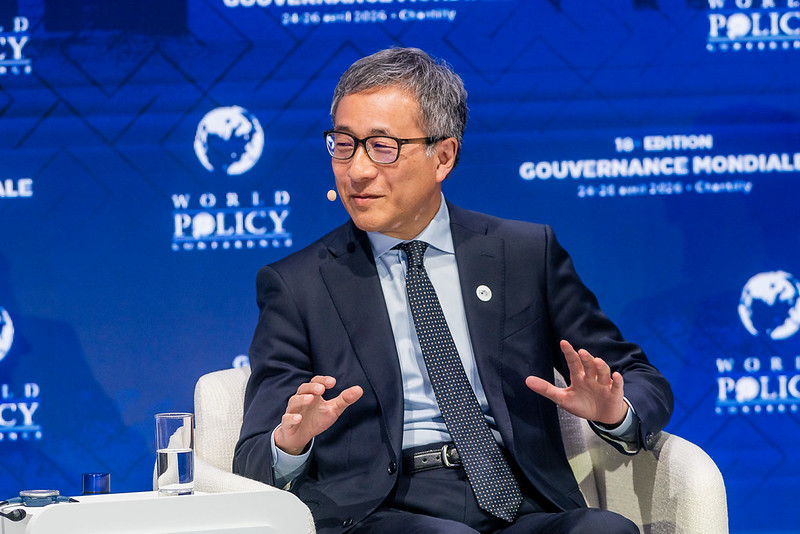
Still, the current trans-Pacific calm is merely the product of a confluence of factors that makes it risky for either side to take forceful action that could upset the status quo. It should not be mistaken for a genuine thaw. That assessment featured prominently at the World Policy Conference held near Paris from April 24 to April 26.
Particularly symbolic was a warning from Wang Jisi, founding president of Peking University’s Institute of International and Strategic Studies and one of China’s leading authorities on American studies.
“In the short term, I think [relations between] China and the United States will remain stable,” said Wang. “[But] they are long-term competitors, rivals, and they don’t like each other … don’t trust each other.
“I’m worried that maybe beyond this year, sometime next year, or at least in 2028 when you have a new U.S. president, rivalries will be intensified.”
Given the current circumstances, it is difficult to envision a “G2” framework in which the U.S. and China jointly manage global affairs. Rather, major powers should be prepared for a possible resurgence in U.S.-China tensions following this brief period of calm.