E.U. Sees Real Brexit Talks at Last — and Real Dangers

Aug. 15, 2018

By Steven Erlanger, The New York Times

BRUSSELS — From the start of the torturous negotiations over Brexit, as Britain’s exit from the European Union is known, the talks have followed an all too familiar dynamic.

The Europeans set the agenda; the British push for concessions or special deals, while trying to work out among themselves what they really want. The Europeans say no, sticking to a pretty hard line.

But now, with 85 percent of a deal completed, and the toughest issues remaining, European officials say they are increasingly worried that Prime Minister Theresa May’s government is so divided and fragile that it could collapse, scuttling a deal and inflicting damage on the Continental economy.

So the Europeans are now exploring ways to finesse their position, three senior European officials say, to sign a withdrawal agreement by the end of the year so it can be ratified by the end of March, when Brexit occurs regardless.

That would formally divorce Britain from the bloc after more than 40 years of marriage. But some of the hardest issues would be left for transition talks that will last another 19 months, until the end of 2020.

All of the officials spoke anonymously, following diplomatic practice, and because they do not have permission to be quoted by name.

Big issues remain to be resolved, with the Irish border chief among them. So the Europeans say they may agree to fuzzy language in the withdrawal agreement’s political declaration — along the lines of “aiming to negotiate the closest possible partnership.”

The aim is to reduce internal British political warfare over how to best keep the promise of no hard border between Ireland, which will remain in the European Union, and Northern Ireland, which will not.

The new British Foreign Secretary, Jeremy Hunt, has been traveling through northern Europe, lobbying for Britain’s position, warning of a chaotic no deal Brexit, and urging “a change in approach” by Brussels. The British and European Union negotiators will meet again on Thursday and Friday, an unusual mid-vacation session.

A big sticking point is how to oversee disputes between Britain and the bloc, since Mrs. May, pushed by fervent Brexiteers, does not want to give the European Court of Justice, the bloc’s highest court, any authority over Britain once it leaves the European Union.

But the thorniest issue is the nature of the border between Ireland and Northern Ireland, because its status hinges on some understanding of the future trading relationship between Britain and the bloc, which remains up in the air.

Mrs. May, at her meeting with her cabinet at Chequers in July, supported the concept of a “free trade area for goods” — but not services — made possible by what she called a “facilitated customs arrangement.”

European officials said that the Chequers statement at least clarified for the first time what Britain wants, even if they rejected her customs proposal out of hand.

What was objectionable, they say, is that Britain talks of wanting an “economic partnership” with the bloc that is akin to being part of the single market for goods alone.

The Europeans have been clear that Britain cannot keep what it had as a member without the obligations of membership, in particular the free movement of goods, as well as capital, services and labor.

Nor can it be in a formal customs union if it wishes to make its own trading deals, as Mrs. May continues to insist.

Britain has failed to understand, the Europeans say, how much the European Union itself feels threatened by the world since the Brexit referendum — by the challenges of President Trump, Russia and China, as well as the rise of authoritarian leaders in Hungary and Poland and populists in general who are largely anti-Brussels, as are those in Italy.

So there is even less willingness now to compromise on key European Union principles, and a desire, especially from France, to make it clear that membership in the bloc has privileges not shared by other countries.

There is also a growing weariness with Britain and Mrs. May, who seems to be arguing that she is politically so weak that she cannot talk honestly with her own citizens about what Brexit actually means.

“The U.K. is looking at this from the angle of the future relationship,” a senior European official said. “The other 27 are looking at this as an attack on what the E.U. is.”

“We regret the loss of the U.K., which is a cost for everyone,” the official added. “But it would be even worse if this is the occasion for compromising on the core of the E.U. — that’s to say, the single market.”

That understanding finally seems to be coming home to the British, the Europeans feel, but they are reluctant to specify the consequences, for fear of hurting Mrs. May and creating a new political crisis in Britain that would throw the whole Brexit process into chaos.

So the Europeans are discussing vague language about a future relationship, hoping that will be enough to make Britain accept the need for a backstop to ensure there is no hard or visible border on the island of Ireland.

“The aim,” a second European official said, “is to make what seems unacceptable merely unpalatable.”

European officials are also searching for compromise.

If a formal customs union is impossible, European officials say one solution might be a future free-trade agreement with the European Union, much as Canada and Japan now have, but one that could allow the unencumbered movement of goods across the British (and Irish) borders.

But there is no guarantee that such a free-trade deal will be quick or easy. Normally such agreements take years to negotiate.

There is also discussion of limiting the jurisdiction of the European Court of Justice and European Union customs officials over Northern Ireland as part of the “backstop” deal, which Ireland (with the support of Brussels) has insisted be written into the withdrawal agreement.

If Britain and Brussels cannot work out their future trading relationship in time, the backstop would essentially establish a border between the entire island of Ireland and the rest of Britain for customs, regulatory standards and value-added tax.

Given the difficulties, some in Britain have been forecasting no deal at all, a so-called cliff-edge Brexit. But senior European officials think that a deal is still more likely than not, if both sides are “reasonable.”

They also say they would be willing to extend the “transition” period to negotiate a new relationship with Britain past December 2020, its current end date. But a specific clause to that effect, with a time limit, must be included in the withdrawal agreement.

The problem for Britain is that any extension would mean additional payments into the European Union budget and a continuation of “rule taking” without a vote, which would outrage Brexiteers.

What many European officials fear is less a cliff-edge Brexit next March than one at the end of 2020, if a final free-trade deal is not completed.

To negotiate a special free-trade deal with Britain that avoids a hard border in Ireland, plus a possible second agreement on security, would ordinarily take years.

But the Brexit withdrawal agreement comes first, and the remaining issues are difficult.

At least now though, European officials say, the talks, at long last, can get more serious.

S’octroyer la souveraineté européenne

BERLIN – Après le récent voyage en Europe du président américain Donald Trump – dont le point d’orgue fut sa désastreuse  avec le président russe Vladimir Poutine – le doute n’est plus permis : il veut, lui et ses partisans, détruire l’ordre international dirigé par l’Amérique et le système mondial des échanges.

Certes, Trump n’est pas synonyme des États-Unis. Il a remporté les élections de 2016 malgré un nombre de suffrages inférieur de trois millionsà celui de son adversaire et sa cote de popularité n’a jamais dépassé les 50 %. Il est pourtant président des États-Unis, ce qui en fait l’homme le plus puissant du monde. Ses actes, quoique souvent absurdes et contradictoires, ont des conséquences graves dans le monde réel, et plus encore pour les partenaires les plus proches de l’Amérique. Lors de sa visite au Royaume-Uni, Trump est allé jusqu’à qualifier l’Union européenne d’« ennemie ».

En cherchant à déstabiliser à peu près tout ce qui définissait l’Occident depuis la fin de la Seconde Guerre mondiale, Trump a mené le monde à un tournant historique. Le péril ne pèse pas tant sur les relations entre les États-Unis et l’Union européenne, qui demeurent fortes, que sur la position dominante de l’Occident sur la scène mondiale. Trump  le déplacement du centre de gravité de la puissance mondiale, aux dépens de l’Amérique mais aussi de l’Europe. À mesure que les revenus et le patrimoine se déplacent de l’Ouest vers l’Est, la Chine verra augmenter ses capacités de remettre en cause la suprématie géopolitique, économique et technologique des États-Unis sur le monde.

Cette transition ne se fera pas sans heurts. Pour l’Europe, les enjeux ne sauraient être plus élevés. Le rééquilibrage de la puissance, déjà en cours, pourrait déterminer le destin des démocraties européennes, de leur État-providence, de leur indépendance et de leurs façons de vivre. Si l’Europe ne s’y prépare pas elle-même, elle n’aura d’autre choix que de suivre l’Amérique ou la Chine – l’atlantisme ou l’eurasisme.

Les Européens devraient se montrer circonspects envers les alliances et les règles actuelles s’ils veulent réellement assurer, durant cette période, leur protection. Le monde pourrait fort bien se diriger vers une situation où les grandes puissances, en l’absence d’un hegemon, joueraient constamment des coudes pour assurer leur position. Mais les circonstances sont aujourd’hui très différentes de ce qu’elles étaient au temps du « Grand Jeu ». L’escalade d’une rivalité entre la Chine et les États-Unis n’aurait pour le Vieux Continent rien d’avantageux.

Pour les Européens, le XIXe siècle fut façonné par les conséquences de la révolution française et de révolution industrielle, tandis que le XXe siècle fut déterminé par deux guerres mondiales, la guerre froide et l’acquisition des armements nucléaires. À la fin de la Seconde Guerre mondiale, deux puissances non-européennes, de chaque côté du vieux système des États européens, s’affirmèrent – les États-Unis et l’Union soviétique. l’Europe n’était plus qu’une case, parmi d’autres, sur l’échiquier.

Pourtant l’Europe avait jusqu’alors gouverné le monde, en raison, principalement, de son développement technologique. Mais la fin de la Seconde Guerre mondiale mit un terme à cette domination. L’Europe – notamment l’Allemagne – fut divisée entre les deux nouvelles puissances, et sa souveraineté fut assumée, en vérité, par les cercles américains de la politique étrangère et par le Kremlin.

Certes, la France et la Grande-Bretagne, les deux puissances européennes victorieuses, préservèrent, en tant que membres permanents du Conseil de sécurité des Nations unies (et plus tard en tant qu’États dotés de l’arme nucléaire) un reste de souveraineté. Mais compte-tenu du nouveau rapport des forces mondial, celui-ci relevait plus du symbole qu’il ne traduisait une véritable influence.

Vint la fin de la guerre froide, et toute l’Europe prit ardemment une orientation transatlantique. En matière de sécurité, l’Europe demeurait dépendante des États-Unis. Mais sur les plans économique et technologique, les Européens avaient regagné leur souveraineté. Institutionnellement, cette division des tâches se traduisait respectivement par l’OTAN et par l’UE. Cette répartition nous fut sans aucun doute utile, mais elle est aujourd’hui remise en question par Trump.

Trois éléments nouveaux ont, en particulier, donné aux Européens des raisons de craindre pour leur avenir. Tout d’abord, Trump  le degré de participation des États-Unis au système de défense mutuelle qu’est l’Organisation du traité de l’Atlantique nord. En deuxième lieu, son administration s’emploie activement à l’Organisation mondiale du commerce et le système mondial des échanges sur lesquels repose l’essentiel de la prospérité européenne. Enfin l’essor de la numérisation et de l’intelligence artificielle menace aujourd’hui de renverser les hiérarchies technologiques mondiales.

Chacun de ces éléments constitue un danger pour la place de l’Europe dans le monde. La question est désormais de savoir si l’UE s’octroiera sa pleine souveraineté et s’affirmera elle-même comme puissance sur la scène mondiale ou bien si elle se laissera pour de bon distancer. C’est le moment de vérité. Il n’y aura pas de seconde chance.

Seule l’UE peut regagner la souveraineté de l’Europe pour le XXIe siècle. Si la tâche en est laissée aux États-nations traditionnels comme le Royaume-Uni, la France ou l’Allemagne, l’échec est certain. S’octroyer la souveraineté n’exigera pas seulement un gigantesque effort, mais aussi un front uni et une nouvelle compréhension des relations entre l’UE et ses États membres. Le projet européen continuera à faciliter les échanges et à garantir la paix ; mais la souveraineté commune doit désormais s’y inscrire.

Si l’UE réussit dans sa tâche, Trump lui aura involontairement rendu un grand service. L’histoire emprunte parfois des voies étranges. L’essentiel est de la prendre comme elle vient, et de ne pas tergiverser lorsque surgit le moment d’une action décisive.

Traduit de l’anglais par François Boisivon

La Maison-Blanche du mensonge

par 
CAMBRIDGE (MASS.) – Le 1er juin de cette année, le président des États-Unis Donald Trump s’était livré à 3 259 affirmations fausses ou mensongères, selon la base de données de vérification factuelle du Washington Post, qui enregistre et classe chaque déclaration douteuse formulée par le président. La moyenne est donc de 6,5 affirmations fausses par jour, en hausse par rapport à celle des cent premiers jours de son mandat, qui n’était que de 4,9 – elle a atteint son pic en mai, avec huit mensonges quotidiens.

Les partisans de Trump justifient cette propension au mensonge en assurant que « tous les politiciens mentent ». Il est certain qu’ils mentent, et force nous est d’admettre, après une courte introspection, que tous les humains en font autant. Mais le degré et le nombre des mensonges comptent aussi. En trop grand nombre, les mensonges dévaluent la confiance.

D’autres mensonges présidentiels ont servi des buts plus élevés. En certaines circonstances, les historiens ont même applaudi à la décision d’un président de tromper l’opinion pour faire triompher ce qu’il considérait comme un plus grand bien ou un bien ultérieur. John F. Kennedy l’a trompée sur le rôle joué par l’évacuation des missiles américains de Turquie dans l’accord qui mit un terme à la crise des missiles de Cuba, en 1962, mais leur intérêt s’en trouvait sans aucun doute mieux assuré que si le risque très élevé de guerre nucléaire avait perduré.

L’exemple de [septembre] 1941, avant l’entrée des États-Unis dans la Seconde Guerre mondiale, est plus ambigu. Afin de persuader une opinion isolationniste de la menace constituée par l’Allemagne d’Hitler, le président Franklin D. Roosevelt affirme qu’un sous-marin allemand a attaqué un destroyer américain [le USS Greer], alors que c’est en réalité l’attitude du navire américain qui a provoqué une réaction hostile. En temps de guerre, lorsque des lèvres trop mal scellées peuvent couler des navires et que le secret est essentiel, la vérité, pour reprendre la formule de Winston Churchill, est « si précieuse qu’elle doit toujours être accompagnée d’une escorte de mensonges ».

La dissimulation machiavélienne est un recours commun dans les stratégies de négociation qui permettent l’obtention d’un accord, un art dont Trump se prétend un maître. Ceci explique peut-être ses mensonges au sujet des armes nord-coréennes, des droits de douane européens et de l’ingérence du président russe Vladimir Poutine dans l’élection présidentielle américaine de 2016. Mais sa mauvaise foi concernant la taille de la foule présente lors de sa prestation de serment, les sommes versées à des femmes afin d’acheter leur silence ou les motifs de la mise à pied de l’ancien directeur du FBI, James Comey, ne s’apparentent en rien à l’art de gouverner. Tous ces mensonges sont de pure convenance, destinés à manipuler les tiers et l’opinion.

Même lorsque les raisons d’un président ne relèvent pas de la simple commodité, il devrait se montrer prudent lorsqu’il choisit de mentir. Avant de faire du mensonge un instrument dans l’art de gouverner, il devrait prendre en considération l’importance du but à atteindre, les moyens différents dont il dispose pour y parvenir et si la tromperie peut être maintenue dans certaines limites ou bien s’il risque de s’y enferrer.

Plus un dirigeant trompe l’opinion, plus il sape la confiance, affaiblit les institutions et crée des précédents dévastateurs. Les mensonges de Roosevelt en 1941 étaient destinés réveiller le peuple américain, mais ils créèrent aussi le précédent qui permit à Lyndon B. Johnson d’obtenir que le Congrès adoptât la résolution sur le golfe du Tonkin, dont résulta la catastrophique escalade de la guerre du Viêt-Nam. Le danger est que les dirigeants se persuadent qu’ils mentent à l’opinion pour son bien alors qu’ils le font pour obtenir un avantage politique ou personnel.

Johnson ne voulait pas apparaître comme un lâche ou rester dans les mémoires comme celui qui aurait perdu le Viêt-Nam. Il ne cessa plus de mentir au peuple américain sur les progrès réalisés au cours de la guerre. Il voulait aussi que celle-ci fût limitée.

L’un des bénéfices moraux d’une guerre limitée est d’éviter les dommages causés par l’escalade. Mais ce type de guerre ne va pas sans une part de bluff. Pour conserver sa crédibilité dans ses négociations avec l’ennemi, un président doit maintenir un optimisme sans faille dans l’opinion, prétexte aux fausses informations livrées à celle-ci. Dans le cas de Johnson, cette nécessité fut encore renforcée par ses raisons personnelles. En 1968, les gens disaient qu’il suffisait de le voir remuer les lèvres pour savoir s’il mentait. Il décida de ne pas se représenter.

Le successeur de Johnson, Richard Nixon, mentit lui aussi au sujet de la guerre du Viêt-Nam, notamment sur son extension au Cambodge. Ce mensonge fut suivi d’un autre, lorsqu’il tenta d’étouffer l’effraction des locaux du parti démocrate [dans son quartier général de l’immeuble du Watergate, à Washington], organisée sur ordre de l’administration présidentielle. Lorsque le fait fut finalement révélé, par des enregistrements sur bandes magnétiques, Nixon démissionna de la présidence, en 1974, pour éviter sa mise en accusation et sa destitution.

Johnson et Nixon firent non seulement du tort à leur présidence, mais aussi à la confiance de l’opinion. Au début des années 1960, les sondages montraientque les trois quarts des Américains avaient une grande foi dans l’État. À la fin de la décennie suivante, un quart seulement témoignaient de la même perception. Si les causes de ce déclin sont complexes, les mensonges présidentiels y eurent certainement leur part.

Certains observateurs, faisant valoir le comportement qui fut le sien dans le secteur privé, affirment que Trump ment simplement par habitude. D’autres pensent que la fréquence, la répétition et le caractère flagrant de ses mensonges ne relèvent pas d’une habitude, mais d’une stratégie politique délibérée qui consiste à nuire aux institutions dès lors qu’elles reposent sur la confiance. Quoi qu’il en soit, Trump a sapé la crédibilité d’institutions comme la presse, les agences de renseignement et le département de la Justice des États-Unis, tout devenant relatif tandis qu’il joue sur le soutien d’une base extrêmement loyale.

Une Amérique après Trump pourra-t-elle se redresser ? Il n’est pas inutile de rappeler qu’à Johnson et à Nixon succédèrent Gerald Ford et Jimmy Carter, qui était nettement plus honnêtes, et que la confiance de l’opinion dans l’État remonta quelque peu lors de la présidence de Ronald Reagan au cours des années 1980. Mais comme le montre le simple nombre des mensonges qu’il profère, les États-Unis n’ont jamais connu un président comparable à Donald Trump.

Traduction François Boisivon

L’Europe est-elle l’amie ou l’ennemie de l’Amérique ?

PARIS – La conduite de Donald Trump depuis qu’il est devenu président des États-Unis, en janvier 2017, est aussi étonnante qu’imprévisible. Cependant sa politique est malgré tout plus cohérente que ne l’avaient généralement prévu les observateurs. La versatilité de Trump est déconcertante, mais dans l’ensemble, ses décisions sont en phase avec ses promesses de campagne et avec les opinions qu’il professait bien avant que quiconque ne songe à l’éventualité de son élection. Il ne faut pas donc pas s’étonner que se soit développé un fructueux artisanat qui s’attache à produire des théories rationnelles du comportement en apparence irrationnel de Donald Trump.

Le dernier problème en date est celui posé par son attitude à l’égard de l’Europe. Lors d’un meeting, le 28 juin, il a déclaré : « Nous aimons bien les pays de l’Union européenne. Mais l’Union européenne s’est construite, évidemment, pour profiter des États-Unis. Et savez-vous quoi ? Nous ne pouvons laisser faire une chose pareille. » Au cours de son récent voyage sur le continent, Trump a traité l’UE d’« ennemie » et ajouté qu’elle était « peut-être pire que la Chine ». Quant au Brexit, il a fait savoir que, selon lui, la Première ministre britannique Theresa May aurait dû « poursuivre en justice » l’UE.

Puis vint la trêve, le 25 juillet : Trump et Jean-Claude Juncker, le président de la Commission européenne, se sont accordés pour s’efforcer de travailler conjointement à un programme de libre échange et de réforme de l’Organisation mondiale du commerce.

Il semble donc que nous soyons à nouveau amis – à moins qu’il ne s’agisse d’un simple moment de répit avant que ne reprennent les hostilités. Les véritables questions n’en demeurent pas moins : Pourquoi Trump a-t-il attaqué à maintes reprises le plus sûr et le plus vieil allié des États-Unis ? Pourquoi semble-t-il mépriser à ce point l’UE ? Pourquoi les États-Unis s’ingénient-ils à affaiblir l’Europe, plutôt que de rechercher une coopération plus étroite pour protéger leurs intérêts économiques et géopolitiques ?

La démarche de Trump est d’autant plus frappante que l’émergence rapide de la Chine comme rival stratégique constitue le grand problème de la sécurité nationale américaine. Contrairement aux espoirs qu’on avait d’abord nourris, la Chine ne converge pas vers l’Ouest, ni sur le plan politique, ni non plus sur le plan économique, parce que l’État et le parti au pouvoir interviennent encore massivement dans les activités du pays. D’un point de vue géopolitique, la Chine travaille activement à se construire une clientèle, à l’aide notamment de son projet le plus en vue, « une ceinture, une route » (« One Belt, one Road » – OBOR), et  « promouvoir la mise en place d’un nouveau type de relations internationales », qui se démarque du modèle soutenu par les États-Unis au XXe siècle. D’un point de vue militaire, elle est engagée dans un renforcement significatif de son dispositif. C’est la Chine et non l’Europe qui forme à l’évidence la principale remise en cause de la suprématie mondiale des États-Unis.

La stratégie chinoise du précédent président des États-Unis, Barack Obama, combinait dialogue et pressions. Il avait commencé à construire deux gigantesques alliances économiques qui excluaient la Chine (et aussi la Russie) : le Partenariat transpacifique (PTP), avec onze pays du pourtour pacifique, et la Partenariat transatlantique de commerce et d’investissement (PTCI), avec l’Union européenne. Mais Trump a retiré les États-Unis du PTP et tué le PTCI avant même que ce dernier ne voie le jour. Il s’est ensuite lancé dans un conflit commercial avec l’UE, s’en prenant à l’Union comme à ses États membres et plus particulièrement à l’Allemagne.

À cela, trois explications sont possibles. La première tient à l’obsession de Trump pour les soldes commerciaux bilatéraux. Si l’on adopte cette hypothèse, Trump considère l’Allemagne, le reste de l’Europe et la Chine comme des rivaux aussi menaçants les uns que les autres. Personne d’autre ne pense que cela ait le moindre sens économique. Et il ne doit rien attendre d’une telle stratégie qu’une atteinte au traditionnel partenariat atlantique et l’affaiblissement de celui-ci. Mais il se plaint au moins depuis les années 1990 de voir des Mercedes dans les rues de New York.

La deuxième explication est que Trump veut éviter de voir l’UE se positionner en troisième protagoniste d’un jeu trilatéral. Si les États-Unis cherchent à faire de la relation avec la Chine une lutte bilatérale pour le pouvoir, ils ont de bonnes raisons de considérer l’UE comme un obstacle. Étant elle-même gouvernée par le droit, l’UE ne peut que s’opposer à une conception purement transactionnelle des relations internationales. Or une Europe unie qui détiendrait les clés du plus gros marché mondial n’est pas un acteur qu’on puisse négliger. En revanche, une fois l’UE affaiblie, voire démantelée, des pays européens fragiles et divisés n’auraient d’autre choix que de se rallier aux décisions des États-Unis.

On peut avoir, enfin, une lecture plus politique du comportement de Trump : il chercherait un changement de régime en Europe. Celle-ci, à l’en croire – et il n’a pas manqué de faire connaître son opinion – « perd sa culture », car elle a laissé l’immigration « transformer son tissu ». Steven Bannon, son ancien « stratège en chef », a de plus annoncé qu’il passera la moitié de son temps sur le continent européen afin de contribuer à la construction d’une alliance des partis nationalistes et à la victoire de celle-ci lors des prochaines élections au Parlement européen, en mai prochain.

Voici quelques semaines, seule la première interprétation semblait plausible. Les deux autres pouvaient être écartées comme des fantasmes inspirés par un goût excessif pour les théories du complot. Aucun président des États-Unis ne s’est jamais représenté l’UE comme une conspiration ourdie dans le but d’affaiblir les États-Unis. De fait, tous les prédécesseurs de Trump après-guerre auraient reculé d’horreur à l’idée d’une dissolution de l’Union. Mais l’actuel président des États-Unis est allé trop loin dans son dénigrement de l’Europe pour qu’on puisse aujourd’hui négliger les scénarios les plus sombres.

Pour l’UE, c’est un moment charnière. Dans les années 1950, elle a été lancée à l’abri du parapluie sécuritaire des Américains et avec leur bénédiction. Depuis lors, elle s’est construite comme une expérience géopolitique menée sous la protection des États-Unis, dans le contexte d’un système international qu’ils dirigeaient. Pour cette raison, les volets extérieurs de son action – tant du point de vue économique ou diplomatique que de sa sécurité – ont toujours occupé un rang secondaire par rapport aux volets internes.

Ce que signifie la crise récente, c’est que ce schéma ne tient plus. L’Europe doit désormais définir sa position stratégique à l’égard d’une Amérique plus distante, voire hostile, et vis-à-vis de puissances montantes qui n’ont aucune raison d’être aimables avec elle. Elle doit défendre ses valeurs. Et décider de toute urgence ce qu’elle entend faire pour sa sécurité et sa défense, pour sa politique de voisinage et la protection de ses frontières. C’est l’épreuve de vérité.

Économiquement, l’UE dispose toujours du potentiel d’un acteur global : la taille de son marché, la force de ses grandes entreprises, une politique commerciale unifiée, une politique réglementaire commune, une autorité unique de la concurrence et une monnaie qui n’est devancée que par le dollar dans les avoirs internationaux. Elle pourrait – et devrait – utiliser ses atouts pour une réorganisation des relations internationales qui réponde aux griefs légitimes des États-Unis à l’égard de la Chine et aux inquiétudes non moins légitimes de celle-ci sur sa place dans la communauté internationale. L’Europe a mené la lutte contre le changement climatique ; elle pourrait aussi jouer un rôle majeur pour ce qui concerne le commerce, l’investissement et la finance.

Le vrai problème de l’Europe n’est pas économique mais politique. Les difficultés qu’elle affronte surviennent à un moment de division entre île et continent, entre Nord et Sud, entre Est et Ouest. Et les questions posées sont primordiales : Qu’est-ce qui définit une nation ? Qui est responsable des frontières ? Qui garantit la sécurité ? l’UE est-elle fondée sur des valeurs partagées ou sur de simples calculs d’intérêts nationaux ?

Si l’UE ne parvient pas à se définir dans un monde fondamentalement différent de ce qu’il était voici seulement dix ans, elle ne survivra probablement pas en tant qu’institution digne de ce nom. Si elle y parvient, en revanche, elle peut retrouver aux yeux des citoyens européens son but et sa légitimité, entamés par des années de déconvenues économiques et politiques.

Traduit de l’anglais par François Boisivon

Global Politics for a Globalized Economy

 ,  

Global markets are now more important than national markets for small and medium-size countries, and approaching that status for large economies. The emergence of such a truly global capitalism means that more and more economic activity will no longer be embedded in the politics or regulatory systems of various nation-states.

WASHINGTON, DC – From the end of World War II to the mid-2010s, economic globalization progressed relentlessly through expanded trade, proliferating capital flows, faster (and cheaper) communication, and, to a lesser extent, human migration. Yet, even as these linkages have deepened and multiplied, the global economy has remained fundamentally a collection of national economies, each embedded in national politics. This is now changing.

In the democratic countries that have built the market capitalism that dominates the world today, the building blocks of the economy – taxation, public spending, and regulatory frameworks – are enacted by the legislature and interpreted by the legal system. This lends legitimacy to them and the economic activities they facilitate.

But a shift is occurring: global markets already are more important than national markets for small and medium-size countries, and they are approaching that status for large economies. In less than a decade, it will be the huge world market, rather than national markets, that allocates capital, finance, and skilled labor. Many firms will be truly multinational, with headquarters located in one place (probably where tax liabilities can be minimized), production and sales happening largely elsewhere, and managers and workers sourced from all over the world.

The emergence of such a truly global capitalism – a process that, to be sure, is far from complete – means that markets will no longer be embedded in the politics or regulatory systems of various nation-states. If they are to produce desirable outcomes, they will need to be embedded more deeply in – and regulated more effectively by – global institutions.

Of course, international economic institutions – from the International Monetary Fund and World Bank to the economic bodies of the United Nations and the World Trade Organization – already exist and have long served as platforms for member states to adopt shared rules. The IMF and the WTO, in particular, have acquired some real regulatory authority in macroeconomic and trade policy, respectively.

Domestic politics were largely eschewed in establishing and sustaining these international institutions. Though treasuries, central banks, and trade ministries – especially of the advanced countries – acted politically, they did so with very little public debate. Even today, the average citizen in the United States, France, or India knows little about what the WTO actually does.

In other words, the emergence of a global market is not embedded in any legitimacy-conferring political process. Multilateral institutions are thus viewed as elitist, making them a political target. This is reminiscent of the European Union’s “democratic deficit,” which has fueled resistance to further integration.

In fact, resistance to global capitalism is also rampant and rising. In particular, US President Donald Trump espouses a kind of “go-it-alone” neo-nationalism. Far from deepening multilateral structures, he wants to dismantle them, dislodging the global market from the regulatory institutions in which it is already only weakly embedded. At both the national and international levels, Trump believes that the less regulation, the better.

The EU, meanwhile, pursues the opposite line. Despite the internal challenges it faces, it continues to try to regulate markets beyond national borders. This year alone, the European Commission has imposed over €5 billion ($5.8 billion) in fines on Alphabet Inc., Google’s parent company, and Qualcomm for breaching antitrust restrictions. And with its General Data Protection Regulation, the EU has sought to tighten restrictions on the use, sharing, and control of personal data.

Because the EU has such a large market, such actions have a far-reaching impact. But when it comes to setting truly international standards, the EU obviously falls short. This has become all the more true with figures like Trump actively working against its efforts and espousing deregulation at a time when the level of global economic interconnectedness demands just the opposite.

Allowing major multinational companies, which are already reaping massive profits and crowding smaller players out of entire industries, to avoid paying much tax does far-reaching damage, not least by exacerbating inequality and weakening public budgets. But such firms can be regulated effectively only through multilateral cooperation. Likewise, the only way to make any headway on combating the effects of climate change is for all countries to work together.

The realities of today’s global economy demand that we make multilateral institutions work. That means not only increasing the clout of existing institutions – here, reform is a prerequisite – but also establishing new institutions, such as a Global Competition Authority. None of this will be possible without a real global political debate.

Of course, the emergence of a global politics has far-reaching potential implications for traditional ideas about democracy, not to mention national sovereignty. At the same time, however, allowing the global market to function without adapted regulation, enacted by legitimate and effective international institutions, would amount to abandoning the essence of democracy.

The challenge ahead has been presented by Harvard economist Dani Rodrik in the form of a trilemma: when it comes to democracy, national sovereignty, and globalization, we can have any two, but never all three. Rodrik advocates less globalization and more democracy. Nationalists like Trump prefer strengthening the nation-state, in ways that could weaken both democracy and globalization, at least in the longer term.

In the medium term, however, further globalization seems unavoidable, meaning that it is the nation-state, and national politics, that must be constrained. One way to lend legitimacy to the new global politics would be to ensure that it is  at the local level. This will require local political leaders to adopt a narrative that explains how global problems impact their constituents. Climate change is a successful example of this form of localized global politics.

Whatever institutional arrangements are chosen, ensuring that a new global politics strengthens, rather than undermines, democracy is the central political challenge of the twenty-first century. We can no longer afford to shy away from it.

The End of NATO?

US President Donald Trump escalated his war on US alliances and multilateral institutions at NATO’s summit in Brussels and then at his meeting with Russian President Vladimir Putin in Helsinki. There is now little doubt that Trump’s strange affinity for Putin represents a serious threat to European security.

STOCKHOLM – What is left of NATO and the transatlantic order after US President Donald Trump’s tumultuous week in Brussels, the United Kingdom, and Helsinki, where he defended Russian President Vladimir Putin against accusations of cyber warfare by America’s own intelligence agencies?

Watching events unfold through rose-tinted glasses, one might think that the West’s most important strategic alliance is more or less okay, or even growing stronger. In fact, NATO is in peril, and its fate now lies in Trump’s contemptuous hands.

Prior to and during the NATO summit, there was much hand-wringing over member states’  as a share of GDP. Each member is expected to increase its spending to 2% of GDP by 2024, but Trump seems to think that this already should have been done. And at the summit last week, he suddenly called for a new target of 4% of GDP – which is more than even the United States spends.

To be sure, over the past few decades, NATO’s primary focus was on peacekeeping operations in distant places, rather than on its core function of territorial defense. For most European member states, the peace dividend from the alliance’s operations justified cuts in domestic military spending.

But this attitude changed in 2014, when Russia annexed Crimea and launched secretive military incursions into Eastern Ukraine. Since then, NATO member states’ defense budgets have increased by around 4% per year on average, making the 2024 target eminently achievable.

More fundamentally, Trump’s complaint that the US is shouldering an unfair share of the burden for NATO’s collective defense is dubious. While the US military budget equals roughly 72% of combined defense spending by all NATO member states, roughly three-quarters of US military spending is directed toward regions other than Europe. Around half of the US defense budget is spent on maintaining a presence in the Pacific, and another quarter is spent on operations in the Middle East, strategic nuclear command and control, and other areas.

Moreover, although the US has increased its defense outlays in Europe substantially over the past few years, it is worth remembering that most US forces and facilities there are actually focused on the geostrategic arc from India to South Africa. With facilities such as Ramstein, Fairford, Rota, Vicenza, and Sigonella, the US has long used Europe as a staging ground for deploying forces elsewhere. And the early-warning and surveillance facilities that the US maintains in the United Kingdom and Norway are there to defend the continental US, not Europe.

The fact is that total European defense spending is around twice what the US spends on European security, and also roughly twice what Russia spends on defense, according to estimates produced at the US National Defense University.

The critical importance of US command, control, and intelligence forces in Europe should not be minimized, but it should at least be put into perspective. Although the US Army recently rotated heavy brigades through Europe for military exercises, its permanently stationed troops are equipped only for limited interventions.

This is why NATO must continue to improve its defense capacity in Europe. At a minimum, Europe needs more military forces, and those forces need to be equipped for rapid deployment to critical areas. The new mobility command that is being established in Germany is a promising first step.

And yet, Russia’s advantages over NATO have less to do with resources than with command and control. As a single country, Russia’s military forces are more integrated, and can be deployed more quickly in pursuit of strategic directives from the Kremlin. Such nimbleness was amply demonstrated in Crimea in 2014 and in Syria the following year.

For its part, NATO does have a deeply integrated command structure for the forces that are assigned to it. But that hardly matters if political decisions to deploy forces or launch operations are not taken in time. In any military confrontation, unity of will and the speed of high-level decision-making determine the outcome.

The problem is that while NATO’s military capacity is actually improving, its political decision-making capacity is deteriorating. Imagine what would happen if a NATO member state sounded the alarm about Russia launching a secretive Crimea-style military operation within its borders. Then, imagine that US intelligence agencies confirmed that an act of aggression was indeed underway, despite Putin’s denials.

Finally, imagine how Trump might respond. Would he call Putin to ask what’s going on? And would Putin make another “incredible offer” to help US investigators get to the bottom of things? Even more to the point: Would Trump quickly invoke the principle of collective defense under Article 5 of the NATO treaty? Or would he hesitate, question the intelligence, belittle US allies, and validate Putin’s denials?

These are truly disturbing questions to have to ask of an American president. They will now hang over Europe’s head indefinitely.

The West Must Face Reality in Turkey

Turkey’s currency crisis and standoff with the United States over the imprisonment of an American pastor have exposed the crumbling edifice of the two countries’ Cold War-era partnership. Rather than hold out hope that Turkey will return to the Western fold, US and European policymakers must consider a new policy toward the country.

NEW YORK – Now that Turkey is at loggerheads with its erstwhile ally, the United States, the country’s currency crisis has morphed into a political problem of the first order. The immediate issue is Turkey’s refusal to release the American pastor Andrew Brunson, who is being held on charges of terrorism, espionage, and subversion for his alleged role in the failed July 2016 coup against Turkish President Recep Tayyip Erdoğan.

The US government is right to object to Brunson’s detention. But its reaction has been counterproductive. In particular, the imposition of additional US tariffs on imports of Turkish steel and aluminum could further undermine confidence in Turkey’s economy, triggering a wider crisis that would do serious harm to the global economy. Moreover, tariffs allow Erdoğan to blame his country’s economic woes on America, rather than on his own government’s incompetence.

It is still possible that the Turkish government will find a way to release Brunson, and that US President Donald Trump, anxious to demonstrate fealty to the evangelicals who form a core part of his base, will rescind the tariffs. But even if the immediate crisis is resolved, the structural crisis in US-Turkish relations – and Western-Turkish relations generally – will remain. We are witnessing the gradual but steady demise of a relationship that is already an alliance in name only. Though the Trump administration is right to have confronted Turkey, it chose not only the wrong response, but also the wrong issue.

The relationship between Turkey and the West has long been predicated on two principles, neither of which obtains any longer. The first is that Turkey is a part of the West, which implies that it is a liberal democracy. Yet Turkey is neither liberal nor a democracy. It has effectively been subjected to one-party rule under the Justice and Development Party (AKP), and power has become concentrated in the hands of Erdoğan, who is also the AKP’s leader.

Under Erdoğan, checks and balances have largely been eliminated from the Turkish political system, and the president controls the media, the bureaucracy, and the courts. The same failed coup that Erdoğan cites as grounds to imprison Brunson has also served as an excuse for detaining thousands of others. At this point, it is impossible to see how Erdoğan’s Turkey could ever qualify for EU membership.

The second principle underlying Turkey’s “Western” status is alignment on foreign policy. Turkey recently bought more than 100 advanced F-35 fighter jets from the US. Yet, in recent years, Turkey has also supported jihadist groups in Syria, moved closer to Iran, and contracted to purchase S-400 surface-to-air missiles from Russia.

Above all, Turkey and the US find themselves on different sides in Syria. While the Syrian Kurds have been close partners of the US, they have been deemed terrorists by Turkey, owing to their ties to Kurdish groups inside Turkey that historically have sought autonomy, if not independence. Against this backdrop, it is not far-fetched to imagine US and Turkish forces coming to blows.

Some might say that the current level of US-Turkish friction is nothing new; the two countries have long had their share of differences. The Turks were not happy with the US decision to withdraw medium-range missiles from Turkey as part of the deal that ended the 1962 Cuban Missile Crisis. The two countries clashed repeatedly over the Turkish intervention and subsequent occupation of Northern Cyprus in 1974, and over US support for Greece. Turkey refused to give US military forces access to Incirlik Air Base during the Iraq war in 2003. And in recent years, the Turkish government has been infuriated by America’s refusal to extradite the Pennsylvania-based cleric Fethullah Gülen, whom Erdoğan believes masterminded the 2016 coup attempt.

Still, what we are seeing today is something different. The anti-Soviet glue that kept the two countries close during the Cold War is long gone. What we have now is a loveless marriage in which the two parties continue to cohabitate under the same roof, even though there is no longer any real connection between them.

The problem is that the NATO treaty provides no mechanism for divorce. Turkey can withdraw from the alliance, but it cannot be forced out. Given this reality, the US and the European Union should maintain a two-pronged approach toward Turkey.

First, policymakers should criticize Turkish policy when warranted. But they must also reduce their reliance on access to Turkish bases such as Incirlik, deny Turkey access to advanced military hardware like F-35s, and reconsider the policy of basing nuclear weapons in Turkey. Moreover, the US should not extradite Gülen unless Turkey can prove his involvement in the coup with evidence that would stand up in a US court and satisfy the provisions of the 1981 mutual extradition treaty. Nor should the US abandon the Kurds, given their invaluable role in the fight against the Islamic State (ISIS).

Second, the US and Europe should wait until the Erdoğan era is over, and then approach Turkey’s new leadership with a grand bargain. The offer should be Western support in exchange for a Turkish commitment to liberal democracy and to a foreign policy focused on fighting terrorism and pushing back against Russia.

Erdoğan recently warned in the New York Times that the US-Turkish partnership “could be in jeopardy,” and that Turkey would soon start looking for new friends and allies if US unilateralism and disrespect were not reversed. In fact, the partnership was already in jeopardy, largely because of Turkish actions, and Erdoğan had already begun the process of looking for new friends and allies. It is time for the US and Europe to adjust to this reality.

Rozlyn Engel

Responsable de la stratégie économique de la MITRE Corporation, une organisation non lucrative de 2,1 milliards de dollars qui travaille pour les secteurs privé, public et universitaire pour faire évoluer la sécurité, la stabilité et le bien-être aux Etats-Unis, et chercheur non résident du programme de politique économique américaine de la Fondation Carnegie pour la paix internationale. Ces deux postes se concentrent sur la nature de la concurrence économique stratégique dans le système international d’aujourd’hui, le rôle de l’innovation et des nouvelles technologies, les risques macroéconomiques et leur impact sur les politiques, ainsi que sur la politique économique américaine. Cadre supérieur au Bureau de l’analyse macroéconomique du Département du Trésor des États-Unis (octobre 2016 – août 2018). Responsable du renseignement national et agent national du renseignement pour l’économie au Bureau du directeur du renseignement national américain (2013-2016). Elle est titulaire d’un doctorat en économie de l’Université Columbia et d’une maîtrise en histoire économique de la London School of Economics.

Pourquoi Trump s’en prend-il à l’Iran ?

23 juillet 2018

Renaud Girard, Le Figaro

S’exprimant dimanche 22 juillet 2018 devant un parterre de diplomates iraniens, le Président Rohani a tendu une demi-branche d’olivier aux Etats-Unis. « L’Amérique devrait comprendre que sa paix avec l’Iran serait la mère de toutes les paix mais que lui faire la guerre serait la mère de toutes les guerres ! », a dit ce président réformateur, élu en 2013 et réélu en 2017 par la population iranienne, sur un programme d’ouverture à l’Occident. Rejetant cet appel du pied diplomatique de Téhéran, le Président Trump a réagi le 23 juillet par un tweet d’une extrême intransigeance : « Au Président Rouhani : ne vous avisez plus jamais de proférer des menaces contre les Etats-Unis ; sauf à vous exposer à des conséquences que très peu de peuples ont subi jusqu’à présent dans l’Histoire ! »

Tout se passe comme si les Etats-Unis avaient bel et bien renoncé à trouver un arrangement diplomatique avec le régime des mollahs, parvenus au pouvoir en 1979 à Téhéran, après avoir renversé un Shah qui était jusque-là l’allié le plus fiable de l’Amérique au Moyen-Orient. Logiquement, l’accord nucléaire du 14 juillet 2015 (où l’Iran renonçait à poursuivre son enrichissement d’uranium en échange d’un abandon des sanctions commerciales internationales), signé entre les mollahs et les cinq membres permanents du Conseil de sécurité de l’Onu plus l’Allemagne, devait conduire à terme à un rétablissement des relations diplomatiques entre Washington et Téhéran. L’Agence internationale de l’Energie atomique de Vienne avait publié plusieurs rapports soulignant que l’Iran remplissait entièrement ses obligations de dénucléarisation. Mais, en mai 2018, en dépit d’un appel de ses alliés à la tempérance, Donald Trump a dénoncé unilatéralement la signature de l’Amérique, jugeant trop laxiste l’accord qui avait été négocié et signé par John Kerry, le Secrétaire d’Etat du Président Obama. Pire, en proférant des menaces de représailles contre toutes les entreprises occidentales qui continueraient à commercer avec l’Iran et à lui acheter son pétrole, le président américain actuel a institué une sorte de blocus de la République islamique.

Le 22 juillet, dans un discours adressé à la nombreuse diaspora iranienne installée en Californie, le Secrétaire d’Etat Mike Pompeo a qualifié de « mafia » les autorités au pouvoir en Iran. Il a aussi annoncé la constitution d’un média audiovisuel en persan, financé par le gouvernement américain. Le chef de la diplomatie américaine reprend ainsi des instruments qui avaient cours lors de la guerre froide contre l’URSS, comme Radio Free Europe. Est-ce à dire que les Etats-Unis ont secrètement décidé d’un « regime change » en Iran, en dépit de proclamations antérieures du président Trump critiquant le droit-de-l’hommisme botté de ses prédécesseurs ? Est-ce plutôt un coup de bluff devant aboutir à une négociation, sur le modèle de sa tumultueuse relation avec la Corée du Nord ?

Comparaison n’est pas raison. Car l’Iran est dans une situation beaucoup plus précaire que celle de la Corée du Nord. Elle a réussi à réactiver son alliance stratégique avec la Chine, envers laquelle les Etats-Unis ont entamé une guerre commerciale de vaste ampleur. Il est désormais improbable que la Corée du Nord s’engage dans une dénucléarisation sans condition, et fort probable que Pékin et Moscou ne feront plus de zèle dans l’application des sanctions commerciales onusiennes contre Pyongyang.

L’Iran se trouve dans un double état de faiblesse, qui n’a pas échappé aux stratèges de l’administration Trump. Intérieurement, la jeunesse iranienne, fort instruite des mœurs occidentales grâce à internet, ne supporte plus le carcan de la dictature religieuse. Extérieurement, le régime des mollahs vient d’être lâché par la Russie, au profit d’Israël. Depuis 2012, Moscou et Téhéran ont entretenu une alliance de circonstance pour sauver de la déroute le régime baasiste de Damas, vieil allié de l’un comme de l’autre. Mais, entre la Russie et Israël, il existe une alliance de cœur et de sang. Le 9 mai 2018, assistant au défilé de la Victoire sur la Place Rouge, Benjamin Netanyahou arborait un ruban de Saint-Georges au revers de son veston. Ce mardi 24 juillet, le ministre des affaires étrangères et le chef d’état-major russes sont en visite en Israël, pour discuter du dossier syrien avec leurs homologues juifs.

Au Moyen-Orient, les vues russes et israéliennes convergent. En mai 2018, l’aviation israélienne a détruit de très nombreuses implantations militaires iraniennes en Syrie. Les Russes n’ont pas bronché, ayant auparavant renoncé à livrer à l’Iran les missiles antiaériens S-400 qu’ils leur avaient pourtant promis. Moscou souhaite le rétablissement du Statu quo ante en Syrie : un pays qui soit son allié, tout en renonçant à s’en prendre militairement à Israël – politique suivi par Hafez al-Assad dès 1982. La Russie, qui souhaite conserver de bonnes relations avec la communauté sunnite à travers la planète, n’a aucun intérêt aujourd’hui à favoriser la constitution d’un axe chiite allant de Téhéran jusqu’à la Méditerranée. Visant le Hezbollah libanais et les conseillers de la force spéciale iranienne Al Qods, le président Poutine a appelé « toutes les forces étrangères » à quitter le territoire syrien.

Le président iranien a menacé de répondre à l’agression commerciale américaine par la fermeture du détroit d’Ormuz, par lequel passent 30% des exportations mondiales de pétrole. Fermer un détroit international est un acte de guerre tout court. Rohani a commis là une double erreur stratégique : il a affaibli l’autorité de son pays car chacun sait que sa marine n’est pas de taille face à l’US Navy ; il a donné un prétexte en or à Trump pour nourrir son escalade.

Trump ne forge sa politique extérieure qu’en fonction des gains qu’il peut en retirer pour son image intérieure. Il dit ne pas vouloir la guerre avec l’Iran. Mais il sait aussi qu’un petit Trafalgar infligé aux mollahs renforcerait considérablement sa main avant les élections américaines législatives de mi-mandat. Il n’a pas oublié comment l’expédition navale aux Malouines de 1982 contre la dictature argentine avait renforcé, en Grande-Bretagne, l’autorité intérieure de Margaret Thatcher…

Poutine / Macron : une relation à demi-mot

PROPOS RECUEILLIS PAR JEAN-CLAUDE GALLI | 18 JUILLET 2018

Emmanuel Macron, Coupe du monde de football oblige, vient d’effectuer sa troisième visite en Russie en moins de deux mois. L’occasion pour lui de rencontrer à nouveau Vladimir Poutine avec lequel ses prédécesseurs entretenaient des rapports distants, souvent difficiles. De l’aveu même de l’Élysée, les deux hommes se parlent régulièrement – chaque semaine – au téléphone. Le chroniqueur de politique internationale du Figaro, Renaud Girard, qui a interviewé le président Poutine lors de sa venue à Versailles en mai 2017 et a eu la possibilité d’accompagner le président Macron à Saint-Pétersbourg en mai dernier, revient pour le Courrier de Russie sur ces relations inattendues entre le maître du Kremlin, qui dirige son pays depuis plus de dix-huit ans, et le jeune chef d’État français, étoile politique montante de l’Europe et du monde occidental.

Le Courrier de Russie : Vous êtes un spécialiste de la Russie, vous avez récemment été l’invité du président de la République, Emmanuel Macron, lors de sa visite au Forum économique international de Saint-Pétersbourg (SPIEF) et, à cette occasion, le témoin privilégié de sa rencontre avec Vladimir Poutine. Comment jugez-vous les relations entre les deux hommes ? 

Renaud Girard : Avant tout, je pense qu’il était important que le président Macron accueille le président Poutine à Versailles, l’an dernier, le 29 mai 2017, ne serait-ce que pour la symbolique que représentait ce voyage – il s’agissait du 300e anniversaire de la visite de Pierre le Grand et de l’instauration de relations diplomatiques entre la France et la Russie. Cette année, à Saint-Pétersbourg, dans la ville même de Pierre le Grand, il s’agissait en quelque sorte d’un nouvel hommage. D’ailleurs, le président Macron n’a pas hésité à critiquer rétrospectivement Louis XIV qui n’avait pas su recevoir le jeune Pierre le Grand, lors de son premier voyage en Occident [la « Grande Ambassade », 1697-1698, ndlr], n’ayant pas alors la préscience du pouvoir qu’allait prendre la Russie dans l’Europe du Nord, notamment après la bataille de Poltava et la victoire de Pierre sur la Suède [8 juillet 1709, ndlr].

« Le président Macron a réussi a tisser des liens d’amitié, ou de proximité avec Vladimir Poutine, des liens personnels. »

Sur la plan du symbole, la visite du président Macron à Saint-Pétersbourg est donc un moment fort pour les relations entre les deux pays, dont l’histoire et les racines historiques communes ponctuent les relations. Le symbolique, dans les relations internationales, est d’ailleurs beaucoup plus important qu’on ne le croit généralement.

Ensuite, ce qui m’a frappé dans ce voyage, c’est que le président français est parvenu à tisser des liens d’amitié, ou de proximité avec Vladimir Poutine, des liens personnels.

Et la politique, qui se fait par les hommes, et non par une fatalité économique, dépend de ces liens. Ils ont ici réussi à instaurer un dialogue dans lequel ils se font confiance : « le courant passe bien ». À Versailles, Emmanuel Macron était un président complètement « neuf », tout juste élu. Poutine était impressionné par ce jeune homme sorti de nulle part et qui l’accueillait comme un « roi de France ». Cette année, les choses sont différentes: Emmanuel Macron est arrivé à Saint-Pétersbourg comme une figure politique de premier plan, à la fois dans l’Union européenne et face aux États-Unis.

La qualité des relations personnelles qui se sont établies entre les deux hommes pourra, le jour venu, être utile pour construire ensemble, mais aujourd’hui différents dossiers sont encore bloqués et les circonstances ne sont pas réunies pour qu’ils puissent être débloqués.

LCDR : Certains prétendent que la persistance de ces blocages vient de ce que les personnes en charge, à Paris, des relations avec la Russie, notamment au Quai d’Orsay, sont les mêmes qui s’en occupaient avant l’élection d’Emmanuel Macron. D’aucuns déplorent leur alignement sur la diplomatie américaine. Pensez-vous que ces critiques soient justifiées ?

R. G. : Je crois qu’Emmanuel Macron est un homme qui sait se faire respecter, et faire respecter ses décisions. Il sait écouter, mais une fois que la décision est prise il attend qu’elle soit appliquée – puisque, comme chacun sait, dans la Constitution de la Ve République, c’est le président qui est chargé de la politique étrangère du pays.

Pour autant, en ce qui concerne les sanctions, par exemple [adoptées contre Moscou pour son implication dans la crise ukrainienne, ndlr] ‒ et bien que la France y soit beaucoup moins favorable, comparée à certains pays comme l’Allemagne, les Pays-Bas ou la Suède ‒, il est très difficile de les lever alors qu’aucun progrès n’a été constaté en Ukraine, sur le plan tant politique que militaire.

Au passage, il faut souligner la difficulté à établir les responsabilités : qui n’applique pas les Accords de Minsk ? Sur le volet politique, les Ukrainiens disent avoir voté le statut de région autonome réclamé par ces accords pour les régions de Donetsk et Lougansk. Les Russes, eux, prétendent que ce processus n’est pas achevé.

La situation est donc aujourd’hui bloquée, et je n’ai pas l’impression qu’elle pourra évoluer avant l’élection présidentielle, à Kiev, prévue au printemps 2019.

« Nous payons pour les autres et pour une politique qui n’est pas la nôtre. »

LCDR : Tout le monde semble englué dans ce dossier : la Russie, mais aussi la France et l’Allemagne, ces deux pays étant les garants des accords de Minsk, une initiative politique française au départ. Même Emmanuel Macron, avec cette capacité à convaincre que lui reconnaissent ses interlocuteurs, n’arrive pas à relancer le processus…

R. G. : Le problème c’est que nous sommes pénalisés, Allemands, Français et Italiens, par ce système de sanctions et de contre-sanctions [décidées par Moscou, ndlr], alors que ceux qui ont réellement voulu les mettre en place, les Américains, n’ont pas de commerce avec la Russie. Cela revient à une situation où nous payons pour les autres et pour une politique qui n’est pas la nôtre. En réalité, les Américains n’ont pas renoncé à un élargissement de l’OTAN aux anciennes républiques de l’URSS, alors que nous nous sommes opposés à l’entrée de la Géorgie et de l’Ukraine dans l’OTAN, en avril 2008, lors du sommet de Bucarest. Hélas, notre message, à l’époque, n’a pas été très clair : il eût été plus judicieux d’exposer clairement notre volonté d’en finir avec l’extension de l’OTAN à l’Est de l’Europe, ce chiffon rouge agité au nez et à la barbe des Russes qui ont historiquement un complexe obsidional.

« Si, en 2014, l’opposition ukrainienne a lâché les Européens, c’est parce qu’elle avait conscience du soutien que lui apportaient les Américains. »

LCDR : Complexe qui n’avait pas été pris en compte par les prédécesseurs d’Emmanuel Macron…

R. G. : Le ressenti russe a très certainement échappé à François Hollande, un peu moins à Nicolas Sarkozy, et encore moins à Jacques Chirac, qui comprenait mieux les Russes et entretenait avec eux de bonnes relations.

Il est avéré aujourd’hui que dans cette région du monde et d’autres, dans l’ensemble de l’Orient, qu’il soit russe ou arabo-musulman, les Américains et leurs alliés européens mènent des politiques divergentes.

Si l’accord du 21 février 2014, passé entre les leaders de l’opposition ukrainienne et le président prorusse Viktor Ianoukovitch (parrainé par la France, l’Allemagne et la Pologne), avait tenu, il est vraisemblable que les États Unis ‒ notamment par l’intermédiaire de la néoconservatrice, Victoria Nuland, leur secrétaire d’État de l’époque pour l’Europe ‒ auraient aussitôt tout fait pour le saboter.

Si, en 2014, l’opposition ukrainienne a lâché les Européens, c’est parce qu’elle avait conscience du soutien que lui apportaient les Américains.

Cette divergence de politique se retrouve au Moyen-Orient, où les Européens considèrent l’Iran comme une grande nation avec laquelle il faut commercer ; une nation qui doit revenir sur la scène internationale et ne plus être traitée en paria. Les États-Unis, en revanche, après avoir été à l’initiative de ce magnifique traité diplomatique qu’était l’accord de dénucléarisation de l’Iran [conclu à Vienne le 14 juillet 2015, ndlr], sont revenus sur leur signature.

LCDR : Le soutien américain à l’Ukraine n’a jamais été aussi fort qu’aujourd’hui. Pourquoi Kiev accepterait-elle d’appliquer les accords de Minsk alors que Washington lui promet l’intégration à l’OTAN ?

R.G. : Il n’est absolument pas dans l’intérêt des Russes et des Ukrainiens de maintenir cet état d’hostilité : commercer, faire du business, serait évidemment plus avantageux pour les deux pays. Cela crève les yeux. Le problème est que les présidents Porochenko et Poutine, chacun dans son pays, sont des centristes. Mais ils sont dépassés par la virulence de leurs nationalistes. Ils n’ont pas envie, en faisant des concessions, d’être taxés de trahison.

Il s’agit aussi de sauver la face et de rassurer les Russes. Or, autant il est envisageable pour les puissances européennes qui restent dans l’Union ‒ c’est-à-dire l’Allemagne, la France et l’Italie ‒ de dire à la Russie : l’Ukraine n’intègrera jamais l’OTAN, autant il ne faut pas espérer l’entendre des Américains.

À cela s’ajoute le fait que les relations russo-européennes sont difficiles par elles-mêmes : la Chancelière Merkel reproche à Vladimir Poutine de lui avoir menti pendant la crise de Crimée en mars 2014 ; les Pays-Bas n’ont pas oublié le crash de l’avion de la compagnie Malaysia Airline, rempli de touristes hollandais et abattu par un missile de fabrication russe… Ces rapports russo-européens, déjà tendus, sont rendus plus difficiles encore par les dissensions transatlantiques, qui ne permettent pas d’avoir une politique coordonnée et raisonnable à l’égard de la Russie.

« L’Europe et la France ne sont pas vraiment capables de faire le pari de la Russie. La France, comme les autres pays européens, ne fait ce pari qu’à demi-mot, sans s’impliquer entièrement. »

En réalité, une forte défiance persiste entre la Russie et les États-Unis, surtout du côté du Congrès, puisque le président Trump a des foucades prorusses, comme nous venons de le voir à Helsinki, lors de sa rencontre avec le président Poutine ou, il y a quelques semaines, lorsqu’il a proposé que la Russie réintègre le G7.

Mais quand le général de Gaulle menait, à partir de son voyage en Russie de 1966, une politique de détente et de rapprochement avec l’URSS, elle pouvait se révéler utile et donc être utilisée par l’allié américain de la France. Aujourd’hui on a des divergences et une mésentente très fortes entre l’Europe et l’Amérique, sans qu’il en ressorte aucun effet bénéfique. Les effets de la politique gaullienne, eux, était très clairs, puisque c’est à Paris qu’ont été signés les traité de paix sur le Vietnam et que c’est de Gaulle qui a conseillé à Nixon de reconnaître la République populaire de Chine. Aujourd’hui, nous sommes devant une scène politique internationale éclatée, une Europe et une France qui ne sont pas vraiment capables de faire le pari de la Russie : la France, comme les autres pays, ne fait ce pari qu’à demi-mot, à mi-lèvre, sans s’impliquer entièrement. Aucun pays ne se risque à faire ce pari à 100 %. Le dernier sommet de Bruxelles n’a fait que confirmer ces valses-hésitations : les Italiens n’ont pas osé voter contre les sanctions à l’encontre de la Russie.

LCDR : Comment prendre ce pari de la Russie ?

R.G. : Les Européens pourraient dire : « Nous abolissons le régime des sanctions à l’égard de la Russie mais nous voulons en échange des gestes de bonne volonté de sa part. » Ces gestes de bonne volonté, sont, avant tout, la reprise du contrôle par les Ukrainiens de leur frontière du Donbass. Pour ce qui est de la Crimée, c’est une affaire qui ne pourra être réglée que par un accord bilatéral russo-ukrainien (peut-être un accord de co-souveraineté), or cet accord ne se fera pas tout de suite.

Notez que l’Union européenne n’est pas un partenaire facile à appréhender puisqu’elle a ses propres divisions : il est évident que les Néerlandais et les Allemands n’ont pas la même vision des Russes que les Français, qui n’ont toujours eu qu’à se réjouir des rapprochements franco-russes dans leur histoire.

LCDR : Peut-on parler d’une politique russe d’Emmanuel Macron ?

R. G. : Il a posé des principes qui permettent un rapprochement, ce qui est important. Au Forum de Saint-Pétersbourg, il a dit clairement que la France avait renoncé à tout néo-conservatisme et qu’elle respectait la souveraineté des États : c’était une déclaration majeure à la fois pour Vladimir Poutine et pour la Russie, qui estiment que les Occidentaux n’ont pas à imposer des changements de régime politique aux autres pays. Emmanuel Macron a posé un principe qui le rapproche de la Russie et qui est une critique du comportement passé des Américains, lesquels avaient ouvertement pris le parti du regime-change en Ukraine, au moment de Maïdan.

« Les Occidentaux n’ont pas entendu le discours de Vladimir Poutine lors de la conférence sur la sécurité à Munich, en février 2007, dans lequel il exprimait son irritation face à ce qu’il considérait comme un expansionnisme de l’OTAN à l’est de l’Europe. »

L’annonce du président Macron est très claire mais, malgré cela, il va être difficile de reconstruire des relations de confiance avec la Russie. On pourrait comparer les relations internationales à un aquarium : il est aisé de préparer une soupe avec les poissons qui y vivent, mais beaucoup plus compliqué de repeupler l’aquarium lorsqu’on a dans son assiette une soupe de poisson ! Quand les relations se sont détériorées au point de déclencher une annexion, un changement de frontière comme en Crimée, quand des milliers de vies humaines ont été perdues en Ukraine, c’est-à-dire en Europe, alors il est très difficile de reconstituer l’aquarium.

Les Occidentaux n’ont pas été capables d’entendre le discours de Vladimir Poutine, prononcé lors de la conférence de Munich sur la sécurité, en février 2007, dans lequel il exprimait son irritation face à ce qu’il considérait comme un expansionnisme de l’OTAN à l’est de l’Europe et une conduite désinvolte de l’Occident à l’égard de la Russie. Les Européens et les Américains ne l’ont pas pris au sérieux et n’ont jamais traité le problème qu’il soulevait. Celui-ci, au demeurant, ne sera pas traité avant longtemps : les Européens sont frileux lorsqu’il s’agit d’assumer une nouvelle politique à l’égard de la Russie. Cette frilosité est due à la pression des États-Unis, mais aussi à leur propre désunion. Au sein de l’Union européenne, se confrontent les puissances prorusses (l’Espagne, l’Italie, l’Autriche, la Hongrie et même la France d’une certaine façon) et les puissances hostiles à la Russie, comme les pays baltes, la Pologne, l’Allemagne de Merkel, la Hollande et l’Angleterre, bien que cette dernière quitte l’Union. Dans un contexte comme celui-là, avoir une politique efficace pour « reconstituer l’aquarium » est particulièrement ardu.

Trump : les Etats-Unis à la dérive ?

vendredi 20 juillet 2018,

Pierre Weill, France Inter

Sommet de l’Otan, rencontre avec Vladimir Poutine, enquête du procureur Muller : le président des Etats-Unis enchaîne les interventions remarquées, qu’il ponctue de tweets imprévisibles et de revirements inédits. Quelles sont les conséquences de ses incohérences ? On en parle ce soir au Téléphone sonne.
Cabrioles, volte-face et tête-à-queue, l’attitude diplomatique de Donald Trump agite les rencontres internationales. Et inquiète jusque dans ses propres rangs.Faut-il s’alarmer du comportement du Président de la première puissance mondiale ? 

Avec nous pour en parler : Laurence Nardon, spécialiste des Etats-Unis à l’Institut français des relations internationales (IFRI), et François Durpaire, historien des Etats-Unis.

Les invités

L’équipe

Can Multilateralism Survive?

In today’s deeply interconnected world, we need rules and institutions to govern markets and economic activity more than ever. Yet multilateralism is under increasing strain, and the lack of a clear and consistent means for assessing changing global power dynamics is not helping.

WASHINGTON, DC – It is often said that the unipolar world order, dominated by the United States, that emerged at the end of the Cold War has lately shifted to a “multipolar” arrangement, owing to the growing geopolitical “weight” of countries such as China, as well as many emerging economies. But the actual metrics by which we weigh global powers are typically discussed in only vague terms, if at all.

There is no agreed scale with which to measure a country’s international weight relative to others. For example, the International Monetary Fund and the World Bank use economic metrics, such as GDP and trade volumes, that are not standardized across other institutions. The United Nations does not even use the same metrics across all of its agencies: in the General Assembly, every country is weighted equally, and there are no veto rights; in the Security Council, the five permanent members (China, France, Russia, the United Kingdom, and the US) have veto rights.

At a time when multilateralism is under increasing strain, it is useful to understand the underlying shift in key weights and try to judge how much of what we are experiencing reflects structural shifts in these weights and how much is simply due to independent policy changes.

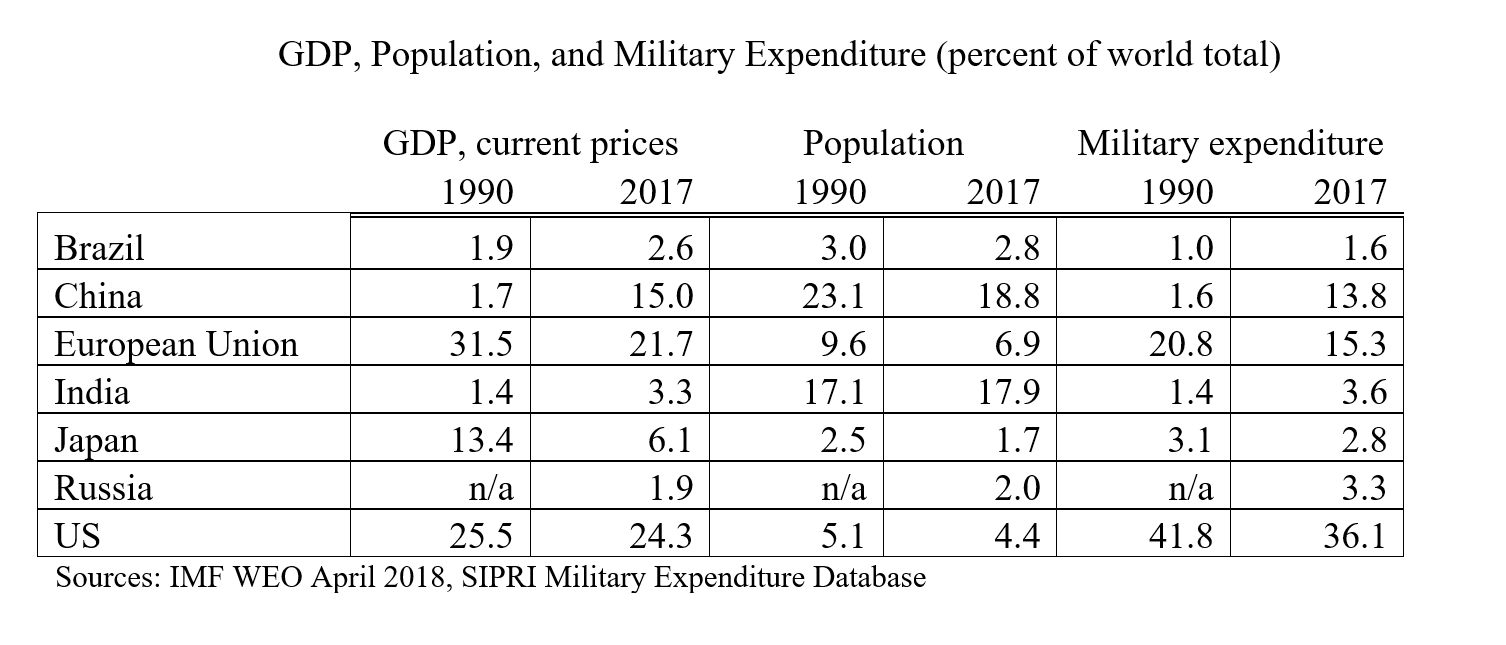
Three metrics of countries’ international weight stand out: the size of the population; the size of the economy, measured by GDP at market prices (GDP in purchasing power parity terms is more useful for measuring welfare); and military might, measured imperfectly by defense expenditure. If we consider all three metrics to be equally or similarly important, the world’s most “important” powers would seem to be the US, China, the European Union, Japan, India, Russia, and Brazil.

Of course, there are many questions, beginning with whether the EU – which negotiates trade arrangements as one entity, but comprises members with sovereignty in many areas – should be regarded as a unified actor in global affairs. Moreover, it is certainly not clear that the three metrics should, in fact, be regarded as equally important.

In any case, these three metrics represent a useful starting point for comparing the configuration of global weights in 1990, when the so-called unipolar order was emerging, and 2017, when the contours of a multipolar order should be visible.

These figures highlight, first and foremost, the rise of China, whose shares of both GDP and military expenditure have increased considerably (from 1.7% to 15% and from 1.6% to 13.8%, respectively). India has also increased its share in both areas, but from a much smaller base (from 1.4% to 3.3%, and from 1.4% to 3.6%, respectively). No other power has achieved a similar increase in “size.” The US has lost a little in terms of both GDP and population but remains the biggest power by far when military might is taken into account. With a (declining) population and GDP of just 2% of the world totals, Russia is very “small,” although its possession of nuclear weapons is a factor that must be taken into account.

Judging by these metrics, the world is entering the next decade in a kind of bipolar state, strongly dominated by the US and China. If the EU is treated as a single power – including by its own members (say, by pursuing common policies) – it could represent a third pole. India, whose GDP is now growing at nearly 8% annually, could eventually comprise a fourth, but it has some way to go.

An international order that rests on three and a half legs does not quite live up to the multipolar hype. This holds important implications for efforts to . In particular, because the world is not quite multipolar, it is not structurally as conducive to a multipolar multilateralism as many have assumed. To survive, multilateralism will need the support of the big players.

Many have been hoping that China would put its weight behind a multilateral world order, but China’s leaders seem prepared to use multilateral structures only when it suits them. The EU, for its part, clearly has a strong multilateral bent, but it is weakened by internal divisions. If it were to overcome them, it could be the champion of multilateralism we need; for now, however, it is too divided. India could become an important advocate of multilateralism, but it is currently pursuing unilateral policies and still lacks the requisite international influence.

This leaves the US, still, as the lynchpin of global cooperation. Coalitions can be built to address particular issues or on a regional basis; but preserving – let alone deepening – the existing system of global governance will be impossible without US support.

At a time when the US is increasingly resisting and even actively undermining international cooperation, this is a source of serious concern. After all, as Robert Kagan recently pointed out, in today’s deeply interconnected world, we need rules and institutions to govern markets and economic activity more than ever. This will only become more obvious as new technologies like artificial intelligence and genetic engineering pose political and ethical issues that must be addressed on an international level.

Of course, the US is far from united in its opposition to multilateralism, and the country has so much to gain from openness and cooperation that it may embrace its previous role again within a few years. In the meantime, however, it is essential for other actors to continue to use and encourage multilateralism at every opportunity. Limited sectoral or geographical cooperation can be achieved and should be promoted whenever possible.

More broadly, the larger ideological battle for a rules-based international system must be fought using a strong dose of global civics as an antidote to neo-nationalism. The tactical defeats currently suffered can be reversed if the ideological battle is won. Given the need for inclusive cooperation, adapting and strengthening a rules-based and ethical global governance system is crucial to securing long-term peace and progress. Given America’s continuing “size,” it is critical for the world as a whole that the US is fully engaged and again becomes a global-governance leader for the digital age.

François Arago, un homme divers

Publié le 20 juillet 2018

Le cycle « Histoire et philosophie des sciences » propose un éclairage sur des figures de grands savants membres de l’Académie des Sciences ou revient sur de grandes découvertes scientifiques avec un angle sociétal et éthique

Cette séance a été organisée avec l’Académie des sciences morales et politiques, sous la présidence de Pascale Cossart, Secrétaire perpétuel de l’Académie des sciences, et Pierre Léna, membre de l’Académie des sciences.

Voir la vidéo de la conférence.

Le nom d’Arago n’évoque au plus grand nombre qu’un boulevard. Et pourtant, son impact sur le XIXe siècle fut décisif. Tout d’abord, comme scientifique. Jeune, Arago transforme l’astronomie. Puis, plus âgé, comme passeur tout comme patron de science, Arago enthousiasme un large public pour cette science et rénove l’Académie des sciences. Enfin, comme homme politique, à l’âge mûr, il signe l’abolition de l’esclavage en France et dans les colonies. Comment s’articulent les moments si divers de cette existence ? Quelles traces ont-ils laissées dans l’histoire? Telles sont les questions auxquelles ce « 5 à 7 d’histoire et philosophie des sciences » cherchera à répondre.

Les défis de la construction européenne à moyen et long termes

Publié le 23 juillet 2018

Intervention de Thierry de Montbrial aux Ateliers Maurice Allais.

La réponse de l’Europe à ses nouveaux défis nécessite de concevoir le présent comme le choc du passé et du futur. Une vision de long terme solide et convaincante est au prix de cet effort de conception. Les recommandations que l’on peut en tirer résident autant dans l’apprentissage des modes de coopérations que dans la création d’un nouveau type d’unité au sein d’une Europe renforcée. Dans la période de mondialisation que nous connaissons, l’idée européenne ne trouvera de solutions qu’à travers le retour d’une légitimité de ses structures de gouvernance.

« L’Union européenne est une construction originale, davantage par la voie qu’elle suit que par son but. La paix du monde dans les décennies qui viennent dépend en grande partie de son développement. Car elle a une capacité de rayonnement économique et culturel sans affirmation de puissance au sens le plus classique du terme. Donc il faut choyer cette Union européenne, la réformer, la renforcer. Et alors, elle pourra exercer un leadership dans la gouvernance mondiale. »

Voir la vidéo.

Jean-Paul Agon

Diplômé d’HEC, Jean-Paul Agon rejoint le Groupe L’Oréal en 1978 où il effectue l’ensemble de sa carrière. Il dirige successivement plusieurs de ses marques, pays et zones géographiques. Il crée notamment en 1997 la zone Asie-Pacifique, devenue depuis la 1ère région du Groupe, puis prend la tête de l’Amérique du Nord à partir de 2001. Il devient Directeur général de L’Oréal en 2006, puis Président-directeur général de 2011 à 2021. En 15 ans, Jean-Paul Agon adapte l’entreprise en menant de profondes transformations stratégiques, en particulier la révolution digitale et du e-commerce et celle de la responsabilité et de la durabilité. Avec une double ambition : allier performance économique et exemplarité en matière environnementale, sociale, éthique et sociétale. L’Ethics Resource Center lui a décerné le « Pace Leadership in Ethics Award » pour les réalisations de L’Oréal dans le domaine de l’éthique des affaires, de la diversité, de la transparence financière et du développement durable. Il est administrateur d’Air Liquide, co-Président du Comité France-Chine, membre de l’European Round Table of Industrialists et administrateur de l’Institut français des relations internationales (Ifri). Il est Officier de la Légion d’honneur. 

Ashoka Mody

Professeur associé Charles and Marie Robertson en Politique économique internationale à la Woodrow Wilson School, Université de Princeton. Il est l’auteur de l’ouvrage EuroTragedy: A Drama in Nine Acts. Précédemment, il a été directeur adjoint au département de la recherche et au département européen du Fonds Monétaire International. Il a travaillé à la Banque mondiale, au laboratoire AT&T’s Bell et au Centre for Development Studies de Trivandrum. Il a été professeur associé à la Wharton School de l’Université de Pennsylvanie et est chercheur associé au Centre des études financières de Francfort. Il détient un doctorat en économie de l’Université de Boston.

Daniel Keller

Président de « Servir en Entreprise » depuis Septembre 2024, la communauté des alumni de l’ENA dans le secteur des entreprises et précédemment président de Servir (anciennement Association des anciens élèves de l’ENA) de 2017 à 2023, ancien membre du Conseil économique, social et environnemental en tant que personne qualifiée (2015-2021), Daniel Keller est directeur chargé des missions transverses à la direction de la Retraite complémentaire et de l’Action sociale de Malakoff-Humanis. Ancien élève de l’École normale supérieure de Fontenay-Saint-Cloud, agrégé de Lettres modernes et ancien élève de l’École nationale d’administration, il a commencé sa carrière au ministère de l’Économie et des Finances en tant qu’administrateur civil à la direction générale des Impôts puis au service de la Législation fiscale. Il a rejoint le Groupe Renault où il a occupé diverses responsabilités à la direction commerciale, dans le réseau de distribution, en France et en Europe, ainsi que dans les fonctions centrales, en tant que directeur de la Qualité Commerciale Monde pour le groupe. Il a dirigé un groupe de concessions automobiles Renault-Dacia en région parisienne. Président du Grand Orient de France de 2013 à 2016, il a ensuite été directeur de la Transformation et du Digital chez Humanis, chargé de l’organisation, de la conduite de projets et de l’efficacité opérationnelle de 2016 à 2019, puis directeur support des métiers de la retraite complémentaire de 2019 à 2022.

Amadou Gon Coulibaly

Premier ministre, ministre du Budget et du Portefeuille de l’État, chef du gouvernement de la République de Côte d’Ivoire. Précédemment secrétaire général de la présidence de la République. ministre d’État, ministre de l’Agriculture (2003-2005), puis ministre de l’Agriculture (2006-2010). directeur des études économiques et financières à la direction du contrôle des grands travaux (DCGTX) et directeur général adjoint (1994-1995). Maire de la commune de Korhogo de 2001 à 2018. En janvier 2019, il a été nommé président du directoire du Rassemblement des Houphouëtistes pour la démocratie et la paix (RHDP).

Devant Poutine, Donald Trump ne croit pas à l’interférence de la Russie

Publié le 16 juillet 2018

Virginie Robert, Les Echos

Le président américain a scandalisé l’opinion américaine en affirmant lundi, à côté du leader russe, qu’il n’y avait eu aucune collusion pendant la dernière campagne électorale.

« Il n’y a aucune collusion » : Donald Trump a été prompt à affirmer, lundi à Helsinki, qu’il ne croyait pas à l’ingérence des services de renseignements russe dans la campagne de 2016. « Nous avons fait une campagne [électorale] remarquable et c’est la raison pour laquelle je suis président », a-t-il ajouté.

A côté d’un Vladimir Poutine qui n’en demandait pas tant, il a assuré que « l’enquête était un désastre pour les Etats-Unis » et qu’elle ruinait un dialogue entre les deux pays qui aurait dû être repris depuis longtemps. Le président russe, qui a nié toute ingérence, a de son côté offert d’inviter les enquêteurs de l’équipe de Robert Mueller, l’ex-patron du FBI et procureur spécial, en Russie, à condition que les autorités russes puissent interroger des proches d’un donateur de Hillary Clinton, le financier Bill Browder.


L’entretien entre les deux chefs d’Etat aura duré plus de deux heures, avec l’aide de seulement deux interprètes, et s’est poursuivi par un déjeuner de travail avec leurs équipes. Avant même son entrevue avec Vladimir Poutine, le président américain a beaucoup choqué en attribuant aux Etats-Unis l’état de la mauvaise relation du pays avec la Russie. « Nous sommes d’accord », a d’ailleurs répondu le ministre des affaires étrangères russe, Sergueï Lavrov.


Le tweet a été d’autant moins apprécié que « la chasse aux sorcières » évoquée a eu pour conséquence  la mise en examen d’une douzaine d’agents russes.

Privilégier la relation personnelle

Très impatient avec ses alliés de l’Otan, difficile avec la chancelière Angela Merkel comme avec la Première ministre britannique Theresa May,  considérant Européens, Chinois et Russes comme des « ennemis » pour certains aspects, Donald Trump a voulu privilégier la relation personnelle avec son homologue russe. Plutôt qu’un adversaire, il voit « un compétiteur », avec lequel il a mené un premier round de « négociations » via « un dialogue profondément productif ». Rappelant qu’à eux deux ils représentent 90 % de la capacité nucléaire dans le monde, il a assuré que les deux Etats voudraient travailler ensemble pour améliorer, avec l’aide d’Israël, la situation en Syrie, stopper la prolifération nucléaire, lutter contre le terrorisme islamiste et ranimer les liens d’affaires entre Moscou et Washington. Le contrôle des armes, l’Ukraine et l’Iran ont également été mentionnés dans les conversations des deux dirigeants.

Indignation

Donald Trump a proposé la création d’un forum d’experts (politologues, militaires) pour améliorer la relation entre les deux Etats. Vladimir Poutine a également proposé de coopérer dans le domaine de l’énergie. « Nous pourrions travailler de manière constructive pour réguler les marchés internationaux, car nous ne sommes pas intéressés par une baisse extrême des prix ».

En montrant plus de connivences avec le président russe qu’avec n’importe quel allié de l’Amérique, Donald Trump n’a pas manqué de susciter une pluie de critiques, y compris dans son propre camp. Le sénateur Républicain John McCain a notamment vu la conférence de presse commune des deux présidents comme l’« un des pires moments de l’histoire de la présidence américaine ».

Virginie Robert

An ideological exercise in Spain

17 july 2018

Prince Michael of Liechtenstein, GIS

Pedro Sanchez, who twice led Spain’s Socialist Party, the PSOE, to crushing electoral defeats, engineered a parliamentary coup last month that ousted the government of Mariano Rajoy by a tiny margin and succeeded in installing his own minority cabinet.

Mr. Sanchez was helped by two factors. First were the corruption allegations against members of Mr. Rajoy’s People’s Party (PP), and second was backing from the radical, broadly Marxist Podemos party, along with far-left Catalonian separatists. Since the Socialists have only 84 seats in the 350-seat Congress of Deputies, or lower house of parliament, Mr. Sanchez’s government can only function awith the support of these two allies.

Spain’s economic situation improved strongly over the last few years of Mr. Rajoy’s premiership (2011-2018), but voters were unhappy with the political establishment, and incidents of corruption were unfortunately real.

Mr. Sanchez, by contrast, is a far-left socialist, and will now have to consolidate his fragile position by catering to the Marxist ideology of Podemos on one side and the radicalism of Catalan nationalists on the other.

At the same time, the new prime minister is cultivating Brussels with pro-European rhetoric, creating the expectation of drastic improvements in Spain. Mr. Sanchez aspires to play a much stronger European role than his predecessors. He has received recognition on the European Union level by comforting language and a vow to continue Mr. Rajoy’s fiscal consolidation strategy.

Power grab

Nevertheless, a closer look at Mr. Sanchez’s actions shows a disturbing push to consolidate power – both for ideological reasons, and also to satisfy the desires of his Marxist-leaning and separatist allies.

Showing his radical anti-Christian position, the prime minister refused – for the first time in Spanish history – to take the oath of office with a bible or a cross. Even for an atheist, this was an unnecessary demonstration, striking an ideological rather than a simply secular attitude.

Another of his first acts was to replace the head of RTVE, Spain’s public broadcaster, with a personality agreeable to Podemos. This will pave the way for news coverage of the government with a strong pro-left slant. One of Mr. Sanchez’s close associates was also installed at the Centro de Investigaciones Sociologicas (CIS), an influential state-owned institute for public opinion polling.

Optimism about Mr. Sanchez should not blind European observers to clear signs of an internal power grab


These are clear signs of a strong internal power grab from the left, and certainly not proof of a healthy democratic self-confidence about the government’s intended policies. Optimism about Mr. Sanchez’s “pro-EU” declarations should not blind European observers to these disquieting developments.

As indicated by his recent meeting with Catalan leader Quim Torra, Prime Minister Sanchez will also be forced to court the separatist movements in Catalonia with an opportunistic policy, as he needs their support.

Polarizing force

Pedro Sanchez appears to believe that his youthful vocation to change and lead is irresistible. Youthful elan is certainly good, but it is likely to fail when hitched to an outdated socialist belief in the efficacy of government planning and intervention.

Both in terms of reviving the economy and improving social cohesion, experience has shown that these methods do not work – except sometimes as short-term fixes that bring adverse unintended consequences in the long run.

Certainly Spain – like many other European countries – needs action and reform. Pragmatic leadership and charisma are valuable, but do not express themselves in ideological demonstrations. A mix of ideology, power grabbing, opportunistic policies and activism could prove to be a dangerous cocktail for Spain.

On the European level, the new government could have a similarly detrimental effect. It may give French President Emmanuel Macron an energetic new ally to push his agenda for a more centralized EU. But that might only further alienate other member countries, especially Germany – polarizing rather than integrating an already battered Union.


Tendons la main à Theresa May !

Publié le 17 juillet 2018

Renaud Girard, Le Figaro

Le vote référendaire du 23 juin 2016, où le peuple britannique a décidé de quitter l’Union européenne (UE) a créé beaucoup de confusion et de colère de part et d’autre de la Manche. Maintenant que les émotions sont retombées et que les Européens ont découvert que la stratégie de leur allié américain pouvait être encore plus erratique que celle de leur allié britannique, le moment est venu pour la France de réfléchir calmement au futur de ses relations avec la Grande-Bretagne, sans laisser les technocrates de la Commission européenne gérer seuls ce dossier politique important.
L’été est propice à la réflexion, puis à la négociation, puisque tous les éléments sont désormais en place. Le 12 juillet 2018, après deux ans d’atermoiements, le gouvernement britannique de Theresa May a enfin publié un livre blanc, contenant ses propositions pour le futur des relations entre le Royaume-Uni et l’UE. En désaccord avec ce texte qui fait des concessions à Bruxelles, ses ministres les plus eurosceptiques, Boris Johnson et David Davis, ont démissionné. Le nouveau cabinet May souhaiterait qu’un accord soit trouvé avec le Conseil européen dès le mois d’octobre 2018, afin de laisser du temps pour les ratifications parlementaires, avant l’entrée en vigueur du Brexit, prévu pour mars 2019.
Il est évident que le Royaume-Uni devra payer à l’UE le montant de toutes les dépenses auxquelles il s’était engagé comme membre de l’Union (cela fait un total de l’ordre de 40 milliards d’euros). Il est évident que la City ne pourra plus jouer le même rôle dans les affaires financières européennes et qu’elle perdra le privilège, unique au monde, de tenir des comptes en euros. Aujourd’hui, les banques britanniques n’ont pas l’obligation d’avoir « un compte de correspondant » en euros dans une banque de la zone, elles peuvent ouvrir directement un compte en euros auprès de la Banque centrale européenne de Francfort.
Mais les Français ne sauraient souscrire à une intransigeance excessive de la Commission face au Royaume-Uni, au risque de se pénaliser eux-mêmes. Les traités de l’UE ont créé quatre libertés de circulation : pour les biens, pour les personnes, pour les services, pour les capitaux. Le gouvernement de Sa Majesté souhaiterait ne pas toucher à la première mais reprendre sa souveraineté sur les trois autres. Theresa May a compris l’importance de ne pas entraver les échanges industriels (majeurs, par exemple, pour Airbus, qui produit en Angleterre la voilure de ses avions, et qui y achète beaucoup de ses moteurs).
La Commission ne veut pas laisser le client britannique choisir à la carte, elle veut lui imposer soit le menu gastronomique, soit le menu diététique, mais rien entre les deux. Elle a peur du mauvais exemple que cela créerait envers d’autres membres de l’UE. Cette peur est excessive : le cas anglais est très particulier ; aucun autre membre ne songe sérieusement à partir.
La France a un excédent commercial de 6 milliards d’euros avec le Royaume-Uni. Elle n’a donc aucun intérêt à un changement des règles de commerce sur les biens avec lui. Dans le cas de figure où l’on accepterait la proposition de Theresa May, les Britanniques devraient bien sûr appliquer toutes les normes (de qualité, de santé, etc.) décidées par l’UE, sans pouvoir participer à leur élaboration. Si le maintien de la liberté de circulation des biens avec le Royaume-Uni ne coûte rien à l’Union européenne, pourquoi ne pas la maintenir ? Il est évident que tous les coûts administratifs de gestion de cette situation particulière devraient être pris en charge par les Britanniques.
En matière de sécurité, la coopération directe entre les polices devrait être maintenue. La Commission préconise le transfert des données par le biais d’officiers de liaison au sein d’Europol. C’est un détour superflu. La coopération franco-britannique directe en matière de lutte contre la criminalité organisée et contre le terrorisme fonctionne bien. Laissons-la en état. On ne change pas une équipe qui gagne. Tant pis si les fonctionnaires de la Commission n’y retrouvent pas le schéma logique auxquels ils aspirent. Ces technocrates prétendent aujourd’hui exclure la Grande-Bretagne du système satellitaire Galileo, qui donne à l’Europe une indépendance indispensable en matière d’accès au GPS. Considèrent-ils les Britanniques comme des alliés moins sûrs que les Maltais ou les Chypriotes ?
Soyons clair. La relation des Britanniques avec la construction européenne a été du grand n’importe quoi. Un jour, ils refusent d’y participer ; le lendemain, ils nous supplient d’intégrer le Marché commun ; le surlendemain, ils veulent en changer les règles, etc., etc.
Le général de Gaulle l’avait compris avant tout le monde, qui avait expliqué dans une Conférence de presse prophétique de 1963 que la Grande-Bretagne ne se sentirait jamais à l’aise dans ce club (conçu pour être à terme un contrepoids amical à la puissance américaine). Cédant à la pression des Hollandais, le président Pompidou a commis l’erreur stratégique de la faire entrer.
Mais ce qui est fait, est fait. Est-ce une raison pour punir la Grande-Bretagne ? Bien sûr que non. Nous, Français, devons accepter son caractère parfois fantasque et maintenir des liens d’excellence avec elle. Car nous devons prendre en compte des enjeux beaucoup plus importants. Historiquement, c’est une alliée depuis plus d’un siècle. C’est à elle que nous devons notre siège permanent au Conseil de sécurité des Nations Unies. C’est une démocratie parlementaire qui fonctionne admirablement (sauf quand elle commet l’erreur de recourir à l’instrument latin du référendum…). Militairement, c’est notre seul partenaire efficace sur le continent européen (où aucun autre pays, à part la France, n’a démontré un tel « fighting spirit »). Culturellement, beaucoup d’Anglais gardent une passion pour la civilisation des Français et réciproquement.
Punir les Britanniques serait nous punir nous-mêmes. Il nous faut au contraire aider Theresa May, actuellement en difficulté. Car elle a offert la pire des solutions, à l’exception de toutes les autres, pour paraphraser le mot célèbre de Churchill sur la démocratie…


Mustapha Bakkoury

Président de Masen. Avec le déploiement du Plan Noor, Masen est maintenant une référence sur l’échiquier régional et international des énergies renouvelables. Avant de rejoindre Masen, il était à la tête de l’une des principales institutions du Maroc, la Caisse de Dépôt et de Gestion. Il a occupé de hautes fonctions dans le domaine bancaire, notamment au sein du groupe BNP Paribas. Il a été en charge du développement et du financement des activités de la Société Nationale d’Aménagement Communal (SONADAC). Il est diplômé de l’Ecole Nationale des Ponts et Chaussées de Paris et a complété sa formation par un DESS en Banque et Finances dans une des plus grandes universités françaises. Il est par ailleurs Président de la région Casablanca-Settat.

Sebastiaan Debrouwere

Sebastiaan est investisseur en capital-risque chez Balderton Capital, l’un des principaux investisseurs européens dans les start-ups en phase de démarrage. Avant cela, il a été l’un des premiers employés de la startup européenne de micro-mobilité Circ, où il a mis en place la chaîne d’approvisionnement mondiale et contribué à son acquisition par le pionnier du secteur, Bird. Il a commencé sa carrière chez McKinsey & Co. en travaillant principalement sur la stratégie de croissance et la restructuration. Sebastiaan est diplômé du King’s College de Londres et de la Vlerick Business School. Pendant ses études, Sebastiaan a été président de l’Union des étudiants du King’s College de Londres (2013-15) et président de King’s College London Think Tank, un groupe d’activisme à but non lucratif (2012-2013).

Miguel Angel Moratinos s’exprime sur la régionalisation avancée

11 juillet 2018

M.Miguel Angel Moratinos, ancien ministre espagnol des Affaires étrangères s’exprime au micro de «Matin TV» sur la troisième édition du Morocco Today Forum (MTF) prévu pour le 20 juillet prochain à Casablanca. Pour lui, le thème de la régionalisation avancée retenu pour cette année est de plein actualité.

Why Does Pakistan Have Repeated Macroeconomic Crises?

July 3, 2018

Masood Ahmed, CGD

This note is adapted from a chapter that Masood Ahmed contributed to Pakistan at Seventy: A Handbook on Developments in Economics, Politics and Society (Europa Publications, forthcoming).

A brief history of Pakistan’s macroeconomic management

Over the past 50 years, Pakistan’s record on macroeconomic management has been mixed. In the face of a variety of internal and external shocks, the country has managed to avoid excessive macroeconomic instability in the form of hyperinflation or severe exchange rate volatility. While its internal and external public debt has grown as a share of gross domestic product (GDP), and is now approaching levels that warrant attention, Pakistan has so far managed this growth without resorting to sovereign defaults, which leave a long shadow on a country’s ability to access capital markets. Finally, Pakistan has also avoided the kind of large-scale banking crises that many other developing countries have experienced with lasting impact on credit availability and private sector development.

Alongside these positive features, however, Pakistan has demonstrated an almost unique proclivity to allow fiscal and balance of payments pressures to build up into a near-crisis situation every few years, which then must be dealt with through orthodox economic stabilization tools, often with the help of the International Monetary Fund (IMF). In general, these stresses have been contained before they could become a full-blown economic crisis, but the cumulative cost of these periodic crisis-aversion programs has been to slow down economic and social development, resulting in the mediocre—and in some cases, poor—comparative development indicators that we see today. And, because each episode was addressed with short-term actions that stabilized the economy without adequate follow-through on structural reforms, the underlying weaknesses simply manifested themselves again with the next external shock or period of internal economic mismanagement. Moreover, this preoccupation with managing short-term macroeconomic vulnerabilities has limited the attention that top policymakers can devote to more fundamental issues of economic development and structural transformation.

The next crisis is now approaching. After successfully containing macroeconomic imbalances under an IMF-supported program during 2013–16, irresponsible fiscal expansion and a misguided attempt to maintain an increasingly overvalued exchange rate have led to a large and unsustainable balance of payments imbalance, a steep decline in foreign exchange reserves, and a sharp buildup of external debt, some of it on short maturities and expensive terms. Most economists agree that the post-election government will have no alternative but to approach the IMF yet again for another bailout with associated policy conditionality.

Against this background, this note examines three questions that economists both within and outside Pakistan are asking:

  1. Why does Pakistan have these repeated episodes of macroeconomic distress?
  2. Why have 18 IMF-supported programs failed to deal with this problem in a sustainable way?
  3. Is the potential availability of IMF financing itself an impediment to the policy changes that would reduce the economy’s vulnerability to crisis, and would it be better if the IMF did not provide support to Pakistan the next time there was a macro-crisis?

The causes of repeated macroeconomic distress

The principal factors leading to periodic episodes of macroeconomic stress are chronic and uncorrected structural weaknesses in Pakistan’s economy. While—as in most developing countries—there are many areas of economic management that can be improved in Pakistan, the two principal causes of macroeconomic problems have been the imbalance between public sector spending and income, and Pakistan’s underdeveloped export base, which makes the country highly vulnerable on the external sector.

Income and expenditure of the public sector

There has been a chronic imbalance between the income and expenditure of the public sector. This is not because Pakistan’s public budget is much larger, in relative terms, than that of other emerging markets. Rather, it is because the government’s income from taxes, fees, and other sources is strikingly low compared with other countries.

This is not to say that there is no waste in public spending, or that it could not be better allocated. There are well-documented studies that show how both current and capital spending by the federal and provincial governments and their associated bodies could be dramatically improved to get “more bang for the buck.” Similarly, the persistent losses made by some public sector enterprises,[1] and the even larger losses made in the energy sector,[2] provide additional scope for improving public finances. The case is all the more compelling given the comparatively low level of public spending on health and education, which explains, at least in part, why Pakistan lags woefully behind on social indicators of development. Finally, inadequate public investment in infrastructure constrains the potential for sustained high growth. There is, therefore, a clear need to rationalize and improve the effectiveness of public expenditure.

However, it is on the revenue side that Pakistan is among the weakest performing countries in the developing world. Despite 40 years of efforts to improve both tax policy and tax administration, the ratio of taxes to GDP remains stuck in the low teens, below the middle-income countries (MICs) average of around 18.5 percent.[3] In addition, the tax system is complicated, distorting, and not sufficiently progressive.

Two features of the tax structure are worth noting in particular: the high proportion of taxes collected through indirect taxes (60 percent of total tax revenue) and the small number of individuals who file income tax returns. Indirect taxes—essentially excise taxes, import duties, and fees of various sorts—are generally more regressive than direct taxes; in other words, their burden falls disproportionately on the poor and less well-off households. A further problem is that the second-best system of withholding and presumptive taxes has grown very complex, adding to the negative perceptions of the overall tax system. Attempts to introduce a VAT, a more efficient indirect tax, have failed in the face of political opposition.

The low number of income tax filers (just over one million out of an estimated working population of 116 million[4]), and the prevalent underreporting of income by those who do file, has important consequences. First, it limits total tax revenue for the government. Indeed, it is hard to envisage how the tax to GDP ratio could be increased by 50 percent (to reach the norm for developing countries) without a substantial increase in the number of filers in the tax net.

Second, tax avoidance or under payment undermines public confidence in the fairness of the tax system. The perception (and reality) that people who are known to have very high incomes pay little or no income tax fosters a sense that the system is rigged to protect the rich and powerful. The annual publication of tax payments by parliamentarians, demonstrating in many cases a clear disconnect between their declared tax payments and their visible standard of living, has been a great advance in transparency, but, so far, it has not altered the underlying pattern of behavior.

Those who claim to derive their income from agriculture (on which no income taxes are paid), and those engaged in trading or professional services who are either unregistered as taxpayers or pay small amounts in relation to their perceived incomes, are also often viewed as benefiting from an inequitable system. Property is mostly undervalued for tax purposes, so the revenue from this potentially important source is also very low by international comparison.

Tax avoidance is also found in the corporate sector. Of the 72,500 firms registered with the Security and Exchange Commission of Pakistan in 2016, less than half filed a tax return and half of the filers had a “zero return.”[5]

Many studies have considered the problems of tax policy and tax administration. On the policy side, the recommendations range from proposals to address specific anomalies or missed opportunities all the way to plans for a complete revamp, with a new simplified and efficient approach to setting up a tax system. Similarly, there are incremental as well as radical proposals to reform tax administration, which is generally seen as inefficient and plagued by corruption. There have also been a variety of projects over the years, many supported by international agencies with technical assistance and policy conditionality, to promote these recommendations.

Why have past programs failed to generate a substantial and lasting improvement in Pakistan’s tax outcomes? Many blame corruption and incompetence in the tax administration, and this is certainly part of the explanation. Others point to the large share of the informal sector in Pakistan’s economy, which makes it harder to track individual and small business incomes. Yet others will point to the fact that a large share of the working population would fall below any reasonable income threshold for paying taxes. Finally, there is the problem of lack of trust in the quality and integrity of government spending. Many observers point to the generous levels of private charity by people who pay little in taxes as demonstrating that people are willing to contribute to the larger social good if they are confident that the money will be put to good use. These observers maintain that lower levels of tax avoidance would naturally follow a demonstrated improvement in the coherence and effectiveness of government spending. All these points have some truth to them, but they also apply to other countries that have, nevertheless, succeeded in enrolling much larger numbers of their working population into the tax net.

The larger and more important explanation for Pakistan’s failure to improve its tax outcomes, in my view, is one of political economy. Pakistan simply lacks a powerful enough coalition of interests to raise more taxes and to push for real improvements in the quality of government spending. Normally, this would come from a combination of those in government who want to spend money without raising the deficit and private taxpayers who are increasingly resentful of the high tax rates they pay while their peers remain outside the tax net. While both groups exist in the country, they have not been able to come together and overcome the powerful interests on the other side.

In particular, governments have often backtracked on their efforts to widen the tax net when faced with opposition from their political constituencies or linked interests. As a result, in times of fiscal stress, it has proved easier to cut back on the already low level of public investment spending, with damaging—but lagged—consequences. Many donor agencies and international partners—including the World Bank, the IMF, and bilateral aid agencies—have tried to influence this process through a combination of carrots and sticks, but they too have not succeeded.

Until Pakistan can substantially raise tax revenue by broadening the base of direct taxpayers, it will remain constrained in its ability to expand the delivery of much-needed public services and infrastructure without building up unsustainable fiscal deficits. And without that extra infrastructure and improved human development, growth will remain elusive and the country’s place in an ever more competitive world economy will remain fragile. What events or forces will bring about the political consensus to overcome longstanding constraints in this regard remains a subject of discussion.

The external sector

The second source of macroeconomic vulnerability for Pakistan has been its external sector. Most successful emerging markets followed a strategy of promoting both the quantity and quality of their exports. Starting from low export levels comprised mainly of relatively unprocessed commodities or low value-added manufactures, these countries have dramatically expanded the volume, diversity, and sophistication of their exports. The most-often cited examples are China and the so-called East Asian tigers (Korea, Thailand, Vietnam, Malaysia), but countries in other regions also provide good case studies.

In contrast, exports have remained a much smaller share of Pakistan’s economy since independence. And over the past three years, a combination of factors—security and energy supply problems, lower commodity prices, and an appreciating real exchange rate—have brought exports down to well below 10 percent of GDP. As shown in table 1, exports from Pakistan would have to more than triple from their current level to match the average for MICs. Pakistan’s exports have also been remarkably concentrated in a few low value-added products. Cotton and cotton products, rice, and leather still account for over 70 percent of the country’s exports, and the bulk of exports in each of these categories is in primary or little processed form. Service exports, which have been a rapidly growing source of high value-added export revenue in many countries, remain a small fraction of Pakistan’s exports.

Table 1. Exports of goods in 2017

Country or Group USD billion % of GDP
Pakistan 23.1 7.62
Turkey 166.1 19.56
Malaysia 188.0 59.76
Thailand 235.1 51.63
India 304.1 11.65
Bangladesh 35.30 13.51
Middle-Income Countries Average 76.65 24.47

Source: IMF Balance of Payments Statistics
Note: Data missing for numerous MICs. For a list of MICs, see footnote 3.

Given its low level of exports, Pakistan has relied in recent years on a large and growing volume of remittances and on official and private financing to cover its import bill. It is worth noting, however, that these international flows, especially private flows, can be volatile because they are subject to external and internal shocks. Pakistan has had a consistent rising trend of remittance flows for many years, but recent international economic developments suggest that this is unlikely to persist. Remittances from the Gulf countries, which have been a large and growing share of the total, are likely to plateau as these countries adjust their spending to the new lower price of oil. Pakistan will need to adjust to lower growth in remittances going forward.

In good years, these international inflows have been sufficient not only to meet the demands for foreign exchange—even with an appreciating real exchange rate—but also to lead to an increase in the country’s foreign exchange reserves. However, when there was an external shock—such as the increase in oil prices in the years leading up to 2014—or when an excessively loose fiscal stance or a misguided exchange rate policy translated into an increased demand for foreign exchange, as has been the case more recently, these reserves were drawn down, sometimes to a level that threatened a macroeconomic crisis and led to recourse to the IMF (figure 1). At the time of writing, after a few years of being on a positive trajectory, these reserves were again on a downward trend and hovering around $10 billion, below the three months of imports mark that is used by many institutions as a minimum for certain kinds of financial operations.

Figure 1. Liquid foreign exchange reserves with the State Bank of Pakistan

USD billion, end period
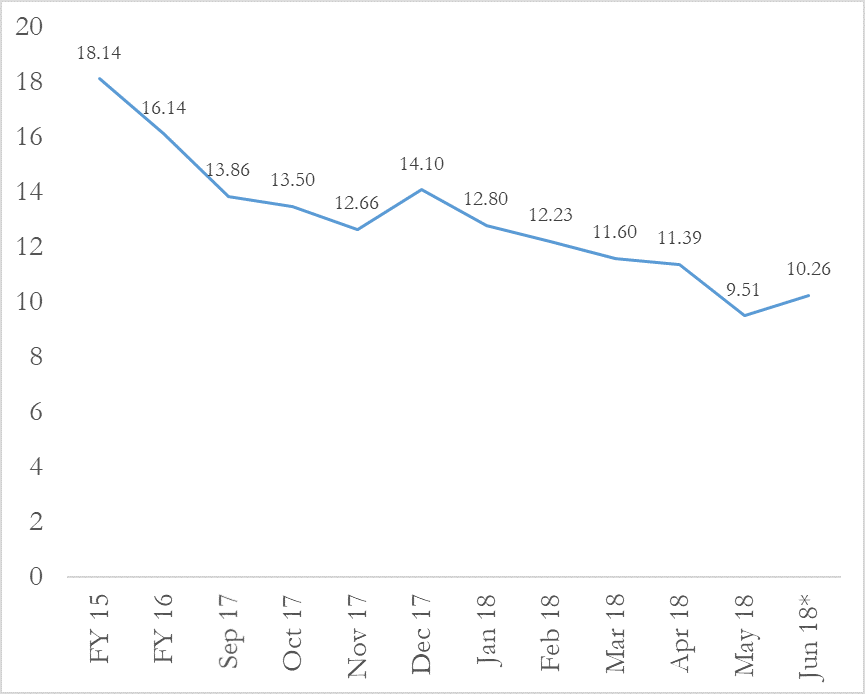
Chart of liquid foreign exchange reserves with the State Bank of Pakistan, FY15 to June 2018

Source: State Bank of Pakistan
*Second week of June

There are many factors that underpin Pakistan’s long-term export performance. Security problems, energy shortages, poor infrastructure, and other shortcomings in the business environment provide a good part of the explanation. Pakistan is 147th in the ranking of countries in the World Bank’s Doing Business report—an indication of its less-than-favorable business climate. A lack of investment in the export sector; or in updating technology and research and development that would raise the value added of exports; or in the educational system to generate enough trained technicians, workers, and managers are other reasons.

Also contributing to the small share of exports in Pakistan’s economy is the protected environment for the domestic market, which has made import substitution a profitable and less risky endeavor for many businesses. It is noteworthy that the largest corporations in Pakistan are either in manufacturing for the domestic market or in the service sector. A few rely on explicit or implicit protection in the form of import barriers or administered prices for inputs and outputs.

Finally, over the years a misguided adherence to an overvalued exchange rate has made it harder for Pakistani exporters to compete in international markets (while also resulting in the loss of a substantial share of foreign exchange reserves in an attempt to prevent necessary exchange rate depreciation). In contrast, some of the more successful emerging market exporters have seen the exchange rate as a tool to preserve their competitiveness and to build foreign exchange reserves to enhance their resilience and economic independence.

Behind these specific factors is the political economy of reforming the anti-export bias. Under the current regime, consumers have benefitted from cheaper imports and entrepreneurs have moved into producing for the domestic market with some degree of protection or in other non-tradeable activities. Exporters have voiced concerns about the exchange rate and other factors affecting their competitiveness, but they have sought government financial support rather than effectively lobbying for a more export-friendly regime.

Can Pakistan’s economy be made more export oriented? The entrepreneurial capacity and business acumen is certainly there. The performance of the small and medium enterprises sector in Sialkot is a striking example of success despite the weaknesses in the business environment and in infrastructure. However, to generalize this type of success requires a combination of public policy and supportive infrastructure investments. In this context, recent improvements in the security situation are welcome, as are investments to increase the capacity for electricity generation and—less so—distribution.

These efforts will need to be supplemented, however, by a much more fundamental revisiting of the public policy and business environment to better align incentives towards exporting. Exchange rate policy will need to prioritize economic fundamentals over seeing a “strong” exchange rate as a mark of national pride. Incremental schemes to provide limited subsidies or special incentives to exporters will only have a limited effect. If Pakistani policymakers truly want to quadruple the volume of exports, it will take nothing short of a national drive sustained over at least a decade. And it will require the political will to resist the calls of vested interests that gain from the current protectionism and anti-export bias.

Why have repeated IMF-supported reform programs failed to deal with the causes of macroeconomic vulnerability?

These two main structural weaknesses—fiscal imbalance and weak export performance—have been present for many decades, and their role in generating macroeconomic vulnerability is well understood. It is legitimate then to ask why they were not addressed under the numerous IMF-supported programs. Of course, the IMF is only one external agency engaged with Pakistan on economic policy questions. Still, the IMF’s focus on macroeconomic stability and its unique access to senior policymakers make the question more directly relevant to it. To be sure, many IMF-supported programs did attempt to address these structural issues, but, in the end, they were only partially successful. Why wasn’t a better and more sustainable improvement achieved despite repeated recourse to IMF financing and the associated policy conditionality?

The answer is that while IMF policy conditionality can reinforce what national governments are committed to doing, it cannot by itself achieve sustained policy change where there is no national commitment to the underlying reforms. Moreover, by its nature, IMF engagement is more effective at addressing short-term problems of macroeconomic instability and can play only a limited role in promoting longer-term actions to address underlying structural issues. In some countries, governments have used the presence (and conditionality) of the IMF to undertake difficult structural reforms, but these were reforms that the government wanted to carry out. Where the IMF has been less successful is in pushing reforms that the host country government itself does not support. In these cases, good intentions generally remained just that.

In Pakistan, as in many other countries needing IMF support, the decision to ask the IMF for help is typically deferred until a crisis appears imminent. At that point, both the authorities and the IMF staff agree that the immediate focus of the IMF program should be, first and foremost, on arresting the deterioration in macroeconomic imbalances and restoring macroeconomic stability. And in most instances, the programs have been quite successful in doing that. Fiscal and current account imbalances were contained, reserves started to be rebuilt, and confidence in the economy was strengthened, leading to a pick-up in domestic investment and external financing. In parallel to these stabilization measures, the authorities and the IMF staff also usually agreed on a set of plans to address the underlying structural weaknesses. On the fiscal side, this has often comprised targets for increased tax revenues backed up by plans to enhance tax administration or to bring more people into the tax net. This has sometimes been accompanied by plans to reduce losses in public enterprises through tariff policy, better management, or privatization. On the external front, the structural agenda has mainly focused on improvements to the business environment or tariff policy to encourage increased exports.

In the majority of cases, these reforms were not fully implemented, leading to Pakistan abandoning the IMF assistance program before completion. Although each episode and each program are unique, there is a common pattern. In most cases, the initial year of the programs went well, with the government taking the urgent fiscal, monetary, and exchange rate measures necessary to stabilize the economy and restore a degree of confidence. However, in the later years, when the programs moved to tackling some of the underlying structural weaknesses that gave rise to the macroeconomic stress, the government’s ability and political will to follow through waned and, as the crisis-related pressures were also abating at the time, the programs were left to wither.

Sometimes, the IMF continued to support the country when the macroeconomic aggregates—such as the reduction of the fiscal deficit or the buildup of reserves—continued to show the anticipated progress. In these situations, the IMF staff and board have generally adopted an accommodative posture and given the benefit of the doubt to the country authorities, with the IMF board approving continued program funding with “waivers of conditionality.”

Is the availability of IMF financing a disincentive for reform?

It is sometimes asked whether the availability of IMF financing is itself a disincentive to fundamental reforms. Since policymakers know that the IMF will be there with a “bailout” if they run into a macro crisis, the argument goes, there is less of an incentive for them to undertake difficult reforms that would be counter to the interests of powerful stakeholders. Economists refer to this as the “moral hazard” problem. This is a serious argument with a foundation in both economic theory and empirical evidence. The work of respected economists like Michael Bruno has shown that many instances of fundamental economic reforms have been triggered by a major crisis.

The question then becomes whether, given the history of past programs, the IMF should refuse to finance a new program when approached by Pakistan, in the hope that the ensuing crisis would trigger reforms that would obviate the need for subsequent support. This is theoretically a possibility, but it faces intellectual, moral, and practical difficulties that make it unlikely to happen.

Intellectually, it is true that deep crises can lead to deep reforms, but this is not inevitable in any given episode. Reforms are generated by a variety of factors and conditions, and each country context is different. It is equally possible that a deep crisis will simply result in a prolonged period of chaos and stagnation. On a moral plane, the cost of crisis is borne disproportionately by the poor and vulnerable. Millions would fall below the poverty line, and some would suffer permanent damage to welfare and living conditions. It is not evident that any policymaker or international institution has the right to willingly bring about a crisis with such severe consequences for the poor in the uncertain expectation that it will lead to a change in national behavior. On a purely practical level, the IMF was created to help its members facing an imminent financial and economic crisis, and it would not be realistic to expect its staff or board to refuse assistance to a member to teach it a lesson and change its behavior.

Another question is whether the design of IMF programs is flawed in promoting stabilization over growth or structural change. This is a complex topic on which much has been written both by the IMF and by independent observers. However, at the end of the day, the fundamental problem is that a country facing an imminent balance of payments or economic crisis must make (often painful) adjustments to reduce fiscal or external account imbalances. While the pace and scope of these adjustments can be moderated by the additional funding that comes from the IMF, some adjustment remains necessary. The relevant question becomes how to design the adjustment to minimize the negative impact on growth or on the welfare of the more vulnerable sections of society. This requires the engagement of a broader set of policymakers—at both the federal and provincial level—than has sometimes been charged with managing the discussions with the IMF on macroeconomic issues.

Can the future be different?

How can Pakistan break out of the cycle of near-crisis to stabilization, to partial but inadequate structural reform, to buildup of vulnerabilities leading to a new crisis? One suggestion is for Pakistan to embark on a process to develop and agree upon a national economic agenda. A striking feature of successful emerging market countries is that there is a broad consensus around a core economic agenda. Politicians of different parties, private sector leaders, opinion makers, and economic experts all agree on the general direction and content of the economic program. To be sure, there are differences of emphasis on specific policies or on timing, but much of the content enjoys broad support. This has two advantages: first, when the government in power is trying to undertake a difficult reform—privatization or labor market reforms—there will be debate on the method or the manner in which it is carried out, but not on the basic objectives. And second, this broad consensus provides domestic and international investors with a degree of certainty about the future business environment within which they can operate and make long-term investment decisions.

In Pakistan, there is a broad consensus on a national security agenda and on the direction of foreign policy, but when it comes to economics, such a consensus is lacking. The result is that the party in power manages the day-to-day affairs of the economy, and if a crisis is looming, takes steps to restore macroeconomic stability. But it finds it much harder to implement more fundamental reforms. There is no shortage of visions for the future, but there is a disconnect between these visions and the willingness or ability to take the actions required to make the vision a reality.

Pakistan needs a national discussion on what kind of economy it wants to be in 10 years, and then it must agree on the actions needed to get there. This is a broad topic, but even at a narrow macroeconomic level, Pakistan needs a realistic plan of actions that will generate the growth rates that are often set as aspirations rather than objectives. A non-exhaustive list of questions that a national discussion could seek consensus on includes:

  • What kind of macroeconomic policies would support Pakistan’s broader growth and distribution objectives?
  • What level of inequality is Pakistan comfortable with as a society and what actions is it willing to take to reduce inequality?
  • Do Pakistani policymakers want the government to have tax revenues that are close to the emerging market norm of 20 percent of GDP? If so, what would be the composition and structure of those taxes and what kind of revenue administration system would deliver that outcome?
  • What is the appropriate level and composition of public spending and how should it be divided between the federal and provincial administrations?
  • Where should defense spending be most effectively focused in the context of a tightly constrained overall resource envelope?
  • Does the country want to raise exports from under 10 percent of GDP to 25 percent of GDP?
  • If so, what actions are needed to change the incentive structure for exporting, and is there broad consensus to implement them?
  • Are policymakers willing to support indefinitely a set of loss-making public enterprises, both in the energy sector and outside? If not, can they agree upon a plan for their restructuring and privatization?
  • Does the government have a role in fixing administered prices for a variety of products, in effect protecting the producers from market forces? If so, which products and at what cost?

An often-voiced objection to developing a national economic consensus is that it has not happened in many decades and is unlikely to come about now. Perhaps. But it is also the case that attempting to make major structural reforms without such a consensus has failed so far, and there is enough underlying agreement across the political spectrum on core economic fundamentals that, with a degree of political leadership, forging such a consensus should be possible.

The immediate challenge for the next government will be to address a looming balance of payments crisis with a stabilization program that will inevitably impose short-term hardship and reduce growth. However, the more important agenda for Pakistan is to break through to a high-level equilibrium that would avoid the need for repeated stabilization through reforms that leverage the talent of its youth and the entrepreneurial skills of its private sector, and deliver the economic and social performance that its population demands and deserves.


[1] The cumulative losses of these enterprises stand at around 4 percent of GDP. (Source: IMF Staff Report, “Pakistan’s First Post-Program Monitoring Discussions,” IMF, 2018, www.imf.org/en/Publications/CR/Issues/2018/03/14/Pakistan-First-Post-Program-Monitoring-Discussions-Press-Release-Staff-Report-and-Statement-45724.)

[2] Electric power transmission and distribution losses stand at 17 percent of output. (Year 2014. Source: World Bank, https://data.worldbank.org/indicator/EG.ELC.LOSS.ZS?locations=PK.)

[3] For the year 2014. Source: IMF World Revenue Longitudinal Dataset. The list of middle-income countries can be found at the World Bank’s country income classifications webpage available at: https://datahelpdesk.worldbank.org/knowledgebase/articles/906519.

[4] Source: Serhan Cevik, “Unlocking Pakistan’s Revenue Potential,” IMF, August 2016, www.imf.org/external/pubs/ft/wp/2016/wp16182.pdf.

Amid the Trumpian Chaos, Europe Sees a Strategy: Divide and Conquer

July 13, 2018

Steven Erlanger, The New York Times

BRUSSELS — European allies knew to expect the unexpected from President Trump, especially after their rancorous encounter last month at the Group of 7 summit meeting in Canada.

But Mr. Trump’s European tour has still rattled many on the Continent and in Britain, who have watched from a distance the chaos he creates on a daily basis in the United States but had not been directly exposed to it until this week.

More important, for the long term, they have begun to believe that underneath the presidential narcissism, sarcasm and bluster there is a strategy: to undercut European solidarity in NATO and the European Union so the United States can exercise its economic and military power to shape relations with individual countries, just as China and Russia seek to do.

The atmospherics have been awful. Mr. Trump happily broke protocol at NATO and in Britain, skipping appointments with other leaders, forcing changes in the agenda, scolding other leaders, calling an early news conference to get onto morning television programs in America, making unfounded claims about agreements and giving an interview to the British mass-market tabloid The Sun that deeply embarrassed his host, Prime Minister Theresa May.

But Europeans are now convinced that Mr. Trump has an agenda that is inimical to their interests, said François Heisbourg, a French political analyst. “Europeans realize that he’s not just a temperamental child, but that he wants to dismantle the multilateral order created 70 years ago that he believes limits American power.”

European leaders had already taken into account the disrupter Trump, said Tomas Valasek, the director of Carnegie Europe, a foreign policy think tank. “We’re not in the dark about him, but we’ve never dealt with this sort of political animal before,” Mr. Valasek said. “This is a new ballgame and we’re learning how to play it. We’re not necessarily more effective, but we’re getting wiser.”

Different leaders have tried different strategies with Mr. Trump, from the “buddy-buddy” approach of President Emmanuel Macron of France and Ms. May, to the cooler attitude of Chancellor Angela Merkel of Germany. “But we found that none of this matters,” Mr. Valasek said. “He’ll treat you like a competitor one way or another. He wants to pit countries against one another and use U.S. power and wealth against the others for his advantage.”

The frustration sometimes comes out in meetings. At the NATO meeting, for instance, Prime Minister Lars Lokke Rasmussen of Denmark told Mr. Trump that Danes had suffered as many casualties per capita as the United States had in Afghanistan, and that blood mattered more than money.

“In direct and clear speech, I have made it clear to him that Denmark’s contribution cannot be measured in money,” Mr. Rasmussen said afterward.

“Trump is becoming politically toxic in Western Europe,” Mr. Valasek said. “No one wants to be seen smiling with him after being berated on Twitter. Even more, Mr. Trump’s insults and his unpopularity among European voters make it harder for European leaders to do what he wants them to do, like increase military spending, even when they think they should do it.”

After Mr. Trump split with the Europeans on issues like climate change and the Iran nuclear deal, Mr. Valasek said, “leaders don’t want to be associated with anything he wants; it’s the kiss of death.”

They are also fearful of his populism, his support for Britain’s withdrawal from the European Union, or Brexit, and his affinity with their political adversaries, who share his nationalist, anti-immigration message.

Yet, Europe faces a dilemma with Mr. Trump, as Sigmar Gabriel, the former German foreign minister, said in an interview with Der Spiegel. “The truth is, we can’t get along with Trump and we can’t get along without the U.S.,” Mr. Gabriel said. “We therefore need a dual strategy: clear, hard and, above all, common European answers to Trump. Any attempt to accommodate him, any appraisal only leads him to go a step further. This must be over. From trade to NATO.”

He continued: “We cannot delude ourselves anymore. Donald Trump only knows strength. So we have to show him that we are strong.”

How to do that, however, is less clear, since Europe’s security dependence on the United States is both obvious and will not change soon, despite European talk of more money for a joint European defense.

The problem is visible not just in Germany but in Spain, distant from Russia. Pedro Sánchez, Spain’s new Socialist prime minister, outraged the leftist lawmakers who helped put him in office when he pledged to raise his country’s military spending to 2 percent from the current 0.9 percent of the country’s gross domestic product.

John C. Kornblum, a former American ambassador to Germany who still lives there, said that “the real problem is that postwar Europe seems not to have regained a sense of purpose and direction.”

“It cannot formulate self-confident and achievable goals,” Mr. Kornblum continued, “and above all seems unable to stand up for itself against the criminals of the world” — including the former Serbian leader Slobodan Milosevic in the 1990s and President Vladimir V. Putin of Russia now.

The European nations’ great accomplishments — continental peace and social welfare — have led them “to become self-righteous in their pride about them, but in reality these steps forward were only possible within an American bubble,” Mr. Kornblum said.

And now Mr. Trump has called them out on it and “spoken the unspeakable,” Mr. Kornblum said, and it is both unwelcome and uncomfortable.

If nothing else, Mr. Trump’s apparent willingness to turn over the table has gotten the attention of Western allies, creating a sense of urgency to meet the spending goals, and not everyone drew back in alarm.

The French newspaper Le Monde, for example, was relaxed. “Once again, Donald Trump brought on the show, but the damage was limited,” the newspaper said. “The NATO summit, which threatened to become a psychodrama because of the American president’s caprices, wound up reinforcing the alliance. The Europeans are ready to pay more for their defense, and the U.S. reaffirmed its military commitment to its historic allies.”

But the big question is whether any amount of spending would actually satisfy Mr. Trump, or whether his real attempt is to divide NATO and the European Union, both Mr. Heisbourg and Mr. Valasek said. Mr. Trump mixes his threats about more trade tariffs if the European Union does not come to better terms with his threat to withhold security from those same countries.

Of course, Mr. Trump also uses and misuses the figures he chooses. He often says that the United States pays for 90 percent of NATO, or sometimes he says 70 percent, when the figure is really about 67 percent, and includes the percentage of global military spending.

In fact, according to the International Institute for Strategic Studies, of the $603 billion the United States spends on defense, only about $31 billion goes to Europe. That number is increasing. But the European countries of NATO are spending about $239 billion and rising, even if their spending is not very efficient or coordinated.

Similarly, Mr. Trump likes to cite a $151 billion trade deficit with the European Union. But that figure is for goods only — not for services,which represent nearly 80 percent of the economy, where the United States has a small trade surplus with Europe.

For Mr. Heisbourg, Mr. Trump the businessman is simply “monetizing American power.” As Mr. Trump recently said, he regarded the European Union “possibly as bad as China, just smaller.” He sees Germany as dominating the bloc, and Germany, for which he has a special animus, as “the weak link in an organization vulnerable to linkage between trade and security,” Mr. Heisbourg said.

The same is true of Mr. Trump’s support of Brexit, on display again on Friday in Britain. Mr. Trump’s view is that “if you have a soft Brexit and stick with the European Union too closely, it doesn’t work for me, so goodbye, you’re on your own,” said Pierre Vimont, a former French ambassador to Washington. “For Trump there are no allies and no enemies, just partners or not, and the U.S. will deal with them separately. And the Europeans have no key to answer this new U.S. foreign policy.”

Leung Chun-ying

Ancien chef de l’exécutif de la région administrative spéciale (RAS) de Hong Kong, expert de la loi fondamentale de Hong Kong, et vice-président du Comité national de la Conférence consultative politique du peuple chinois. Entre 1984 et 1997, M. Leung a été secrétaire général du comité consultatif de la loi fondamentale mais il a aussi occupé des postes de direction durant toute la transition politique vers la création de la région administrative spéciale de Hong Kong. Après 1997, il a été membre puis coordinateur du Conseil exécutif de Hong Kong. Il a fondé le Belt and Road Hong Kong Centre et le Greater Bay Area Centre en 2017. M. Leung a par ailleurs été un élément fondamental dans les réformes sur le terrain et le logement et dans la mise en place d’un marché immobilier en Chine.

Otan : vers un nouveau pacte de sécurité ?

Publié 

Renaud Girard, Le Figaro

Dans les Relations internationales, il y a parfois des moments rares, qu’il faut savoir saisir.

Cet enchaînement particulier de la mi-juillet 2018 en est un. Les 11 et 12 juillet à Bruxelles se tiendra un sommet de l’Otan. Le 16 juillet un autre sommet, lui aussi en grande partie consacré à la sécurité en Europe, se tiendra à Helsinki entre les Etats-Unis et la Russie. Pourquoi ne pas préparer pendant le premier sommet un plan qui serait proposé lors du second ?

Le scénario attendu du sommet de l’Otan est connu : son Secrétaire général va dresser un tableau alarmiste des menaces potentielles en provenance de l’Ours russe ; le président américain va exprimer sa lassitude de payer pour la défense de ses riches alliés européens ; et ces derniers vont promettre de faire davantage d’efforts budgétaires en faveur de leurs forces armées. Le « si vis pacem, para bellum » ayant fait ses preuves dans l’Histoire, cette approche classique n’est pas sans justification.

Mais la France pourrait utiliser sa position particulière dans l’Alliance atlantique, marquée par sa tradition d’indépendance, pour faire acte d’inventivité à ce sommet de l’Otan. Elle pourrait faire valoir à ses alliés que la sécurité ne se recherche pas que dans l’armement, qu’elle se recherche aussi dans les traités.

Lors de la crise des missiles de Cuba (1962), le monde n’était pas passé loin de l’apocalypse atomique. S’ouvrit alors une seconde phase de la guerre froide, où les grandes puissances nucléaires mirent en place des arrangements (comme le téléphone rouge entre Moscou et Washington) et construisirent des traités, afin d’éviter les possibilités de dérapage, afin de réduire l’intensité de la course aux armements, afin de garantir la sécurité du continent européen. La plupart de ces traités sont aujourd’hui caducs. La France serait donc bien avisée de proposer à ses partenaires de l’Otan le principe d’une nouvelle grande Conférence sur la sécurité en Europe, qui aborderait tous les sujets qui fâchent : missiles nucléaires à portée intermédiaire théoriquement bannis (mais les Russes ont déployé dans l’exclave de Kaliningrad des missiles Iskander); « boucliers » anti-missiles de l’Otan en Pologne (dont les rampes de lancement peuvent aussi servir pour des missiles à portée intermédiaire) ; déséquilibre des Forces conventionnelles entre les différents pays ; manœuvres militaires ; cyberguerre, etc.

Le traité de Paris de réduction des forces conventionnelles de novembre 1990 a été suspendu, d’abord par la Russie, ensuite par les pays membres de l’Otan. Il n’est plus pertinent, car conçu bien avant l’élargissement de l’Otan aux anciens pays du Pacte de Varsovie, puis aux pays Baltes. Il a besoin d’être refait de fond en combles.

Le traité ABM de Moscou de 1972 limita à deux, puis à un, le nombre de sites de missiles antimissiles autorisé pour chacune des deux superpuissances. Il a été abandonné par George W. Bush au début de l’année 2002. Il mériterait d’être réactivé.

La cyberguerre est un nouveau type de conflit, très à la mode. C’est vraiment la « continuation de la politique par d’autres moyens » chère à Clausewitz, car, sans vacarme, elle permet d’avertir, d’intimider, de désorganiser, un adversaire qu’on a secrètement décidé de faire plier. Les Russes l’ont pratiqué contre les Etats Baltes ou, plus récemment, contre l’Ukraine. A commencer par la Russie, les Etats parties à cette nouvelle Conférence pourraient adopter un code de conduite où ils renonceraient à s’attaquer les uns les autres sur les réseaux informatiques.

N’est-il pas absurde de tenir une telle Conférence de sécurité en Europe alors que la crise ukrainienne de 2014 n’est toujours pas résolue ? L’hostilité Kiev-Moscou ne se résorbera pas du jour au lendemain car le sang a coulé au Donbass et l’armée ukrainienne y a été humiliée à deux reprises. Mais il faut à tout prix éviter que cette crise en catalyse d’autres. La persistance de la guerre au Donbass milite justement pour l’utilité de cette Conférence. L’absurde est qu’une forme de guerre froide soit revenue à l’Est de l’Europe, alors que l’intérêt des Occidentaux, face à la montée en puissance de la Chine, est qu’ils parviennent à ramener la Russie de leur côté.

Trump est affaibli car son Secrétaire d’Etat s’est fait ridiculiser par la Corée du Nord. C’est donc le moment pour les Européens de lui tendre la main et de l’aider à obtenir un succès diplomatique. L’Otan doit montrer son unité, afin que Trump arrive en position de force face à Poutine. Mais une fois renforcé, le président américain doit aussi proposer une ouverture à son homologue russe. Face à une Russie qui a besoin de réduire son budget militaire, quoi de mieux que la perspective d’un nouveau traité de sécurité ?

Les dirigeantes de Grande-Bretagne et d’Allemagne sont trop affaiblies chez elles pour prendre une telle initiative. A Macron donc de jouer !

Think of the unthinkable

July 10,2018

Prince Michael of Liechtenstein, GIS

The January 1999 introduction of a common currency, the euro, for several European Union countries was a great, visionary concept. It proved extremely helpful in facilitating business and afforded Europe a stronger position in global currency markets. Today, the eurozone faces a crisis that can no longer be ignored or fixed painlessly.

The criteria for joining the euro club were set with great foresight and clarity nearly two decades ago. They included restrictions for governments on the use of the common currency, with its comparatively lower interest rates and availability, to increase public debt. Limiting eurozone countries’ budget deficits to 3 percent of their gross domestic product (GDP) and the total accumulated debt to 60 percent of GDP was supposed to avert such a threat.

If enforced, the limits would have led the weaker economies to gradually improve their productivity and become competitive. Before they joined the euro system, such countries could achieve competitiveness by devaluating their currency. To assure the maintenance of healthy regional competition in Europe, the eurozone’s rules excluded imposition of a common economic policy. Equally wisely, bailing out excessively indebted governments was ruled out.

Brazen irresponsibility

Everything was set for a good start. Optimism was also based on the belief that with the politically independent European Central Bank (ECB) in place, the legendary stability of the old German mark would be extended to the entire eurozone.

So much for good intentions. No later than two years after the common currency’s launch, the two largest eurozone members, Germany and France, violated the deficit criteria. Although Germany corrected its behavior later on, a terrible example had been set. The ECB, too, became politicized and the dam broke.

More and more members embarked on unsustainable growth strategies financed with low-cost debt while expanding oversized welfare programs. Political parties bought votes with debt-financed gifts. Next, to forestall inevitable bankruptcies, the ECB betrayed its mission and engaged in such rule-bending schemes as zero-to-negative interest rates and “quantitative easing” to shore up the troubled eurozone governments.

A country like Italy cannot leave the eurozone without going bankrupt

These travesties appeared helpful – but only on the surface and in the short term. Today, most EU leaders remain stuck in the mind-set in which the right remedies are excluded and the steps considered possible can merely delay the catastrophe. The idea of creating a common eurozone economic and fiscal policy, and common debt, might buy another few years. But it would in no way solve the problem. To the contrary, such measures would turn the eurozone into a transfer union.

Lately, concerns about the Italian debt have surfaced. Justifiably so, given the size of the Italian economy. In contrast to Greece, a bailout of Italy would be too huge to finance. And Italy’s problem is not the only one the EU faces.

Several European countries lament the competitive edge enjoyed by some countries in the north, especially by Germany’s export sectors. It is true that the euro has proven highly beneficial for Germany and the Netherlands, which steadily increased their productivity and kept a lid on public spending. The countries that took advantage of abundant “hard” currency are in a fix today that reveals the scope of the problem for all. The bill for the spenders’ profligacy shows in the target balances of the ECB, where the amount – unpaid and practically unpayable – due to Germany, approaches a trillion euros.

However, a country like Italy cannot leave the eurozone without going bankrupt. If Italy introduced its own currency to become more competitive, the value of that currency would inevitably and drastically weaken against the “hard” euro. Italy’s debt, though, would remain denominated in euros. As a result, the existing, already nonrepayable debt would balloon in the local currency, in which Italy’s income would be generated.

Skating on thin ice

The situation in the eurozone reminds me of a dancing party on dangerously thin ice with the beat of the music quickening and the number of dancers growing, while the temperature keeps rising.

At this point, all of the correct solutions appear unthinkable, as too painful to the interested parties. But as responsible and realistic individuals, we need to face the scenarios – bitter as they may be – and try to make the best choice.

One such solution would be to allow member countries to leave the euro and go bankrupt. This is the simplest way out, albeit with grave consequences to all debt holders who trusted the governments and rating agencies – even after the triple AAA ratings and mathematical models of these agencies proved worthless in the 2008 financial crisis. Under this scenario, the broke governments would need to sell quite a few of their assets to the private sector or pension funds and subject themselves to stricter spending discipline (increasing taxes is certainly not the right way to go).

The responsibility for fixing the eurozone’s problem rests with the politicians, as it has been caused by the states, not a market failure.

The states’ bankruptcies and leaving the eurozone are tough measures, difficult to entertain. In the long term, however, this is the best solution. It offers the only sure path to restoring vibrant economies, solving the liquidity problems and easing the social tensions. Such a cure also would be less damaging for Europe’s global position than any alternative.

Another possible way to go, also politically difficult and considered “unthinkable” for various reasons, would be to split today’s eurozone into two parts. Germany and other highly productive northern countries like the Netherlands could leave the euro and create a “hard” currency system of their own. The remaining eurozone members, including big countries such as France, Italy and Spain, soon would see their euro weaken, their competitiveness improve and the total sum of their debt decrease.

The approach has several drawbacks. The northern block countries would find themselves under even harsher pressure to ramp up their productivity (to remain competitive despite their very strong currency). On top of that, the “northerners” would still need to write down a big part of the receivables from foreign government debt and the ECB, due to the devaluation in the eurozone. Also, the split would send an ominous signal about the prospects of the EU’s internal market, not to mention the “political union” project. Worst of all, it again could create the wrong incentives for fiscally irresponsible governments.

Although this script may seem quite far-fetched, it has a chance of becoming a reality. At the moment, though, it looks like muddling through as usual, for as long as possible. This is irresponsible: if the eurozone countries fail to address their biggest problem, they may quickly get caught on the wrong foot by a sudden political crisis or global economic slowdown.

The responsibility for fixing the eurozone’s problem rests with the politicians, as it has been caused by the states, not a market failure. The governments and some in the media will, of course, try to scapegoat business, as they frequently have done in the past. Business and savers need to be extraordinarily cautious and hedge against the worst consequences of the inevitable crisis.