Steven Erlanger and Katrin Bennhold, The New York Times
VIENNA — Austria’s young chancellor, Sebastian Kurz, was only 9 when most of Europe dismantled its border checkpoints. Like others of his generation, he took for granted that he could study in other European countries and cross the Continent by rail without his passport.
But now Mr. Kurz, 31, who took office last year as part of a wave of populist leaders propelled to power on anti-migration platforms, is among those forcing the European Union to confront a stark quandary: Can it maintain one of its most cherished principles — open borders among its members — and still provide citizens with a sense of security and identity?
It is the latest in a long series of challenges to strain the bloc. Europe has begun to understand that there is a growing backlash against the very policies, including a unified currency and open borders, that were intended to draw the people of Europe together.
Sitting in his wood-paneled office on Thursday, days after a fight over resurrecting a hard border between Bavaria and Austria that almost brought down the German government, Mr. Kurz said the only hope of preserving borderless, visa-free travel in Europe was to get tough on the Continent’s external frontiers — a step that raises its own practical and moral issues.
“A Europe without internal borders can only exist,” he said, “if it has functioning external borders.”
The free movement of people and goods, a principle central to the idea of a confident, unified, liberal new order, is under attack, threatened by a growing public revolt against immigration from the Middle East and Africa. While the number of migrants has fallen sharply in recent years, public anger has not, and the question remains whether Europe can preserve its borderless domain and, in a sense, its reason for being.
It is vital that Europe accomplish that, Mr. Kurz said in the interview, because free movement across borders “is the basis of the European idea, and we have to do everything to keep it alive.”
The borderless area, known as the Schengen zone, covers 26 countries, 4.3 million square kilometers and about 420 million people and is the most iconic achievement of the European project. The free movement of people has been central to how many Europeans want to see themselves: tolerant, open and diverse.
Mr. Kurz wants to effectively shut down Europe’s southern border, ramping up patrols in the Mediterranean and systematically returning migrant boats to the countries — Libya and Egypt, for example — from where they embarked.
But is this the Europe of its founders, or is it something harsher, less optimistic and self-confident?
Mr. Kurz, whose country has just taken over the revolving presidency of the European Union, declined to answer this directly, but he acknowledged that this was “an important moment, a very sensitive time.”
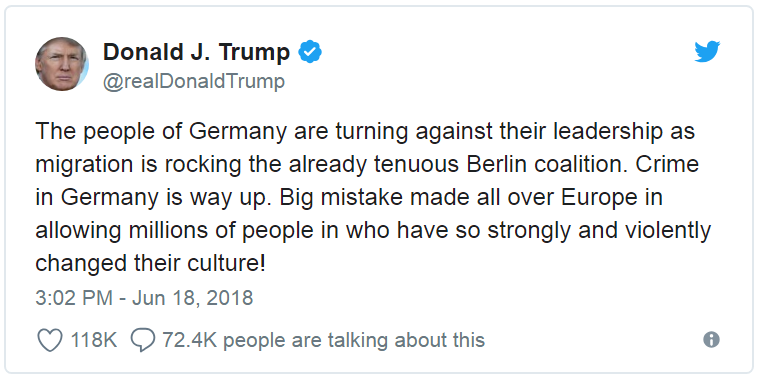
The issue burst into the headlines this week when Germany’s interior minister, Horst Seehofer, a conservative Bavarian, threatened to resign unless Chancellor Angela Merkel agreed to create something like a hard border between Germany and Austria.
Under European rules, migrants are supposed to remain in the country where they first landed, but once they are there — inside the Schengen zone — they can travel freely to where they really want to go, which is very often Germany, Sweden or Austria.
Ms. Merkel refused at first, saying that would produce a cascade of hard borders in other countries, destroying the Schengen zone. Migration, she said, needed a European solution.
In the end, to preserve her coalition, Ms. Merkel agreed with Mr. Seehofer to speed up asylum procedures and turn back asylum seekers who are already registered in other European countries. As part of that deal, Germany would run camps along the Austrian border to assess their status and arrange their deportation if necessary.
The German deal came into sharper relief on Thursday night after the Social Democrats, Ms. Merkel’s other governing partners, signed off on it on the condition that instead of in new camps, migrants would be processed in existing police stations along the border and that they would be held for no longer than 48 hours. In addition, Germany will pass an immigration law by the end of the year that gives would-be immigrants the chance to apply for a work visa.
Still, many details remain to be resolved, not least agreements with other countries to take back migrants who do not qualify for entry to Germany. Mr. Seehofer came to Vienna on Thursday to begin discussions with the Austrians, while the Hungarian prime minister, Victor Orban, was in Berlin meeting with Ms. Merkel.
Mr. Kurz said he had been a critic from the start of the 2015 decision by Ms. Merkel, to welcome in Syrian refugees, prompting more than 1.4 million people to stream on foot through Europe.
He and other conservative and populist leaders — Mr. Orban; the Italian deputy prime minister, Matteo Salvini, and Mr. Seehofer — have recommended a series of measures to control Europe’s borders: to set up screening facilities for migrants outside Europe; to return those rescued at sea to the country of embarkation; and to decide, country by country, who will be allowed to come to Europe — including, he emphasized, legitimate refugees fleeing war and persecution.
Once dismissed as inhumane, all these ideas were endorsed by European leaders last week in Brussels, he said, though so far, no country outside Europe has agreed to set up centers for migrants and no country inside Europe has established transit centers where migrants can be held and screened to see if they are legitimate refugees.
But Mr. Kurz’s idea of patrolling the Mediterranean and systematically returning migrants to the countries — now reinforced by the ascension of a populist government in Italy that is turning back ships bearing migrants, raises moral and legal questions.
“They are doing this in the name of Europe,” said Gerald Knaus, director of the European Stability Initiative, a Berlin-based research group. “But that is a very different kind of Europe.”
Returning asylum seekers to countries in chaos or that are judged to be dangerous also violates international law.
There are practical issues, too. No border is impermeable. “The people who made it to Germany in 2015 crossed many hard borders to get there,” Mr. Knaus said. “So they pick up West Africans and send them back to Egypt?”
Mr. Kurz acknowledged that, but emphasized that the European Union had taken steps that had reduced the numbers of migrants significantly, including the deal Ms. Merkel had cut with Turkey. “It shows that it is possible to reduce numbers dramatically, and now we have to go further this way,” he said.
Officials estimate that 300 to 600 migrants cross the German border a week, with half of them registered elsewhere. Germany gets about 6,000 asylum seekers a month now, half of whom are estimated to have been registered elsewhere. Indeed, Mr. Seehofer acknowledged on Thursday night that the number of migrants he expected to be processed in police stations along the borders would amount to no more than three to five people a day.
Still, populists like Mr. Kurz, echoing counterparts in neighboring countries, warn that even if the numbers are down now, a new surge could come any time, and so the borders must be reinforced immediately.
There are a lot of difficulties with the global asylum system, said Elizabeth Collett, director of the Migration Policy Institute Europe, a study group. “But the idea that there is something wrong about claiming asylum in Europe — that’s quite a shift from a group of countries that created the Geneva convention 60 years ago” that governs refugees, she said.
Mr. Kurz’s focus on external borders is too simple when Europeans cannot agree on a common asylum policy, Ms. Collett said. “It’s not just about what happens on the border, but what happens after the border,” she said.
Europe’s border dilemma was on display in Berlin on Thursday, where Ms. Merkel stood side by side with Mr. Orban at a news conference.
Protecting Europe’s borders must not mean keeping out the needy, Ms. Merkel said. “If Europe with its values is to continue to play a role in the world, then Europe cannot simply turn its back on hardship and suffering.”
Mr. Orban, who has long spoken about migration as an existential threat to European civilization, struck a different tone, saying, “The strategic goal of Hungary is to protect Europe.”
Pierre Vimont, a former French ambassador to the United States, said it was often overlooked that the Schengen system allowed the reintroduction of national border controls as a temporary measure. Such controls have existed for some time between France and Belgium and France and Italy, too. “If this can appease some of the populists for the moment, so be it,” Mr. Vimont said.
“So we can say we’re still inside the Schengen system,” he said. “It’s not very satisfactory but it’s a way of dealing with current pressure.” But temporary measures tend to last, he conceded.
He noted that the open-border zone, like the euro, was only half-built. European leaders eliminated internal borders without reinforcing external borders — because that was expensive, or touched on the sovereignty of countries like Greece and Italy or simply because they did not foresee the problems of terrorism or a migration crisis like 2015.
But the days of magical thinking are over, Mr. Kurz insisted. No state or group of states can fail to protect its borders, he said. “The European Union is not only a great idea, but it’s also an idea we must keep working on,” he said. “What every generation must do is try to make Europe better than it was in the past.”
Whether that will change it beyond recognition is anyone’s guess.
Christopher F. Schuetze contributed reporting from Berlin
 France and Germany wrapped themselves in the flag of liberal democracy and started a ‘value-driven’ crusade
CAMBRIDGE – For years, political leaders such as former US Secretary of Defense Leon Panetta have warned of the danger of a “cyber Pearl Harbor.” We have known for some time that potential adversaries have installed malicious software in our electricity grid. Suddenly the power could go out in large regions, causing economic disruption, havoc, and death. Russia used such an attack in December 2015 in its hybrid warfare against Ukraine, though for only a few hours. Earlier, in 2008, Russia used cyber attacks to disrupt the government of Georgia’s efforts to defend against Russian troops.
Thus far, however, cyber weapons seem to be more useful for signaling or sowing confusion than for physical destruction – more a support weapon than a means to clinch victory. Millions of intrusions into other countries’ networks occur each year, but only a half-dozen or so have done significant physical (as opposed to economic and political) damage. As Robert Schmidle, Michael Sulmeyer, and Ben Buchanan put it, “No one has ever been killed by a cyber capability.”
US doctrine is to respond to a cyber attack with any weapon, in proportion to the physical damage caused, based on the insistence that international law – including the right to self-defense – applies to cyber conflicts. Given that the lights have not gone out, maybe this deterrent posture has worked.
Then again, maybe we are looking in the wrong place, and the real danger is not major physical damage but conflict in the gray zone of hostility below the threshold of conventional warfare. In 2013, Russian chief of the general staff Valery Gerasimov described a doctrine for hybrid warfare that blends conventional weapons, economic coercion, information operations, and cyber attacks.
The use of information to confuse and divide an enemy was widely practiced during the Cold War. What is new is not the basic model, but the high speed and low cost of spreading disinformation. Electrons are faster, cheaper, safer, and more deniable than spies carrying around bags of money and secrets.
If Russian President Vladimir Putin sees his country as locked in a struggle with the United States but is deterred from using high levels of force by the risk of nuclear war, then perhaps cyber is the “perfect weapon.” That is the title of an important new book by New York Times reporter David Sanger, who argues that beyond being “used to undermine more than banks, databases, and electrical grids,” cyberattacks “can be used to fray the civic threads that hold together democracy itself.”
Russia’s cyber interference in the 2016 American presidential election was innovative. Not only did Russian intelligence agencies hack into the email of the Democratic National Committee and dribble out the results through Wikileaks and other outlets to shape the American news agenda; they also used US-based social-media platforms to spread false news and galvanize opposing groups of Americans. Hacking is illegal, but using social media to sow confusion is not. The brilliance of the Russian innovation in information warfare was to combine existing technologies with a degree of deniability that remained just below the threshold of overt attack.
US intelligence agencies alerted President Barack Obama of the Russian tactics, and he warned Putin of adverse consequences when the two met in September 2016. But Obama was reluctant to call out Russia publicly or to take strong actions for fear that Russia would escalate by attacking election machinery or voting rolls and jeopardize the expected victory of Hillary Clinton. After the election, Obama went public and expelled Russian spies and closed some diplomatic facilities, but the weakness of the US response undercut any deterrent effect. And because President Donald Trump has treated the issue as a political challenge to the legitimacy of his victory, his administration also failed to take strong steps.
Countering this new weapon requires a strategy to organize a broad national response that includes all government agencies and emphasizes more effective deterrence. Punishment can be meted out within the cyber domain by tailored reprisals, and across domains by applying stronger economic and personal sanctions. We also need deterrence by denial – making the attacker’s work more costly than the value of the benefits to be reaped.
There are many ways to make the US a tougher and more resilient target. Steps include training state and local election officials; requiring a paper trail as a back-up to electronic voting machines; encouraging campaigns and parties to improve basic cyber hygiene such as encryption and two-factor authentication; working with companies to exclude social media bots; requiring identification of the sources of political advertisements (as now occurs on television); outlawing foreign political advertising; promoting independent fact-checking; and improving the public’s media literacy. Such measures helped to limit the success of Russian intervention in the 2017 French presidential election.
Diplomacy might also play a role. Even when the US and the Soviet Union were bitter ideological enemies during the Cold War, they were able to negotiate agreements. Given the authoritarian nature of the Russian political system, it could be meaningless to agree not to interfere in Russian elections. Nonetheless, it might be possible to establish rules that limit the intensity and frequency of information attacks. During the Cold War, the two sides did not kill each other’s spies, and the Incidents at Sea Agreement limited the level of harassment involved in close naval surveillance. Today, such agreements seem unlikely, but they are worth exploring in the future.
Above all, the US must demonstrate that cyber attacks and manipulation of social media will incur costs and thus not remain the perfect weapon for warfare below the level of armed conflict.