Olivier Blanchard is a French macroeconomist who has spent his professional life in the U.S. He first taught at Harvard, then at MIT, where he was chairman of the economics department from 1998 to 2003. From 2008 to 2015, he was on leave as the chief economist of the IMF. He is now the Fred Bergsten Senior Fellow at the Peterson Institute in Washington. He also remains Robert M. Solow Professor of Economics emeritus at MIT. He is the author of many books and articles, including two textbooks in macroeconomics, one at the graduate level, and one at the undergraduate level. He is a fellow and past council member of the Econometric Society, past president of the American Economic Association, and a member of the American Academy of Sciences.
Dans un “coup de gueule”, Renaud Girard, grand reporter au service étranger du Figaro, accuse lourdement les ONG et les réseaux de passeurs d’alimenter les trafics de migrants.
Donald Trump’s depiction of his meeting with North Korean leader Kim Jong-un as a great success that solved the nuclear problem could make it tougher to maintain international support for the economic sanctions that are still needed to pressure Kim. Weakening the prospect of achieving one’s goals is not the mark of a strong negotiator.
NEW YORK – US President Donald Trump returned from his short summit meeting in Singapore with North Korean leader Kim Jong-un in an exultant mood. “Everybody can now feel much safer than the day I took office,” Trump tweeted. “There is no longer a Nuclear Threat from North Korea.” He subsequently told reporters, “I have solved that problem.”
There is only one catch: what Trump claimed was untrue. The nuclear threat posed by North Korea remains undiminished. The joint statement issued by the two leaders was as brief – just 391 words – as it was vague.
The statement was far more about aspirations than accomplishments. North Korea committed only “to work toward complete denuclearization of the Korean Peninsula.” Missing was any definition of what denuclearization might entail, a timeline for implementation, or a reference to how any actions would be verified. Other issues related to nuclear weapons, including ballistic missiles, were not even mentioned. Thus far, at least, the agreement with North Korea compares unfavorably to the Iran nuclear deal that Trump denounced – and then renounced a month before meeting Kim.
This is not to argue that the Singapore summit had no value. At least for now, bilateral relations are in a better place than they were a year ago, when North Korea was conducting nuclear and missile tests, and observers (including me) were busy calculating the chances that the two countries would be making war rather than peace. And, looking forward, there is, in principle, the possibility that the United States and North Korea will be able to reach agreement on the many relevant issues and details that the Singapore summit statement left out.
But turning this possibility into reality will be extraordinarily difficult. There are many reasons to doubt whether North Korea will ever give up weaponry that, more than anything else, explains America’s willingness to take it seriously and treat it as something of an equal. In addition, the experience of Ukraine, a country that gave up its nuclear weapons, only to see the world do nothing when Russia annexed Crimea, hardly provides a reason for Kim Jong-un to follow suit. Much the same could be said of Libya, given Colonel Muammar el-Qaddafi’s fate.1
There is also good reason to doubt that North Korea, arguably the world’s most closed and secretive country, would ever permit the sort of intrusive international inspections that would be required to verify that it had complied with undertakings spelled out in some future pact.
Trump seems to think that Kim can be swayed not simply by threats and pressure, but by flattery and promises as well. The White House released a four-minute video that showcased Kim as someone who could be a great historical figure if only he would fundamentally change. The video also went to great lengths to show what North Korea could gain economically were it to meet US demands. The president even spoke of the North’s potential as a venue for real-estate development and tourism.
What seems not to have occurred to Trump is that such a future holds more peril than promise to someone whose family has ruled with an iron grip for three generations. A North Korea open to Western businessmen might soon find itself penetrated by Western ideas. Popular unrest would be sure to follow.
Trump emphasizes the importance of personal relationships, and he claimed to have developed one with Kim in a matter of hours. More than once, he spoke of the trust he had for a leader with a record of killing off those (including an uncle and a brother) he deemed his enemies. All of this turned Ronald Reagan’s maxim – “trust, but verify” – on its head, to something like “Don’t verify, but trust.”
In fact, some of Trump’s post-summit remarks have actually weakened the prospect of achieving his goals. His depiction of the summit as a great success that solved the nuclear problem will make it that much tougher to maintain international support for the economic sanctions that are still needed to pressure North Korea. Trump also did himself no favor by unilaterally announcing that the US would no longer conduct what he described as “provocative” war games, also known as military exercises meant to ensure readiness and enhance deterrence. In so doing, he not only alarmed several US allies, but also gave away what he could have traded for something from North Korea.
The danger, of course, is that subsequent negotiations will fail, for all these reasons, to bring about the complete and verifiable denuclearization of North Korea that the US has said must happen soon. Trump would likely then accuse Kim of betraying his trust.
In that case, the US would have three options. It could accept less than full denuclearization, an outcome that Trump and his top aides have said they would reject. It could impose even stricter sanctions, to which China and Russia are unlikely to sign up. Or it could reintroduce the threat of military force, which South Korea, in particular, would resist.
But if Trump concludes that diplomacy has failed, he could nonetheless opt for military action, a course John Bolton suggested just before becoming national security adviser. This would hardly be the legacy that Trump intended for the Singapore summit, but it remains more possible than his optimistic tweets would lead one to believe.
Katrin Bennhold and Steven Erlanger, The New York Times
BERLIN — It was supposed to be the day when President Emmanuel Macron of France received a long-awaited response from Germany on his big ideas on how to rekindle Europe as a force for liberalism in the world.
And he did, sort of.
But his meeting with Chancellor Angela Merkel of Germany on Tuesday was overshadowed by the urgent issue of how to put out the growing number of populist fires over migration on the Continent — including in Germany itself.
Ms. Merkel, faced with a rebellion by Bavarian conservatives that nearly brought down her government on Monday, is staring at a 10-day deadline to reach the kind of European accord on limiting migration that has eluded the European Union for many years.
On Tuesday she came one small step closer. When Mr. Macron was asked whether he would take back asylum seekers who were first registered in France if Germany refused them at the border, as demanded by the Bavarians, Mr. Macron obligingly said he would. “I confirm,” he said.
France would be obligated to do so under the bloc’s current regulations, but they have proved hollow as Europe has been confronted with millions of migrants and refugees from war-torn Syria, Libya, northern Africa and Afghanistan in recent years.
More than 200,000 migrants sought asylum in Germany last year, and it is on pace to receive as many requests this year, according to Germany’s Federal Office for Migration and Refugees. In 2016, more than 700,000 migrants and refugees asked for asylum in Germany.
Ms. Merkel’s coalition party in Bavaria would like to send back any asylum seeker who has first registered in another European country. But that would mean creating a border in the border-free Schengen zone, which Ms. Merkel thinks would mean the breakdown of free travel, a jewel in the European crown.
In part because Ms. Merkel needs French support in her effort to find a new European consensus on how to address migration, she reached several agreements with Mr. Macron on Tuesday.
Ms. Merkel agreed to a joint budget for the countries that share the euro, which would be separate from the larger European Union budget and would be established as soon as 2021. She also assented to a European reinsurance arrangement for unemployment. Both measures were once unthinkable for Ms. Merkel’s fiscally conservative country.
Their meeting at the Meseberg palace outside Berlin, which took place in advance of a European summit at the end of June, was intended to address broad European issues, but it was marked as well by each leader’s domestic political challenges.
Mr. Macron, who had first laid out his ambitious plans for Europe last September in a rousing speech of 100 minutes at the Sorbonne, needed movement on his eurozone budget proposal from the German chancellor that he could sell at home.
Ms. Merkel, in turn, needed support for fixing Europe’s fractured asylum and migration policies.
“The Europe that we know is too slow, too weak, too ineffective,” Mr. Macron said in September, before reeling off a list of ambitious proposals.
On Tuesday, Mr. Macron did not get nearly as much as he hoped for. He had lobbied for a budget of hundreds of millions of euros to be overseen by a European finance minister. German officials, long suspicious of anything that smacks of a transfer union, agreed finally to the idea of a eurozone budget, but in the tens of millions of euros and overseen by the European Commission.
But Germany did agree to a proposal to coordinate its corporate tax rate with France and to an overhaul of the European Stability Mechanism, the eurozone’s bailout fund, which would expand its mission and allow it to provide emergency loans to countries in recession.
On balance, Mr. Macron probably got a little more than he had expected, given Ms. Merkel’s current political predicament.
“The domestic pressure Chancellor Merkel is currently under makes it easier for the French President to get more money for the new budget,” said Thomas Jäger, a professor at the University of Cologne.
If she is unable to reach agreements with other European countries within about two weeks, her interior minister, Horst Seehofer, has threatened to act unilaterally, turning back any migrant to Bavaria whose asylum process is pending in another European Union country.
Under these circumstances, analysts said, the leaders’ joint declaration, which also covered support for closer military cooperation and foreign policy, was more substantive than might have been expected.
The agreement “is an important step in the right direction,” said Marcel Fratzscher, head of the German Institute for Economic Research, though he added that it would not be sufficient to make the eurozone sustainable and to avoid future crises.
Timothy Garton Ash of Oxford University concurred. “In time-honored fashion they will try to cobble something together that looks like a major joint initiative,” he said. “The question is: Is it enough for Europe?”
“Not yet,” he added.
On migration, the current crisis appears to have focused minds.
“The topic that worries us all at the moment is migration,” Ms. Merkel said, standing beside Mr. Macron at a lengthy joint news conference after their meeting.
Both Ms. Merkel and Mr. Macron hope to fashion deals with the front-line countries receiving the most migrants, like Italy or Spain, similar to one reached with Turkey.
They also want to create a larger and more efficient European border force, adding 10,000 officers, and hope to discuss ways of processing asylum claims in North Africa, notably Libya, before migrants can arrive in Europe. Once migrants are on the Continent, it has proved very difficult to send back those who do not qualify as refugees, especially since many destroy their documents at sea.
Following a tumultuous few days, with President Trump joining the fray in Europe by firing off hostile tweets and banding together with nativists from Hungary to Slovenia, Ms. Merkel’s meeting with Mr. Macron felt at times like a defiant counter summit — an attempt by Europe’s two main centrist leaders to close ranks.
Mr. Macron, who has emerged as Europe’s most energetic leader, has made an urgent case for a liberal Europe. On Tuesday his government’s spokesman responded sharply to President Trump’s tweets by criticizing American policies toward migrants.
“President Donald Trump’s policy of separating migrants entering the U.S. from Mexico from their children shows that the United States and Europe do not share the same ‘model of civilization,’” said the spokesman, Benjamin Griveaux.
“I don’t want what’s happening in the United States to happen in Europe,” he told France 2 television, adding that “clearly we do not share certain values.”
The main responsibility of this generation, he said, “is to defend European solidarity against populism, against all forms of populism, the far left and the far right.”
“If everyone retreats behind their national borders, we won’t succeed,” he said.
The question is how much support Mr. Macron and Ms. Merkel command elsewhere in Europe for their proposed reforms of the eurozone and migration. Some nations, including Austria and the Netherlands, do not favor a separate eurozone budget, while Italy, with a new populist government, has vowed to get tough on migration.
“In that sense,” Mr. Jäger said, “this compromise will be a litmus test of whether the French-German engine can still pull the European train.”
Katrin Bennhold reported from Berlin and Steven Erlanger from Brussels. Melissa Eddy contributed reporting from Berlin.
Français et Allemands sont tombés d’accord sur la création d’un budget pour les dix-neuf. Des changements de traité sont indispensables.
C’est historique. Le deuxième pilier de l’Union économique et monétaire comme l’avait rêvé Jacques Delors devrait voir le jour. Emmanuel Macron et Angela Merkel se sont mis d’accord sur un budget qui va promouvoir la compétitivité, la convergence et la stabilisation dans la zone euro. Ce projet, qui montre à la fois de la solidarité et la volonté de croître ensemble, doit encore être approuvé par les dix-sept autres membres.
« C’est un premier pas important pour l’Europe […] Nous nous engageons pour un budget de l’euro », a déclaré la chancelière allemande Angela Merkel lors de la conférence de presse mardi au château de Meseberg. Il s’agit d’une étape significative pour l’Allemagne, très longtemps réticente à doter la zone euro d’une capacité de financement propre tant elle craignait de devoir financer des pays moins vertueux qu’elle. Cette avancée majeure est le fruit du travail acharné des ministres des Finances, Bruno Le Maire, et Olaf Scholz, ces trois derniers mois.
Objectif : investissements dans l’innovation et le capital humain
« Le but du budget de la zone euro est la compétitivité et la convergence », stipule la déclaration franco-allemande. Cela nécessitera des « investissements dans l’innovation et le capital humain ». Sur la fonction de stabilisation de l’un des Etats de la zone en cas de récession, le document indique que sera « étudiée la question d’un Fonds européen de stabilisation de l’assurance-chômage, pour l’éventualité de graves crises économiques », mais « sans transferts ». La France et l’Allemagne « mettront en place un groupe de travail en vue de faire des propositions concrètes pour le Conseil européen de décembre 2018 ».
Une enveloppe à décider
Aucun montant n’a été encore défini pour ce budget qui doit voir le jour en 2021. Il appartiendra aux Etats membres de discuter des modalités lors des négociations du prochain cadre financier pluriannuel (2021-2027), et cela avant la fin de l’année. Si Emmanuel Macron avait évoqué plusieurs points de PIB et par là des centaines de milliards d’euros, la chancelière avait de son côté préféré évoqué des montants à deux chiffres.
A défaut d’être d’accord sur le montant, les deux dirigeants se sont accordés sur des pistes de ressources qui « proviendraient à la fois des contributions nationales, de l’affectation de recettes fiscales et de ressources européennes. » Angela Merkel a mentionné une taxe européenne sur les transactions financières.
Ce sont des réformes importantes, des engagements politiques que nous prenons ensemble.
« Ce sont des réformes importantes, des engagements politiques que nous prenons ensemble […] qui supposent un travail technique au niveau ministériel jusqu’à la fin de l’année, ensuite, sans doute l’année suivante, des changements de traités qui sont indispensables », a ajouté Emmanuel Macron.
Selon le projet franco-allemand, ce sont les dix-neuf pays de la zone euro qui assureront la gouvernance de ce budget et assumeront les décisions stratégiques. Et c’est la Commission européenne qui en assurera l’exécution.
Dimanche 17 juin 2018, l’Aquarius, un navire européen affrété par les Organisations non gouvernementales (ONG) SOS Méditerranée et Médecins sans frontières, a donc débarqué dans le port espagnol de Valence 630 immigrants clandestins venus d’Afrique, repêchés une semaine auparavant au large des côtes de Libye. Deux navires appartenant à l’Etat italien (l’un de la marine de guerre, l’autre du corps des garde-côtes) y ont le même jour débarqué un nombre moins important de clandestins.
Auparavant, ces migrants, pour la plupart originaires de pays lointains d’Afrique noire comme le Nigéria, la Côte d’Ivoire ou la Guinée, avaient chacun payé un minimum de 3000 euros par personne à des réseaux de passeurs, lesquels sont structurés comme des mafias, avec des ramifications dans tous les pays parcourus par les routes menant vers le prétendu « eldorado » européen. A la tête de ses mafias, on trouve les descendants des Barbaresques. Aujourd’hui, ce sont les mêmes réseaux mafieux qui procèdent indifféremment au trafic d’armes (destinées aux djihadistes), à l’acheminement de la drogue vers l’Europe, au trafic des êtres humains.
Les passeurs – ces nouveaux Barbaresques – ont une méthode éprouvée. Ils entassent les candidats aux voyages dans des canots pneumatiques de fortune ; ils les poussent jusqu’aux eaux internationales à 12 nautiques du rivage libyen ; ensuite ils émettent un SOS ou appellent un centre de secours italien pour indiquer qu’un naufrage est imminent ; puis ils s’en retournent dans leurs repaires, abandonnant à leur sort leurs malheureux passagers, souvent sans eau douce ni nourriture. Le reste du voyage ne coûte plus rien aux passeurs, puisqu’il est pris en charge par les navires des marines ou des ONG européennes. Pourquoi ces derniers ne ramènent pas simplement les naufragés vers les ports les plus proches du littoral libyen ? Parce qu’ils considèrent qu’il s’agirait d’un refoulement contraire au droit humanitaire international. Les nouveaux Barbaresques le savent bien, qui sont passés maîtres dans l’art d’exploiter le vieux sentiment de charité chrétienne de cette Europe si riche, si bien organisée, si sociale.
Sans le vouloir, les ONG participent, de manière gratuite, à un immense trafic, qui a dépassé depuis longtemps en chiffre d’affaires le trafic de stupéfiants. Evoquant les naufragés, une représentante de SOS Méditerranée a affirmé à Valence que l’Europe avait « quatorze mille morts sur la conscience ». Quelle incroyable calomnie, visant à réveiller la vieille culpabilité de l’homme blanc ! Car en quoi les Européens sont-ils responsables que de jeunes hommes africains se jettent dans de dangereuses expéditions pour fuir leurs pays ? Cela fait soixante ans, soit deux générations, que les puissances européennes n’administrent plus l’Afrique, qu’elles en sont parties, dans la liesse des élites et des foules africaines mues par l’idéal de leur indépendance, et avec l’approbation des bonnes consciences de gauche de l’époque. Sont-ce les Européens ou les nouveaux Barbaresques qui ont créé ce trafic honteux ?
Ce trafic est profondément délétère à la fois pour les Etats africains et pour les Etats européens. Il prive l’Afrique d’une jeunesse intelligente, entreprenante et débrouillarde. Car 3000 euros y représente une somme considérable à rassembler. Dans les pays du Continent noir, c’est un beau capital de départ pour créer une affaire, pour creuser un puits dans un village, ou pour monter une installation photovoltaïque. Dans les pays de transition comme le Niger, le trafic attire des jeunes pressés de faire fortune, les éloignant de l’élevage, de l’agriculture, de l’artisanat. Il n’est pas sain que les villages africains vivent dans l’attente des mandats qu’envoient ou qu’enverront les migrants une fois arrivés en Europe, plutôt que de chercher à se développer par eux-mêmes. Il est vital que les aides financières de l’Union européenne pour le Sahel et l’Afrique centrale aillent dans des actions qui combattent l’économie de trafic, mais aussi dans des projets agricoles ou énergétiques capables de fixer les populations sur leurs terres ancestrales.
L’arrivée incontrôlée et en masse de migrants peu au fait de la culture européenne déstabilise profondément les Etats de l’UE, comme on l’a vu avec le vote référendaire britannique et le vote législatif italien. Dans les années cinquante et soixante, les peuples européens se sont exprimés par les urnes pour accepter les indépendances des ex-colonies. En revanche on ne les a jamais consulté démocratiquement sur l’immigration, qui le phénomène social le plus important qu’ils aient connu depuis la seconde guerre mondiale.
Il faut d’urgence arrêter cet appel d’air délétère, sauf à vouloir appauvrir humainement l’Afrique et détruire cette Europe libérale patiemment construite depuis les années 1950…
In the middle of the twentieth century, people feared that advances in computers and communications would lead to the type of centralized control depicted in George Orwell’s 1984. Today, billions of people have eagerly put Big Brother in their pockets.
CAMBRIDGE – It is frequently said that we are experiencing an information revolution. But what does that mean, and where is the revolution taking us?
Information revolutions are not new. In 1439, Johannes Gutenberg’s printing press launched the era of mass communication. Our current revolution, which began in Silicon Valley in the 1960s, is bound up with Moore’s Law: the number of transistors on a computer chip doubles every couple of years.
By the beginning of the twenty-first century, computing power cost one-thousandth of what it did in the early 1970s. Now the Internet connects almost everything. In mid-1993, there were about 130 websites in the world; by 2000, that number had surpassed 15 million. Today, more than 3.5 billion people are online; experts project that, by 2020, the “Internet of Things” will connect 20 billion devices. Our information revolution is still in its infancy.
The key characteristic of the current revolution is not the speed of communications; instantaneous communication by telegraph dates back to the mid-nineteenth century. The crucial change is the enormous reduction in the cost of transmitting and storing information. If the price of an automobile had declined as rapidly as the price of computing power, one could buy a car today for the same price as a cheap lunch. When a technology’s price declines so rapidly, it becomes widely accessible, and barriers to entry fall. For all practical purposes, the amount of information that can be transmitted worldwide is virtually infinite.
The cost of information storage has also declined dramatically, enabling our current era of big data. Information that once would fill a warehouse now fits in your shirt pocket.
In the middle of the twentieth century, people feared that the computers and communications of the current information revolution would lead to the type of centralized control depicted in George Orwell’s dystopian novel 1984. Big Brother would monitor us from a central computer, making individual autonomy meaningless.
Instead, as the cost of computing power has decreased and computers have shrunk to the size of smart phones, watches, and other portable devices, their decentralizing effects have complemented their centralizing effects, enabling peer-to-peer communication and mobilization of new groups. Yet, ironically, this technological trend has also decentralized surveillance: billions of people nowadays voluntarily carry a tracking device that continually violates their privacy as it searches for cell towers. We have put Big Brother in our pockets.
Likewise, ubiquitous social media generate new transnational groups, but also create opportunities for manipulation by governments and others. Facebook connects more than two billion people, and, as Russian meddling in the 2016 US presidential election showed, these connections and groups can be exploited for political ends. Europe has tried to establish rules for privacy protection with its new General Data Protection Regulation, but its success is still uncertain. In the meantime, China is combining surveillance with the development of social credit rankings that will restrict personal freedoms such as travel.
Information provides power, and more people have access to more information than ever before, for good and for ill. That power can be used not only by governments, but also by non-state actors ranging from large corporations and non-profit organizations to criminals, terrorists, and informal ad hoc groups.
This does not mean the end of the nation-state. Governments remain the most powerful actors on the global stage; but the stage has become more crowded, and many of the new players can compete effectively in the realm of soft power. A powerful navy is important in controlling sea-lanes; but it does not provide much help on the Internet. In nineteenth-century Europe, the mark of a great power was its ability to prevail in war, but, as the American analyst John Arquilla has pointed out, in today’s global information age, victory often depends not on whose army wins, but on whose story wins.
Public diplomacy and the power to attract and persuade become increasingly important, but public diplomacy is changing. Long gone are the days when foreign service officers carted film projectors to the hinterlands to show movies to isolated audiences, or people behind the Iron Curtain huddled over short-wave radios to listen to the BBC. Technological advances have led to an explosion of information, and that has produced a “paradox of plenty”: an abundance of information leads to scarcity of attention.
When people are overwhelmed by the volume of information confronting them, it is hard to know what to focus on. Attention, not information, becomes the scarce resource. The soft power of attraction becomes an even more vital power resource than in the past, but so does the hard, sharp power of information warfare. And as reputation becomes more vital, political struggles over the creation and destruction of credibility multiply. Information that appears to be propaganda may not only be scorned, but may also prove counterproductive if it undermines a country’s reputation for credibility.
During the Iraq War, for example, the treatment of prisoners at Abu Ghraib and Guantanamo Bay in a manner inconsistent with America’s declared values led to perceptions of hypocrisy that could not be reversed by broadcasting images of Muslims living well in America. Similarly, President Donald Trump’s tweets that prove to be demonstrably false undercut American credibility and reduce its soft power.
The effectiveness of public diplomacy is judged by the number of minds changed (as measured by interviews or polls), not dollars spent. It is interesting to note that polls and the Portland index of the Soft Power 30 show a decline in American soft power since the beginning of the Trump administration. Tweets can help to set the global agenda, but they do not produce soft power if they are not credible.
Now the rapidly advancing technology of artificial intelligence or machine learning is accelerating all of these processes. Robotic messages are often difficult to detect. But it remains to be seen whether credibility and a compelling narrative can be fully automated.
CTO and Group Vice President Corporate Strategy & External Relations VALEO. Previously, he was technical advisor for Industrial Affairs at the Office of the French Minister of Defense, Jean-Yves Le Drian (2014-2016). He was also project manager at the Aerospace & Defence Unit, French Government Shareholding Agency (2011-2014), advisor for Industry at the Office of the Chairman and CEO of OCP Group (2009-2010). He graduated from the Ecole Polytechnique and the Ecole des Mines, Paris.
Pour Hubert Védrine, ancien ministre des Affaires étrangères, la rencontre entre Donald Trump et Kim Jong Un pourrait amorcer une mutation du régime nord-coréen, sous l’égide notamment de la Chine.
L’image a fait le tour du monde : le dictateur de Corée du Nord a serré la main du président des Etats-Unis, après 70 ans de guerre. “Ça n’est pas une opération de relation publique, c’est un événement très important”, a salué Hubert Védrine, l’ancien ministre des Affaires étrangères de François Mitterrand, au micro de la matinale d’Europe 1 mardi. Avec une nuance toutefois : “On ne peut pas l’évaluer précipitamment : il faut attendre les vrais résultats, la mise en œuvre. Y a-t-il un vrai calendrier de dénucléarisation ?”, a-t-il interrogé.Un calendrier de dénucléarisation… L’ancien responsable de la diplomatie française estime ainsi qu’à ce stade, Donald Trump “n’a pris aucun risque”. “C’est une opération réussie s’il y a un calendrier étalé de dénucléarisation dans le temps, avec deux ou trois gestes au début”, répète-t-il, alors que mardi matin, le contenu précis du document que le président américain a annoncé vouloir signer avec le leader nord-coréen n’était pas encore connu.… impossible à mettre en place ? Hubert Védrine ne croit pas cependant que le régime de Pyongyang puisse à court terme se priver de “l’assurance vie qu’il s’est donnée au fil des décennies” en développant l’arme nucléaire. “Je n’imagine pas ce régime y renoncer demain matin, ça n’a aucun sens. Personne ne pourrait l’imposer”.Le modèle chinois en exemple. Cette poignée de main fait également de Kim Jong Un le gagnant du bras de fer qui l’a opposé à Washington ces derniers mois, sa propagande pouvant désormais expliquer que c’est grâce à son leadership et à l’arme atomique qu’il a pu obtenir ce tête à tête avec le locataire de la Maison Blanche. “Il peut dire ça, mais la propagande fonctionnera s’il arrive à faire évoluer la vie des gens, ce qui veut dire une politique économique à la chinoise ; il garde le contrôle politique, stratégique et policier, mais le pays se développe”, relève encore Hubert Védrine.
“La Corée du Nord veut survivre en tant que régime, tout en évoluant”, indique-t-il. Pour lui, le système communiste dictatorial de la péninsule pourrait désormais suivre la trajectoire empruntée par la République populaire de Chine à partir de la fin des années 1970. “Ils vont développer une économie à la chinoise. Mais la Chine ne veut pas d’une réunification trop rapide. Ils seraient incapables d’assumer ce poids. Ce serait trop lourd, ça les ferait couler”, avertit Hubert Védrine.
Dans un monde chaotique où il est difficile d’avoir confiance dans le long terme, nombreux sont les chefs d’Etat qui pilotent à vue. La Chine, pourtant, achèvera en 2049 les routes de la soie qui relieront l’Europe et l’Afrique aux intérêts asiatiques.
En Afrique, certains Etats se donnent une perspective de long terme : le Maroc a réintégré l’Union africaine l’année dernière et développe des projets d’envergure, tels que la rocade atlantique d’Agadir à Dakar ; l’Algérie, avec le projet de dorsale transsaharienne qui relierait Alger-Cherchell à Lagos au Nigeria ; l’Egypte, avec la modernisation du canal de Suez ; le Ghana, avec son président qui affiche sa volonté de rupture avec le passé et trace le chemin d’une Afrique ambitieuse, autonome, liée à l’Europe, dans un rapport équilibré.
Le président Macron a donné une vision de l’ancrage de la France à l’Europe, à l’Afrique et au monde, le 29 août 2017, devant les ambassadeurs de France :« La stratégie que je veux mettre en oeuvre consiste à créer un axe intégré entre l’Afrique, la Méditerranée et l’Europe… C’est en Afrique que se joue largement l’avenir du monde. »
Nous adhérons avec une profonde conviction à cette vision car elle est à la fois ambitieuse et réaliste :
– L’Europe est déjà le premier investisseur en Afrique et son premier client. Plus des trois quarts du commerce international des pays de l’UE se réalise en Europe, avec la Russie, avec les pays sud-méditerranéens et l’Afrique – même si les positions commerciales de l’Europe en Afrique se dégradent face à l’offensive chinoise.
– L’internationalisation des échanges conduit à une globalisation, mais aussi à une régionalisation de certaines activités qui bénéficient de l’avantage de la proximité géographique et de la complémentarité économique. C’est ainsi que l’Alena a rapproché les économies des Etats-Unis et du Mexique, et que l’ensemble des Amériques du Nord et du Sud font, désormais, 56 % de leurs échanges commerciaux. C’est ainsi que l’intégration des pays de l’Asie orientale est passée en trente ans de 30 à presque 60 % de leurs échanges commerciaux.
– Avec 500 millions d’habitants vieillissants, l’Europe doit faire le choix du développement accéléré de l’Afrique qui comptera 2,5 milliards d’habitants en 2050. Les marchés sont et seront de plus en plus au Sud.
– Enfin, cette vision est réaliste au regard des défis communs tels que le terrorisme, l’immigration non contrôlée, le réchauffement climatique et la défense des valeurs morales communes, qui imposent la mutualisation des objectifs et des moyens.
Nouveau traité
La stratégie à mettre en place doit puiser dans un certain nombre de mécanismes et d’institutions qui ont fait leurs preuves en Asie orientale et dans les Amériques. On y trouve d’abord une fondation qui rassemble experts, intellectuels, représentants des sociétés civiles et chefs d’Entreprise travaillant à l’accélération des interconnexions, des réseaux techniques (eau, transport, électricité), financiers et culturels (reconnaissance des diplômes universitaires, échanges d’étudiants…).
A ce jour, il n’existe entre l’Europe et l’Afrique aucun organisme comparable à la Cepalc (700 chercheurs, 40 millions de dollars par an) pour les Amériques ou à l’Eria (15 laboratoires et 30 millions de dollars par an) pour l’Asie orientale.
On y trouve ensuite une institution d’instruments financiers pour le développement, dont disposent déjà les Amériques (BID) et l’Asie orientale (ADB et BAII) pour assurer la mobilité des capitaux Nord-Sud dont la BAD et la BEI pourraient être la plate-forme de base. Le troisième mécanisme serait un partenariat économique entre les pays du Nord (EU) et les pays du Sud (AU). Enfin, il faudrait un lieu de concertation politique comparable à l’Organisation des Etats américains (OEA) et aux Sommets de l’Asie orientale.
L’ensemble de ces quatre outils devrait prendre la forme d’un nouveau traité entre l’Europe et l’Afrique qui prendrait la place des accords de Cotonou qui viennent à échéance fin 2020. Ce « New Deal » donnerait du sens à l’avenir de l’Europe et de l’Afrique.
Aliko Dangoteest président du groupe Dangote Industries Limited, Piero Fassino est ancien ministre, député de la République italienne, Talal Abu Ghazalehest chairman de Talal Abu-Ghazaleh Organization (TAG-Org), Jean-Louis Guigou est président de l’Ipremed, Mehdi Houas est ancien ministre en Tunisie, Mo Ibrahim est président de Mo Ibrahim Fondation, Miguel Angel Moratinos est ancien ministre en Espagne, Pascal Lamy est ancien directeur général de l’Organisation mondiale du commerce, Stéphane Richard est président-directeur général d’Orange
Autres signataires :
Pierre Beckouche, professeur des universités, Paris-I Panthéon-Sorbonne
Khater Abi-Habib, président de Kafalat
Didier Acouetey, président du cabinet Africsearch
Mounir Abdelnour, ancien ministre
Iqbal Gharbi, directrice de la chaire d’anthropologie religieuse, université Zitouna de Tunis
Jalloul Ayed, ancien ministre
Abdessalem Ben Ayed, président-directeur général de Pireco
Joachim Bitterlich, ancien ambassadeur
Roland Branquart, président d’Euro2C
Jean-Louis Chaussade, directeur général du groupe Suez
Shermine Dajani, présidente de PanMed Energy Ltd.
Khalil Daoud, président de Liban Post
Nathalie Delapalme, directrice exécutive de la Fondation Mo Ibrahim
Kemal Dervis, ancien ministre
Eric Diamantis, avocat partner du cabinet Clyde & Co.
Elias Doumet, président du groupe Matelec
Moulay Hafid Elalamy, président-directeur général du groupe Saham – Maroc
Isidro Fainé, chairman de la Caixa Banking Foundation
Elisabeth Guigou, ancienne ministre, présidente de la Fondation Anna Lindh pour le dialogue des cultures en Méditerranée
Christian Hiller von Gaertringen, consultant sur le financement de projets d’investissements en Afrique
Noureddine Hajji, président d’Ipemed Tunisie
Marc Hoffmeister, président de Classe Export
Alfonso Iozzo, président du Centro Studi sul Federalismo
Alain Juppé, ancien Premier ministre
Jean Kacou Diagou, président-directeur général du groupe NSIA
Ridha Khadher, artisan-boulanger
Fadia Kiwan, directrice honoraire de l’Institut des sciences politiques de l’université Saint-Joseph de BeyrouthVenance Konan, écrivain
Eneko Landaburu, ancien chef de la délégation de la Commission européenne en Espagne
Denis MacShane, ancien ministre
Alexandre Maymat, responsable de la business unit région Afrique & outre-mer, Société Générale
Radhi Meddeb, président-directeur général du groupe Comète Ingénierie
Romano Prodi, ancien président de la Commission européenne
Jean-Pierre Raffarin, ancien Premier ministre
Jean-Louis Reiffers, doyen honoraire de la faculté des sciences économiques de l’université d’Aix-Marseille-II
Carmen Romero, ancienne députée européenne
Arnaud Rousseau, président-directeur général du Groupe Avril, président-directeur général du groupe de la Fédération des producteurs d’oléagineux et de protéagineuxJean-Michel Severino, président d’Investisseurs & Partenaires (I & P)
Jemal Taleb, ambassadeur itinérant de Mauritanie
Fouad Trad, directeur général délégué de Byblos Bank Europe
Jean-Jacques Van der Slikke, senior vice-president for North Africa and the Middle East at Safran Group
Hubert Védrine, ancien ministre
Douraid Zaghouani, chief operating officer, Investment Corporation of Dubai
Dr Fouad Zmokhol, président de l’Association of Lebanese Business People in the World (RDCL World)
EU Commission President Jean-Claude Juncker proposed to amend the union’s budget rules so that Brussels could discipline the countries of Central Europe (source: dpa)
The European Economic Community came into being some 60 years ago with the signing of the Treaty of Rome. The objective was to secure Europe’s peaceful integration through the creation of an internal market. The process of expanding the common market and eliminating barriers was extremely successful, at first for the six founding members: France, Germany, Italy and the Benelux countries. The French-German friendship, cultivated after centuries of wars, and the renaissance of the European spirit after nearly 200 years of nationalism, were the first great fruits of that process. Gradually, more European countries joined the six pioneers.
Nearly four decades later, the community reached another milestone with the Maastricht Treaty, which came into force in 1993, establishing the European Union (EU). The decision to launch a common currency was made despite the failure of some member states to meet the criteria to qualify. The euro, however, was created not only to facilitate intra-European trade and give Europeans the backing of a strong currency in the global competition. There was a political agenda as well. The new currency was supposed to help induce EU members into a political union.
Ignored rules
In theory, the European Central Bank (ECB) was designed to be independent of politics. Such setups work for sound currencies. But as the euro was born with a political agenda, the ECB’s independence proved to have limits. To ensure the stability of the common currency, on Germany’s insistence a set of economic parameters – the so-called Maastricht criteria – was established for the participating countries. The euro area member states had to keep inflation in check, their budget deficits were supposed to be limited to no more than 3 percent of the gross domestic product, and their overall debt capped at 60 percent of the GDP. In reality, even Germany and France soon violated the Maastricht criteria. And now the ECB exceeds its monetary policy mandate, required by its mission to protect the currency’s value, to involve itself directly in the EU’s fiscal and economic policies.
France and Germany wrapped themselves in the flag of liberal democracy and started a ‘value-driven’ crusade
Through the negligence of the Union but also at the national government level, many member countries have engaged in excessive spending. The Maastricht criteria have been reduced to nice-sounding phrases on paper. As a result, we now have a strong tension between countries with lax fiscal habits, mainly in the south, and more fiscally responsible countries in Northern and Central Europe – especially Germany.
Two mind-sets
Let’s call this situation the North-South tension. There is another disruptive phenomenon in the EU, which we may call the East-West strain. This is the perceived conflict between a socialist-leaning mind-set, typical to Western Europe, and conservative political tendencies, often found in Central Europe. By conservativism, we understand a political orientation that respects proven traditional values and promotes progress based on these values. This does not mean embracing nationalism, but it surely extends to patriotism. To quote the composer Gustav Mahler (1860-1911), conservatism is not about “preserving the ashes but passing on the flame.”
In the context of this East-West tension, France and Germany wrapped themselves in the flag of liberal democracy and started a “value-driven” crusade for closer political integration of the EU. It is unclear what the word “liberal” is supposed to mean here, but the crusade seems to produce rather socialist measures. What we keep getting are higher taxes, ever more regulation, fewer property rights and omnipresent government. Opposing that, some Central European countries are either declaring themselves or being labeled as “illiberal” democracies.
As Alexander Vondra observed in his recent GIS report, it looks like those East-West tensions are now being played up only to hide the real problem – that the EU is dangerously divided between the fiscally austere north and the less responsible south.
For the sake of simplicity, let us set aside the issue of Brexit. There is no doubt that the internal market provided by the EU is beneficial to all member states. Why, then, all these tensions? One often hears the complaint that the euro area has a single currency but not a single economic policy. But that is not necessarily the problem. The real source of pain is that economies are being squeezed into bureaucratic schemes, “harmonized” and forced into the straightjacket of one currency. This “one-size-fits-all” approach ignores the needs and particularities of the member states. In the case of the Greek debt crisis, for instance, the easiest and least painful solution – for everybody – would have been to let Greece default in 2010 and drop the euro, perhaps temporarily. This was not allowed, however, to the detriment of both the Greek population and the cohesion of the Union.
The EU sees itself as equaling Europe, which is simply not the case. This observation is not meant to deny the Union’s great merits. Overestimating its importance, however, skews the perspective and often leads to policy mistakes.
Underlying problem
The last few weeks have brought warnings that Italy’s proposed new government might be a danger to Europe and the EU. This confuses an underlying problem, which could pose a serious danger, with something that would merely trigger a crisis. The problem is out-of-control government deficits and debt, not Italy’s cabinet lineup. It seems the EU is far more preoccupied with situations that may upset the status quo than with issues posing an existential threat to the union. Sometimes, as in a Greek tragedy, everything done to avert a disaster only brings it nearer.
North-South tensions cannot be fixed by establishing a common ministry of finance and transfer payments
After the Brexit vote, the remaining members of the EU displayed two telling reactions. Some were rightly alarmed that something was wrong with the union’s direction. Others, however, responded with knee-jerk calls for an “ever closer union.” This strategy, together with some misguided British internal politics, was the main reason the Brexit crisis occurred in the first place. Europeans increasingly felt that Brussels ignored the principle of subsidiarity. Functions were unnecessarily centralized or “harmonized.” Besides its famous “four freedoms,” the EU does need, of course, common policies in certain areas such as infrastructure, energy, security, etc. But things have gone too far: the concentration of power in Brussels caused a backlash.
Voices of reason
North-South tensions have a real cause. It cannot, however, be fixed by establishing a common ministry of finance and transfer payments. The solution is making the countries truly responsible for their financial decisions. That, more or less, is what the thinking of Wolfgang Schauble, the former finance minister of Germany, and leaders of the austerity-minded northern European countries boils down to.
Germany’s first reaction to Brexit was mixed, including a certain dose of Schadenfreude – imagining that it would be quite a blow to the UK economy, which is probably correct. Schadenfreude is never a healthy emotion, though. Germany realizes that it has lost an important ally in its quest for responsible fiscal politics in the Union. Today, Berlin is backed only by the Netherlands, the Nordic countries and, to a certain extent, the Visegrad countries on this matter. Germany is in a clear minority in Brussels. This does not augur well for the cause of responsible fiscal policy in the EU.
Adding to the drama, now Germany’s government is split as well. The economic and fiscal views of the Social Democrats are akin to those of the southern states of Europe, while the Christian Democrats remain in the northern camp.
Rewarding the guilty
The 2015 migration crisis produced a new set of tensions within the EU. The countries in Central Europe, especially the Visegrad 4 (Poland, Hungary, the Czech Republic and Slovakia), were described as lacking in solidarity for their refusal to accept a policy of assigning refugee quotas to the member states. A “values” conflict between “liberal“ and “illiberal“ democracies soon followed, with Paris and Berlin being the most agitated “liberal” capitals.
So-called liberal values are in fact political constructs that have little to do with classic liberalism
Central Europe is no less European than other parts of the EU, and it is also fiscally responsible. These countries put to good use the transfers of cohesion and development funds that followed the enlargements of 2004 and 2007, improving their infrastructure and building up their economies.
The European Commission is now bringing up the issue of solidarity. With the support of Germany and France, it proposes to cut the transfers to Central Europe while increasing the allowances for the south. Such a shift in allocations would mix clear-cut economic criteria with ideological judgments. If allowed to pass, the policy would betray the basic idea of the EU.
The mistake here – and it might have started with the euro – is that EU politicians talking about net contributors and net recipients are just looking at cash flows into member countries, not at the whole economic picture. The recipients’ economic contribution to the Union, also in creating value through their industrial bases, is neglected.
Seen in this framework, so-called liberal values are in fact political constructs that have little to do with classic liberalism. Such an interpretation of liberalism amounts to a real betrayal of the European spirit and its cornerstone values of diversity and subsidiarity.
La loi qui prétend combattre les « fake news » sera inapplicable et risque même d’être contre-productive. L’édito de Nicolas Barré.
Bientôt en France, une loi de la République définira ce qu’est une fausse information. Qu’y gagnera-t-on ? Une vérité officielle ? Celle que la loi n’aura pas jugée fausse ?
Rupture des relations avec certains États africains, nucléaire iranien, stratégie diplomatique… Mohammed Ibn Abdulrahman Ibn Jassim Al Thani, le ministre qatari des Affaires étrangères, répond à JA.
Jeune Afrique : Quel est votre message pour les États africains, comme le Niger ou la Mauritanie, qui ont rompu avec le Qatar ?
Mohammed Ibn Abdulrahman Ibn Jassim Al Thani : Tout pays qui a la volonté de changer la position qu’il a prise contre le Qatar trouvera notre porte ouverte, et le Qatar accueillera toujours avec bienveillance ses amis africains, avec lesquels il entretient, pour la plupart, des relations depuis plusieurs décennies. Mais nous avons besoin de comprendre pourquoi ils ont rompu sans même chercher à communiquer avec nous, sans même nous permettre de comprendre quelles étaient leurs raisons. Nous estimons avoir le droit à une explication de leur part.
Le Tchad, après avoir rompu avec le Qatar, est revenu sur sa décision deux jours après l’accord entre Glencore, dont le fonds d’investissement qatari QIA est actionnaire, et l’État tchadien. Le levier économico-financier est-il au cœur de votre stratégie diplomatique en Afrique pour contrer l’influence saoudienne ?
Le problème, c’est que les pays qui nous imposent un blocus essaient d’utiliser tous les moyens comme un levier politique pour que les États africains rompent leurs liens avec le Qatar. Beaucoup de ces États ont subi ce genre de pression. Quelques-uns y ont répondu, mais beaucoup les ont ignorées. Pour ce qui est du Tchad, nos relations étaient fortes et très amicales avant le blocus. Nous avons travaillé ensemble sur de nombreux dossiers africains et régionaux, dont l’accord de Doha sur le Darfour est un exemple fort. Le Tchad y a joué un rôle positif et constructif, et il poursuit dans cette voie. Nous avons mis à plat tous les malentendus et nous avons de nouveau des relations amicales.
Comment jugez-vous la sortie américaine de l’accord sur le nucléaire iranien ?
D’abord, nous respectons cette décision. Notre principale préoccupation est la course au nucléaire dans la région. Si l’accord tombe à l’eau, nous craignons de revenir à la situation qui prévalait il y a dix ans, que d’autres pays essaient d’en profiter pour développer leur propre armement nucléaire. Nous ne voulons pas d’une région nucléarisée, qui affecterait notre sécurité nationale. Nous croyons au multilatéralisme, à la valeur des accords internationaux et au droit international. Aussi, nous espérons qu’une voie sera trouvée pour conserver l’accord. Avec l’Iran, nous avons des positions différentes sur des questions de politique régionale, mais notre souhait est de dépasser ces différences par le dialogue, et non par la confrontation.
Les pays des Balkans toujours impatients de rejoindre l’Union européenne. Le prochain Conseil européen pourrait annoncer l’ouverture de négociations d’adhésion pour la Macédoine et l’Albanie mais certains pays dont la France y sont réticents. Le sommet UE-Balkans occidentaux à Sofia, en Bulgarie, il y a deux semaines a été jugé décevant par de nombreux pays aspirant candidats. Dont l’Albanie. De passage à Paris où il participe à une conférence du think tank ECFR (Conseil européen des relations internationales) sur l’Europe, le Premier ministre albanais Edi Rama fait le bilan pour RFI.
Les Etats-Unis sont sommés d’apaiser les tensions commerciales par Pékin, comme par ses plus proches alliés. Les chefs d’Etat du G7 se réunissent cette semaine au Québec.
Ce qui avait alors été considéré comme un armistice semble avoir fait long feu. Les Etats-Unis et la Chine négocient tout en se menaçant mutuellement. Loin de faire profil bas, Pékin a averti dimanche, à l’issue de discussions sino-américaines, qu’aucun compromis commercial ne serait possible si l’administration Trump venait à mettre à exécution ses menaces de sanctions douanières. Une façon de répondre à la Maison-Blanche qui avait ravivé les tensions mardi dernier en remettant sur la table la menace d’imposer de nouvelles taxes sur 50 milliards de dollars de produits chinois importés à la mi-juin ainsi que de nouvelles restrictions aux investissements chinois aux Etats-Unis. Le régime communiste a aussitôt dénoncé une « volte-face » de Washington et menacé de prendre des « mesures fermes » afin de protéger ses intérêts.
Steve Mnuchin, le secrétaire au Trésor américain, a fait les frais ce week-end à Whistle, au Canada, du brusque refroidissement des relations avec les grands argentiers des six autres premières économies du monde. « Des inquiétudes ont été exprimées à propos des taxes imposées par les Etats-Unis sur ses amis et alliés au motif d’un risque à la sécurité nationale, sapant le libre-échange comme la confiance dans l’économie globale », résume le communiqué . A lui de faire passer le message de « complet désaccord », comme l’a qualifié Bill Morneau, le ministre canadien des finances, à l’égard des Etats-Unis. Les échanges, qualifiés de francs, vont reprendre cette semaine à Charlevoix, au Québec, lors de la réunion des chefs d’Etat du G7 (Canada, Japon, Allemagne, France, Royaume-Uni, Italie, Etats-Unis).
« La semaine prochaine dépendra de la décision que l’administration (américaine) est prête à prendre dans les prochains jours et dans les prochaines heures, je ne parle pas de semaines à venir’, pour éviter une guerre commerciale, a ainsi estimé samedi Bruno le Maire. Ironisant sur un « G6+1 », le ministre français de l’économie a fustigé des Etats-Unis « seuls contre tous, qui font courir le risque de déstabilisation économique à la planète. »
When you’re almost 800 Billion Dollars a year down on Trade, you can’t lose a Trade War! The U.S. has been ripped off by other countries for years on Trade, time to get smart!
La décision américaine de taxer l’acier (25%) et l’aluminium (10%) importés aux Etats-Unis « affaiblit un peu plus la relation transatlantique », avait affirmé en fin de semaine la commissaire européenne au Commerce, Cecilia Malmström , estimant que Washington joue à un « jeu dangereux ». Désormais, l’Union européenne va enclencher sa réponse aux attaques américaines , avec le dépôt d’une plainte et, surtout, la mise en place de mesures de « rééquilibrage » pour taxer des produits américains sur le sol européen. Le montant a été estimé pouvant aller jusqu’à 2,8 milliards d’euros. Le Mexique a également adopté des représailles sur des produits américains. Le Canada, de son côté, est prêt à hausser les droits de douane sur 12,8 milliards de biens importés des Etats-Unis : « C’est l’action commerciale la plus forte que le Canada ait décidé depuis la guerre », a souligné vendredi Chrystia Freeland, la ministre canadienne du commerce.
Frédéric Schaeffer, Virginie Robert et Gabriel Gresillon
Après moult vicissitudes, le sommet Amérique-Corée du Nord aura semble-t-il donc bien lieu le mardi 12 juin 2018 à Singapour. Les diplomates des deux pays sont déjà sur place pour préparer les discussions historiques entre les deux leaders qui, il y a un an, s’échangeaient encore des noms d’oiseaux par twitts ou communiqués officiels. Si Donald Trump parvient à préparer un traité de paix avec Kim Jong-un (les deux pays, en guerre depuis 1950, ont signé un armistice en 1953, mais jamais de traité de paix) et à obtenir une dénucléarisation progressive de la péninsule coréenne, il aura remporté un succès diplomatique majeur, qu’avant lui ni Carter, ni Clinton, ni Obama n’avaient réussi à arracher.
Est-ce à dire qu’avec son imprévisibilité, son narcissisme et sa prise de décision à l’intuition plutôt qu’à l’issue d’une réflexion collective, Donald Trump serait en train d’imposer un nouveau mode de diplomatie à la planète ? Il est vrai que, sur le dossier coréen, il a eu la chance de trouver en Kim Jong-un une personnalité symétrique à lui : les deux monstres (au sens étymologique) de la politique internationale peuvent trouver un terrain d’entente psychologique commun, du fait même de leur monstruosité partagée. L’art consommé qu’a Donald Trump de souffler le chaud puis le froid lui a servi dans cette négociation. Sa lettre à Kim Jong-un du 25 mai 2018, polie dans la forme mais ferme sur le fond, dans laquelle il se résignait à annuler la rencontre prévue en raison de l’intransigeance apparente de la partie coréenne, est un modèle du genre. Elle a marché car elle a obligé les Nord-Coréens à faire des gestes. Ayant retenu toutes les leçons apprises dans la jungle de l’immobilier new-yorkais, Trump a voulu montrer qu’il n’était pas prêt à se faire berner sur un deal. Celui-ci est clair : la dénucléarisation militaire de la République populaire démocratique de Corée, en échange d’une reconnaissance diplomatique américaine, d’un abandon des sanctions et d’une aide économique. Une constante de Donald Trump rassure les Coréens du Nord : il ne leur demande pas le moindre « regime change ». Ce président américain adore les militaires, voue un culte à la force, proclame « America first », mais est tout sauf un néoconservateur : il estime qu’il est fou de vouloir imposer la démocratie à d’autres peuples par la voie des armes.
Dans ses relations avec l’Europe, Trump a changé la traditionnelle relation transatlantique, fondée depuis 1945 sur un paternalisme bienveillant. « Fini de profiter de moi ! », dit désormais le président aux anciens protégés de l’Amérique, qui exige qu’ils dépensent davantage pour leur défense et qui leur impose des droits de douane extraordinaires pour réduire leurs excédents commerciaux avec les Etats-Unis. La Commission européenne a réagi intelligemment, en augmentant les tarifs extérieurs de l’UE sur les produits agricoles en provenance des Etats américains du Middle-West et du Sud ayant voté pour Trump en novembre 2016. La Commissaire suédoise au Commerce Cecilia Malmström a saisi que l’actuel président américain ne comprenait que les rapports de force et qu’il n’avait que faire des règles écrites de l’OMC (Organisation mondiale du Commerce).
Le seul texte de loi que Trump respecte est la Constitution américaine, car c’est une bible intouchable pour ses compatriotes. Les traités internationaux sont pour lui des chiffons de papier, à peine dignes de désigner une tendance. Mais, paradoxalement, par sa méthode fort peu diplomatique du coup de pied dans la fourmilière, il provoquera une amélioration considérable des règles de l’OMC, dans leur rédaction comme dans leur exécution. Car il est le premier à s’être insurgé haut et fort contre une réalité qu’on s’efforçait jusque-là de taire : l’extorsion systématique de technologie par les Chinois par chantage aux sociétés occidentales ayant créé des joint-ventures en Chine. Ce pillage des brevets occidentaux n’a jamais été sanctionné par les tribunaux chinois, entièrement soumis au Parti communiste et à l’Exécutif de Pékin. Si un jour la Chine se décide vraiment à respecter les règles de l’OMC, cela aura été grâce à Trump.
Sur le terrain intérieur, sa politique pro-business et sa baisse des impôts ont boosté comme jamais l’économie américaine. Le taux de chômage est descendu à 3,8% et jamais autant de Noirs et d’Hispaniques n’ont été embauchés.
Trump pourra-t-il, avec les mots simples qu’il affectionne, proclamer aux électeurs américains, d’ici le début de l’automne, un triple succès – « J’ai arrêté l’immigration illégale, on entre plus chez nous comme dans un moulin ; j’ai créé plus de jobs qu’aucun de mes prédécesseurs ; j’ai supprimé la menace nucléaire venue de Corée du Nord » ? S’il le peut, il gagnera les élections législatives intermédiaires de novembre 2018, et foncera vers une possible réélection en 2020…
GIS Dossiers aim to give our subscribers a quick overview of key topics, regions or conflicts based on a selection of our experts’ reports since 2011. This survey reviews GIS experts’ analysis of the Trump administration’s economic policies.
United States President Donald Trump’s economic policies have confounded economists and angered many even within his own party. His protectionist rhetoric has alienated allies, and his tax legislation has been the subject of withering criticism. Yet, 18 months into his administration, the U.S. enjoys low unemployment and strong economic growth. The disaster many predicted has not materialized – at least not yet.
That’s not a surprise for GIS readers over the past year and a half. Our experts’ analysis of “Trumponomics” indicated potential benefits and pitfalls, but without the high-pitched alarmism of many international media.
Coolheaded assessment
The Trump administration’s economic policies have received plenty of criticism. However, in April 2017, GIS founder Prince Michael of Liechtenstein urged taking a coolheaded, balanced view of the administration’s proposals, and concluded that Trumponomics deserves a second look.
“The public perception of President Donald Trump’s economic program is that it is a chaotic mix of protectionist measures, tax relief for rich people, uncoordinated increases in infrastructure spending and antisocial cuts in health-care benefits,” he wrote. “The biggest public focus is now on claims of protectionism. But the mantra of the present administration is not against free trade per se, but against the unfair practices of some U.S. trading partners.”
He pointed out that criticism of Chinese trade practices was something previous U.S. presidents had engaged in, and that trade agreements like the Trans-Pacific Partnership (TPP) and the Transatlantic Trade and Investment Partnership (TTIP) had many protectionist measures embedded in them.
Since economics is not a precise science, there will be unintended consequences, both good and bad
Reducing corporate taxes, slashing regulatory costs and encouraging investment are all worthy goals of the Trump administration and a refreshing change from previous administrations’ policies, Prince Michael wrote.
“The success of any economic program depends on its implementation. Since economics is not a precise science, there will be unintended consequences, both good and bad,” Prince Michael presciently noted. “Viewed in this light, there are grounds for optimism about the economic effects of Donald Trump’s presidency.”
Trade wars?
Protectionism loomed large in Donald Trump’s rhetoric on the campaign trail, and as he took office, some analysts even suggested that the world was headed toward trade wars. Indeed, global trade has slowed, and leaders around the world were threatening to erect more barriers. But to blame this trend on President Trump was a false narrative, GIS Expert Professor Enrico Colombatto said. “International trade stalled and declined well before Mr. Trump took office. … Blaming the current American administration is easy, but simplistic.”
International trade is slowing, as more and more countries raise tariffs and impose regulatory barriers. However, this trend began before President Trump took office (source: macpixxel for GIS)
He concluded that the outlook for globalization is “far from hopeless. Progress on lifting barriers to trade and capital may perhaps slow or even stall in the face of geopolitical turmoil. … Yet the global economy is expanding at a significant rate. … The better off the world is, the more difficult it will be to kill off the source of its prosperity” – that is, robust international trade.
Of course, President Trump did erect some barriers, and new tariffs on steel and aluminum imports (25 percent and 10 percent respectively) caught the most attention. GIS Expert Dr. Emmanuel Martin warned that the Trump administration was making a mistake akin to the Smoot-Hawley tariff of 1930, which many economists claim had disastrous effects.
Playing off a high-profile statement President Trump had made on Twitter, Dr. Martin reminded him that trade wars are bad, and nobody wins them. “The simplistic mindset in which ‘exports are good, imports are bad’ is wrong,” he wrote. In the end, putting up barriers to trade risked retaliation, an increase in economic nationalism, and ultimately, lower global economic growth.
Professor Colombatto also pointed out that President Trump’s success in implementing such barriers could turn out to be a Pyrrhic victory. Reducing the trade deficit with countries like Japan and China would ultimately strengthen the dollar, making American exports less competitive and imports cheaper. “So back to square one, with a widening trade deficit,” he wrote.
GIS Guest Expert Derek Scissors posited that President Trump’s protectionist initiatives would not have as big a negative economic impact as some thought, since the U.S. does not suffer from slow growth, innovation or consumption. “Where inequality is high, economic participation is declining and consumption has a high share of GDP, protectionist help for struggling producers and workers is more sensible,” he wrote. “The main problem for the U.S. is not that protectionism will blast consumers, since their buying power is currently high. It is that the domestic economy is so large that even dramatic changes in trade policy do not have much impact,” he concluded.
The art of the (trade) deals
Trumponomics favors bilateral trade deals over multilateral ones. President Trump was quick to withdraw from the TPP (it was one of his first executive orders), and has begun renegotiating NAFTA with Canada and Mexico. The administration has not formally ended negotiations on TTIP, but is clearly not enthusiastic about that deal either.
GIS Expert Uwe Nerlich noted in a February 2017 report on the Trump transition that concluding new agreements with individual partner countries will be a long, hard slog. “Renegotiating trade pacts is a long process with uncertain outcomes. That means the new president cannot rely on successes in this area to buttress his domestic agenda in the near term.”
The current context makes outreach on potential new trade agreements very challenging
GIS Expert Walter Lohman detailed the effects of U.S. trade policy in the Pacific, writing that “the current context makes outreach on potential new trade agreements in Asia very challenging.” Japan, for example, is uninterested in entering a bilateral agreement after having made concessions for the TPP. Previous administrations have entered negotiations with other Southeast Asian countries, but did not successfully conclude a deal, and there is little to indicate circumstances have changed enough for a different outcome. Finally, the Office of the U.S. Trade Representative “simply does not have the resources to effectively take on new negotiations. [It] has been given the responsibility of reaching exemption agreements on 232 tariffs with individual countries.”
NAFTA challenge
Renegotiating NAFTA will prove even trickier. After the 2016 election, GIS Guest Expert Dr. Andrew Selee wrote that Mr. Trump’s determination to rework the deal was the “greatest concern of the Mexican authorities” at the time. “The Mexican government will have to think strategically about what concessions it is willing to make. It will also need to coordinate with the Canadian government to strengthen its hand in what could otherwise turn into a very dangerous negotiation for Mexico’s economy,” he wrote.
So far, President Trump has met stiff resistance from both Canada and Mexico in renegotiating the deal. But gaining concessions may be less important in the short term for Mr. Trump than ensuring his electorate sees he is working to change the agreement. In a February 2017 report on Latin America’s Trump problem, GIS Expert Dr. Joseph S. Tulchin wrote: “[M]erely entering into discussions with Canada and Mexico [on NAFTA] will constitute a victory for Mr. Trump, even without producing any results. The talks could drag on for years.”
Tax cut gamble
In December 2017, President Trump scored the biggest win of his presidency with the passage of his Tax Cuts and Jobs Act (TCJA). The centerpiece of the reform was the slashing of the U.S. corporate tax rate from 35 percent to 21 percent. The law also lowered tax rates for individuals, doubled the standard deduction and expanded the child tax credit. As early as February of that year, Professor Colombatto had predicted that the Trump administration’s real bet was on tax cuts rather than the protectionism that was worrying many. “If the Trump administration manages to implement the fiscal-policy side of the president’s program (lower corporate taxation), much of the protectionist talk will remain mere chest-thumping,” he wrote.
In June, once the first proposals came out, Professor Colombatto warned of some important dangers. While extolling the virtues of lower taxes, he worried that combined with President Trump’s planned spending increases, “they could lead to an unsustainable debt-to-GDP ratio (which is currently at about 106 percent). So, the benefits of the tax cuts will be relatively modest, while the long-run political and economic costs could be substantial.”
Encouraging investment
In December 2017, just before President Trump signed the tax cuts into law, Prince Michael set out a differentiated view of the new legislation, saying criticism of the legislation “does not appear to be fact-based, but rather subjective, mainly emotional and ideological.” He pointed out that while critics claimed the corporate tax cut would result in dividend payments for rich stockholders, the reality was that small and medium-sized firms would benefit greatly, and would use the extra money to invest.
President Donald Trump shows off his signature on the Tax Cuts and Jobs Act, which reduced corporate taxation from 35% to 21% (source: dpa)
In January 2018, GIS Guest Expert Adam Michel detailed how the tax cuts would usher in a new era for U.S. investment. “Businesses have already pledged to expand in the coming year. AT&T Inc. has committed to investing $1 billion in U.S. infrastructure and jobs in 2018. Boeing, Wells Fargo, Comcast and many smaller companies also announced pay increases, bonuses and other new spending as a result of the tax reform,” he wrote. “More can be expected to follow in the coming years.”
Though the reform would result in a onetime addition of $400 billion to the $20 trillion national debt, increased revenue is projected to fully cover that in about a decade, he said. The larger issue regarding U.S. debt, he noted, was not the tax cut, but Washington’s ever-increasing spending, which is projected to increase by $10 trillion over the next 10 years.
Monetary machinations
GIS Guest Expert Lars Christensen noted a few weeks after the 2016 election that Donald Trump and the U.S. Federal Reserve were turning out to be strange bedfellows. Despite Mr. Trump’s criticism of loose monetary policy under then-Federal Reserve Chair Janet Yellen, it was clear that markets were not expecting aggressive interest rate hikes. And restraint on the side of the Fed would help raise aggregate demand in the U.S. Moreover, President Trump’s planned spending, especially huge outlays on infrastructure, “would allow the Fed to raise interest rates without really tightening monetary conditions,” wrote Mr. Christensen.
The Fed may be anxious to keep ample discretionary power and resist pressure from outside
As it got closer to the time for the Fed to begin raising rates however, speculation rose that it was aiming for the so-called “natural” interest rate. Professor Colombatto suggested that the Fed could be seeking cover in this misleading term, “as a way of letting people know that a new target is being adopted and that this new target is less open to public discussion.” He continued: “[T]he Fed may be anxious to keep ample discretionary power and resist pressure from outside,” since the Trump administration would resent an overly strong dollar, as hurtful to U.S. exports and domestic producers trying to fend off foreign competition.
In May 2017, Dr. Martin analyzed the effects of the Fed’s exit from quantitative easing. “Some economists worry that reducing the Fed’s Treasury holdings will push up yields and the costs of government debt service, although others say that would only give President Donald Trump’s administration further incentive to cut spending,” he wrote.
However, he said, a tighter monetary stance would attract capital flows to the U.S. and strengthen the dollar, which in turn could hurt competitiveness and exports. “However, these negative effects could at least be partially offset by Mr. Trump’s planned corporate tax cuts,” added Dr. Martin.
Slashing red tape
While President Trump’s tax and trade initiatives have received the most attention among his economic policies, GIS Guest Expert Diane Katz pointed out that the administration has overseen a regulatory revolution, significantly easing the burden of red tape on U.S. businesses. For example, the White House withdrew 635 previously listed rules, rendered another 244 inactive and delayed 700. President Trump has also committed federal agencies to cutting future regulatory costs to the private sector by some $9.8 billion.
The Trump administration also issued two-thirds fewer regulations (1,209) than the administrations of Presidents George W. Bush (3,233) or Barack Obama (3,356). The number of “major” rules (those anticipated to cost the private sector $100 million or more annually), numbered just 32 in President Trump’s first year, compared to 73 under President Obama and 51 under President Bush.
The Trump administration’s focus on cutting red tape could pay big dividends (source: macpixxel for GIS)
Such changes could have a positive effect on the U.S. economy, since “independent estimates peg the private-sector cost of U.S. regulation at more than $2 trillion annually – more than is collected in income taxes each year,” wrote Ms. Katz.
Fossil fuel focus
Energy policy – especially the expansion of fossil fuel extraction – constitutes an important part of Trumponomics. The idea is that by increasing output of oil, gas and coal, the U.S. can grow its economy and gain energy independence. The boom in shale oil and gas, which began in the U.S., shows the power of markets, wrote GIS Expert Dr. Carole Nakhle in February 2017. She observed:
[T]he economic gains resulting from the industry’s development, and perhaps more importantly from the reduction in oil and gas imports, will give the new administration of President Donald Trump a longer lease on life. Achieving energy independence has been the aspiration of almost every U.S. president since World War II. … Thanks to the shale revolution, it could become reality under Mr. Trump.
GIS Guest Expert Stephen Blank wrote in a March 2017 report on the return of shale and scenarios for the Trump administration that the shale boom played into the administration’s hands “as a way of generating both jobs and revenue for an ambitious investment program in domestic infrastructure. It almost certainly means a big boost to American shale exports.”
He added that this would strengthen U.S. influence on global energy markets, potentially allowing it to push down prices and imports over the long term, while attracting foreign investment to build new refineries and terminals and stimulate the economy.
GIS Expert Frank Umbach analyzed the global impact of Trump’s “America First” energy policies, positing that the Trump administration’s support for fossil fuels could benefit Europe, leading to an influx of liquefied natural gas imports and loosening Russia’s hold on the European gas market.
U.S. LNG will not surpass Russian pipeline gas as Europe’s largest source of gas imports, but its rise will strengthen, not weaken, Europe’s energy supply security. It will become an important counterweight to Russian pipeline gas and will add more liquidity, flexibility, transparency and bargaining power for buyers, which will all help push down gas prices.
China and the US have a shared interest in making nuclear diplomacy work and ensuring that any US-North Korean summit succeeds. A US-North Korean summit that averted a crisis that would benefit neither the US nor China would remind people in both countries of the value of Sino-American cooperation.
NEW YORK – It is not obvious, but North Korea could be the best thing for the relationship between the United States and China since the collapse of the Soviet Union. Whether or not that potential is realized, it is not difficult to understand why it exists.
The contemporary Sino-American relationship was born nearly a half-century ago on a foundation of shared concern about the threat posed to both countries by the Soviet Union. It was a textbook case of the old adage, “The enemy of my enemy is my friend.”
Such a relationship could survive just about anything – except the disappearance of the common enemy. And this is of course precisely what happened with the end of the Cold War in 1989 and the demise of the USSR at the beginning of 1992.
The US-China relationship, however, showed surprising resilience, finding a new rationale: economic interdependence. Americans were happy to buy vast quantities of relatively inexpensive Chinese manufactured goods, demand for which provided jobs for the tens of millions of Chinese who moved from poor agricultural areas to new or rapidly expanding cities.
For its part, the United States was mesmerized by the potential for exporting to the vast Chinese market, which was hungry for the more advanced products it wanted but could not yet produce. Many in the US also believed that trade would give China an increased stake in preserving the existing international order, increasing the odds that its rise as a major power would be peaceful. The related hope was that political reform would follow economic growth. Calculations such as these led to the US decision to support China’s entry into the World Trade Organization in 2001.
Now, years later, the economic ties that had become the foundation of the Sino-American relationship have increasingly become a source of friction that threaten it. China exports far more to the US than it imports, contributing to the disappearance of millions of American jobs, and has not opened up its market as expected or delivered on promised reforms. Moreover, China’s government continues to subsidize state-owned enterprises, and either steals intellectual property or requires its transfer to Chinese partners as a condition of foreign companies’ access to the domestic market.
This critique of China is widely embraced by US Republicans and Democrats alike, even if they disagree with many of the remedies proposed by the Trump administration. And the criticism is not limited to economic affairs. There is growing concern in the US about China’s increasing assertiveness beyond its borders. The Belt and Road Initiative appears to be less a development program than a geo-economic tool to expand Chinese influence. China’s broad claims to the South China Sea and its creation of military bases there are viewed throughout the region as a provocation.
China’s domestic political development has also disappointed observers. The abolition of the presidential term limit and President Xi Jinping’s concentration of power have come as an unwelcome surprise to many. There are also concerns about the suppression of dissent (often cloaked in the guise of Xi’s anti-corruption drive), the clampdown on civil society, and the repression of western China’s Uighur and Tibetan minorities. The net result is that it is now commonplace for official US government documents to pair China with Russia and to speak of it as a strategic rival.
All of which brings us back to North Korea, whose nuclear weapons and long-range missiles are viewed by China as a genuine threat – not to itself, but to its regional interests. China does not want a conflict that would disrupt regional trade and lead to millions of refugees streaming across its border. It fears that such a war would end with a unified Korea firmly in America’s strategic orbit. Nor does it want Japan and other neighbors to rethink their long-standing aversion to developing nuclear weapons of their own. The Chinese government also opposes South Korea’s missile defense system (acquired from the US in response to North Korea’s missile deployments), which China sees as a threat to its own nuclear deterrent.
The US does not want to live under the shadow of a North Korea that possesses long-range missiles capable of delivering nuclear payloads to American cities. At the same time, the US has no appetite for a war that would prove costly by every measure.
China and the US thus have a shared interest in making diplomacy work and ensuring that any US-North Korean summit succeeds. The question for China is whether it is prepared to put enough pressure on North Korea so that it accepts meaningful constraints on its nuclear and missile programs. The question for the US is whether it is willing to embrace a diplomatic outcome that stabilizes the nuclear situation on the Korean Peninsula but does not resolve it for the foreseeable future.
A US-North Korean summit that averted a crisis that would benefit neither the US nor China would remind people in both countries of the value of Sino-American cooperation. And the precedent of the world’s two major powers working together to resolve a problem with regional and global implications might provide a foundation for the next era of a bilateral relationship that, more than any other, will define international politics in this century.
The vital task confronting Europe is to reconcile citizens’ right to make radical choices with the need to ensure that decisions leading to constitutional change are subject to sufficient public deliberation. The EU and the euro must not be constitutional cages; but nor should they be subject to ill-considered decisions.
PARIS – A deep political crisis has erupted in Italy since President Sergio Mattarella’s refusal to appoint Paolo Savona, a declared Euroskeptic, as minister of economy and finance in the coalition government proposed by the leaders of the Five Star Movement (M5S) and the League, the two anti-system parties that emerged as winners of the March general election. Savona had openly advocated preparing a “plan B” for an exit from the single currency, and Mattarella argued that his appointment could have led to precisely that outcome.
Mattarella’s decision immediately provoked a furor. M5S leader Luigi Di Maio called for the president to be impeached, but later withdrew this request. The League’s Matteo Salvini called for new elections, which he said would be a referendum on the freedom or slavery of Italy. And in France, Marine Le Pen, the far-right leader who campaigned for the French presidency last year on a promise to leave the euro, denounced what she called a “coup d’état.”
This is not the first time that continued euro membership has become a major political issue. In Greece in 2015, it was, at least implicitly, part of the debate over the acceptance of the conditions for financial assistance. In France in 2017, Le Pen and Emmanuel Macron explicitly debated it during the presidential campaign. But this is the first time that the euro has been the direct source of a legal dispute over the appointment of a government.
A sudden rise in government bond rates reflects the anxiety in financial markets. But, first and foremost, the crisis raises an issue of interpretation. Does Mattarella’s decision mean voters cannot call into question euro membership? What is the resulting scope for democratic choice? These are fundamental issues of far-reaching consequence for all European citizens.
Mattarella was explicit about his motivations. He did not object to Italians’ right to question euro membership, but he argued that this required an open debate, based on serious, in-depth analysis, whereas the issue had not been brought up in the electoral campaign. As Prime Minister-designate Giuseppe Conte and the party leaders behind him refused to propose any other candidate for the post, the president concluded that his constitutional duty was to refuse to endorse the appointment.
In doing so, Mattarella drew a line separating constitutional choices from political choices. His logic was that political choices can be made freely by a government that commands a parliamentary majority, and that the president has no right to question such choices. Constitutional choices, by contrast, require a different type of decision-making procedure – one that ensures that voters are adequately informed about the potential consequences of their decision. Absent such a debate, Mattarella reasoned, the president’s duty is to preserve the status quo and to prevent a consequential choice from being driven by self-fulfilling market expectations.
As a matter of principle, this distinction makes considerable sense. In virtually all democracies, constitutions protect fundamental human rights, define the nature of the political regime, and assign responsibilities to the various levels of government. These provisions cannot – fortunately – be changed by a simple majority vote in parliament. Constitutions can be amended, of course, but often only slowly, and always only by a supermajority or, in some countries, a referendum. This inertia gives citizens a guarantee that their deep preferences will be upheld.
This raises two questions. First, which are the truly constitutional matters? In Europe, membership in the EU is part of many countries’ fundamental law. Exit cannot be decided by parliament through ordinary procedure. But the constitutional scope is broader: legally speaking, all provisions of the EU treaties fall within it. And this is where the trouble starts. It would obviously be absurd to object to a political debate over EU treaty provisions regarding, say, fisheries or telecoms, or even the fiscal framework. Such provisions should belong to ordinary legislation (to define this distinction more clearly was one of the goals of the failed constitutional treaty of 2005). But, instead of providing a precise delineation, the legal frontier between constitutional and ordinary provisions creates political confusion. Citizens can be forgiven for not having a clear idea of what belongs to which category.
Second, what type of decision procedure should apply to truly constitutional choices? Article 50 of the Treaty of Lisbon, as we have seen, enables the EU to decide how to manage the United Kingdom’s decision to leave. But most countries do not have an article in their own constitution that defines how to decide whether to terminate EU or euro membership. Harvard’s Kenneth Rogoff dubbed the UK’s reliance on a simple-majority referendum to end a 55-year-old partnership “Russian roulette for republics,” because the procedure did not include the checks and balances that such a consequential decision should have required.
As long as membership in the EU and the euro commanded wide consensus, these distinctions were a matter of interest only for legal experts. This is no longer the case, and the debate about them is unlikely to end soon. It is therefore time to make the distinction between genuinely constitutional and non-constitutional European commitments an explicit part of the political order of our countries.
The Italian president’s dividing line is correct in principle: because the common currency is a fundamental social institution, because of the bonds with partner countries that it involves, and because of the major financial, economic, and geopolitical consequences of a potential exit, euro membership must belong to the constitutional realm. But Mattarella’s stance would have been more easily accepted had it been made explicit early on. The fact that his decision was announced only when a conflict erupted between the presidency and the leaders of the parliamentary majority has created doubt about its legitimacy and has offered his opponents an opportunity to claim the moral high ground.
The vital task confronting Europe is to reconcile citizens’ right to make radical choices with the need to ensure that decisions leading to constitutional upheaval are subject to sufficient, and sufficiently informed, public deliberation that results in an unambiguous, time-consistent expression of the people’s will. The EU and the euro must not be constitutional cages; nor should they be subject to ill-considered decisions. Striking the right balance demands procedures that command the required legitimacy.
America’s decision to abandon the global system it helped build, and then preserve for more than seven decades, marks a turning point, because others lack either the interest or the means to sustain it. The result will be a world that is less free, less prosperous, and less peaceful, for Americans and others alike.
NEW DELHI – After a run of nearly one thousand years, quipped the French philosopher and writer Voltaire, the fading Holy Roman Empire was neither holy nor Roman nor an empire. Today, some two and a half centuries later, the problem, to paraphrase Voltaire, is that the fading liberal world order is neither liberal nor worldwide nor orderly.
The United States, working closely with the United Kingdom and others, established the liberal world order in the wake of World War II. The goal was to ensure that the conditions that had led to two world wars in 30 years would never again arise.
To that end, the democratic countries set out to create an international system that was liberal in the sense that it was to be based on the rule of law and respect for countries’ sovereignty and territorial integrity. Human rights were to be protected. All this was to be applied to the entire planet; at the same time, participation was open to all and voluntary. Institutions were built to promote peace (the United Nations), economic development (the World Bank) and trade and investment (the International Monetary Fund and what years later became the World Trade Organization).1
All this and more was backed by the economic and military might of the US, a network of alliances across Europe and Asia, and nuclear weapons, which served to deter aggression. The liberal world order was thus based not just on ideals embraced by democracies, but also on hard power. None of this was lost on the decidedly illiberal Soviet Union, which had a fundamentally different notion of what constituted order in Europe and around the world.
The liberal world order appeared to be more robust than ever with the end of the Cold War and the collapse of the Soviet Union. But today, a quarter-century later, its future is in doubt. Indeed, its three components – liberalism, universality, and the preservation of order itself – are being challenged as never before in its 70-year history.
Liberalism is in retreat. Democracies are feeling the effects of growing populism. Parties of the political extremes have gained ground in Europe. The vote in the United Kingdom in favor of leaving the EU attested to the loss of elite influence. Even the US is experiencing unprecedented attacks from its own president on the country’s media, courts, and law-enforcement institutions. Authoritarian systems, including China, Russia, and Turkey, have become even more top-heavy. Countries such as Hungary and Poland seem uninterested in the fate of their young democracies.
It is increasingly difficult to speak of the world as if it were whole. We are seeing the emergence of regional orders – or, most pronounced in the Middle East, disorders – each with its own characteristics. Attempts to build global frameworks are failing. Protectionism is on the rise; the latest round of global trade talks never came to fruition. There are few rules governing the use of cyberspace.
At the same time, great power rivalry is returning. Russia violated the most basic norm of international relations when it used armed force to change borders in Europe, and it violated US sovereignty through its efforts to influence the 2016 election. North Korea has flouted the strong international consensus against the proliferation of nuclear weapons. The world has stood by as humanitarian nightmares play out in Syria and Yemen, doing little at the UN or elsewhere in response to the Syrian government’s use of chemical weapons. Venezuela is a failing state. One in every hundred people in the world today is either a refugee or internally displaced.
There are several reasons why all this is happening, and why now. The rise of populism is in part a response to stagnating incomes and job loss, owing mostly to new technologies but widely attributed to imports and immigrants. Nationalism is a tool increasingly used by leaders to bolster their authority, especially amid difficult economic and political conditions. And global institutions have failed to adapt to new power balances and technologies.3
But the weakening of the liberal world order is due, more than anything else, to the changed attitude of the US. Under President Donald Trump, the US decided against joining the Trans-Pacific Partnership and to withdraw from the Paris climate agreement. It has threatened to leave the North American Free Trade Agreement and the Iran nuclear deal. It has unilaterally introduced steel and aluminum tariffs, relying on a justification (national security) that others could use, in the process placing the world at risk of a trade war. It has raised questions about its commitment to NATO and other alliance relationships. And it rarely speaks about democracy or human rights. “America First” and the liberal world order seem incompatible.
My point is not to single out the US for criticism. Today’s other major powers, including the EU, Russia, China, India, and Japan, could be criticized for what they are doing, not doing, or both. But the US is not just another country. It was the principal architect of the liberal world order and its principal backer. It was also a principal beneficiary.
America’s decision to abandon the role it has played for more than seven decades thus marks a turning point. The liberal world order cannot survive on its own, because others lack either the interest or the means to sustain it. The result will be a world that is less free, less prosperous, and less peaceful, for Americans and others alike.
First, Italy swore in a euroskeptic government that has worried the financial markets. Then a pro-Europe government in Spain suddenly collapsed, even as the bloc’s leaders were contending with trade tariffs imposed by President Trump.
It was quite a Friday for Brussels, the capital of the European Union. On the same day wild animals were reported missing at a zoo in Germany, stirring anxiety, Europe itself seemed to be wandering through a forest of global politics.
The political uncertainty in Europe’s south, combined with yet another humiliation from Mr. Trump’s Washington, has only added to the sense of consternation, if not crisis, on the Continent.
In fact, Mr. Trump seemed bent on increasing the pressure on his putative allies in ways that widen fissures both within the European Union and with the United States.
“I’d hate to see what’s in store for people who aren’t allies,” said Constanze Stelzenmüller, a German analyst with the Brookings Institution.
Every European effort to find compromise “has met with a brutal slapdown, and these things add up,” Ms. Stelzenmüller said. “While Europe now has relatively little leverage against Washington, there will be a moment when the U.S. needs Europe on a major issue — and what if there’s just silence?”
The growing confrontation with the Trump administration is making some Europeans think about how to make Washington pay a price.
Europeans were told to pay attention to deeds, not words and Twitter messages, said Thomas Kleine-Brockhoff, vice president of the German Marshall Fund in Washington. “But now the actions are piling up,” he said, “and Trump is proving himself not to be a self-proclaimed deal maker, but a deal breaker.”
If restrictions on car imports come next, he said, it will only enhance the growing sentiment in Germany to stop accommodating Mr. Trump, as Chancellor Angela Merkel has tried to do, and instead “find a strong response, so that Europe puts a price on U.S. actions — this is the language Trump understands.”
Spain’s Socialist leader, Pedro Sánchez, won the vote to replace Mariano Rajoy as prime minister and is likely to toe the line with Brussels.CreditFrancisco Seco/Associated Press
European governments are now looking into ways to find leverage over Washington, said Mr. Kleine-Brockhoff, a former adviser to the German president.
“That’s not something that occurred to anyone to do for the last 70 years,” he said. “But if you don’t have leverage with Trump, you get pushed around.”
More Germans and Europeans regard traditional trans-Atlanticists as “dinosaurs who don’t understand that Trump has changed the world order, and who are keeping us from drawing necessary conclusions,” Mr. Kleine-Brockhoff said.
They want to distance Europe from Washington, build up European autonomy and find new accommodations with Russia and China.
But for European governments “there is a real dilemma here,” he said. “If you put a high price on Trump’s behavior, you’re accelerating the very process of deterioration of the alliance that you don’t want.”
In Brussels, Cecilia Malmstrom, the European commissioner for trade, told reporters that the bloc’s relationship with the United States had become “less warmhearted.”
“The situation is worrying and could escalate,” she said, but “we are not escalating the situation.”
“The United States is playing a dangerous game,” Ms. Malmstrom said, which risks undermining “the economic recovery that we have seen lately, notably in the E.U., but also globally.”
Even without Mr. Trump’s antagonism, the dangers for Europe are already considerable. The most vexing ones can be found at home.
A new Spanish government led by Pedro Sánchez, a pro-European, is not expected to challenge Brussels. And it may try to calm tensions with independence-minded Catalonia by opening talks on more devolved powers, something the departing prime minister, the center-right politician Mariano Rajoy, refused to do.
The ArcelorMittal steelworks in Dunkerque, France. President Trump announced trade tariffs on steel and aluminum against Europe.CreditAndrew Testa for The New York Times
But Mr. Sánchez’s government will be a highly vulnerable minority one, and it is likely to usher in a period of weak leadership and potential instability.
Even the breath of air taken after Rome finally formed a government was shallow and anxious. The government is a peculiar coalition of the populist left and populist right, one that is deeply euroskeptic, friendly to Russia and confrontational with Brussels.
The battles are likely to come not just on economic grounds, but on key European policies on migration and sanctions against Moscow.
President Sergio Mattarella of Italy had earlier vetoed an anti-euro economist, Paolo Savona, as finance minister, raising the chilling prospect of new elections that would have effectively been a referendum on membership in the euro.
In the end, the two populist party leaders named another finance minister, but pointedly made Mr. Savona the new Europe minister instead. There, he will have cabinet rank and get to annoy other European ministers in Brussels meetings — including, presumably, the country’s own pro-European foreign minister, Enzo Moavero Milanesi.
The new finance minister is Giovanni Tria, a little-known economics professor who in recent opinion pieces has denounced Germany’s trade surplus as an indicator of the failure of the euro.
And, of course, the fundamentals of Italy’s economic situation have not changed — a cumulative debt of over 130 percent of gross domestic product, low growth, high unemployment, and banks with mounds of nonperforming loans.
Even if the new government keeps Italy in the euro, it promises to reverse a rise in the retirement age and sharply increase government spending and the fiscal deficit, which could create another credit crisis.
The cost of the two parties’ respective electoral promises — most notably, a flat tax and a form of guaranteed income — would amount to at least 6 percent of gross domestic product, the economist Silvia Merler told Politico.
“The magnitude of the increase in the deficit implied by the combined measures will likely violate all E.U. and domestic fiscal rules and put debt on an unsustainable trajectory,” she said.
Asylum seekers on a boat off Crotone, Italy, last year. Matteo Salvini, the new deputy prime minister and interior minister, has promised the expulsion of migrants.CreditChris McGrath/Getty Images
All that is a crisis foretold, with a new budget due in autumn. But there are likely to be other confrontations, with Matteo Salvini — the leader of the League and the incoming deputy prime minister and interior minister — vowing a crackdown on migration and the expulsion of up to 500,000 migrants already in Italy.
That could force Brussels to start an Article 7 process against Italy for breaking the fundamental commitments to the rule of law.
And the new Italian leaders have already expressed their desire to improve relations and trade with Russia and its president, Vladimir V. Putin.
That may mean that the European Union is unable to renew economic sanctions against Russia stemming from its behavior abroad, including its annexation of Crimea, violation of the Minsk accords in eastern Ukraine and the assassination attempt on a former Russian spy and his daughter in Britain, which the Kremlin continues to deny.
“No one should relax, given the election result, with 60 percent of legislators on record as euroskeptic, let alone with Salvini’s extreme line on migration and the budget,” said Stefano Stefanini, a former Italian diplomat. “We’re a democracy and you can’t ignore the will of the people, any more than Europeans can ignore that America has elected Trump.”
But Mr. Trump’s latest blow against allies, the tariffs, only piles on the humiliation, Mr. Stefanini said.
“On every single major issue in the last 18 months, the Trump administration has made decisions in total disregard of its allies’ position,” he said, listing climate, the Iran nuclear deal, the move of the United States Embassy to Jerusalem and “this one, tariffs, which clearly hits European economic interests.”
And now Mr. Trump is threatening restrictions on car imports, which may be aimed at Germany but will also hit France, Britain, Italy and others. “With good will, Europe has laid down to accommodate Trump and indulge his whims, but it doesn’t pay off,” Mr. Stefanini said.
Europeans are concluding that if Mr. Trump “chooses to give priority to being a competitor over being a partner and an ally, then we’ll compete hard.”
Still, a post-Brexit Europe that needs NATO and the American nuclear umbrella will work hard not to break the Atlantic link, he said, because the fundamentals of the alliance matter, and no president lasts forever.
Cette annonce est “contraire aux règles de l’Organisation mondiale du commerce”, a assuré sur franceinfo Pascal Lamy, ancien directeur de l’institution. “Nous avons, nous Européens, le droit de prendre des contre-mesures”, a-t-il ajouté.
“Il faut faire reculer” Donald Trump, a estimé Pascal Lamy, ancien directeur général de l’Organisation mondiale du commerce (OMC), vendredi 1er juin sur franceinfo. Le président américain a confirmé, jeudi, la mise en place de taxes douanières sur l’acier et l’aluminium, au nom de la sécurité nationale. Cette annonce est “complètement grotesque” et “contraire aux règles” de l’OMC. Pascal Lamy a indiqué que des “contre-mesures” sont possibles afin de “faire pression sur les parlementaires américains”.
franceinfo : Assiste-t-on à la fin de la mondialisation telle qu’on la connaissait depuis une vingtaine d’années, avec le retour du protectionnisme ?
Pascal Lamy : Je n’irais pas jusque-là, dans la mesure où ces mesures protectionnistes sont très ciblées sur certains secteurs, et où il n’y a que les États-Unis, pour l’instant, qui se sont engagés sur cette voie. Ce conflit commercial ressemble d’assez près à celui qui a eu lieu en 2002 : les Américains avaient déjà pris une mesure de protection contre le secteur de l’acier. On les avait alors traînés à l’OMC, on avait initié des contre-sanctions, et au bout de 18 mois, ils avaient rempoché leurs mesures et cela ne s’était pas terminé par une guerre commerciale.
L’impact économique de cette mesure est donc à relativiser ?
Disons que cela frappe d’un droit de douane, de l’ordre de 10 à 20%, six milliards d’euros d’exportations européennes, soit une toute petite partie de l’ensemble du flux, donc gardons les proportions. Mais il est vrai que c’est un développement très inquiétant parce que la raison pour laquelle Donald Trump dit qu’il a besoin de limiter les importations européennes d’acier et d’aluminium aux Etats-Unis, c’est parce qu’elles menaceraient la sécurité nationale. C’est complètement grotesque. Et c’est clairement contraire aux règles de l’OMC. Il faut le faire reculer parce que c’est un mauvais précédent.
Emmanuel Macron a parlé d’une décision “illégale”. Expliquez-nous justement pourquoi elle est illégale au regard des règles de l’OMC…
Si vous êtes membre de l’OMC, ce qui est le cas de la plupart des pays de ce monde, vous prenez des engagements qui consistent, en gros, à ne pas recourir au protectionnisme, c’est-à-dire à ne pas indûment frapper le commerce international et notamment les importations. Dans un certain nombre de cas, vous avez la possibilité de le faire, par exemple si vos importations connaissent une évolution imprévue, très brutale, et que cela menace votre production nationale. Ce n’est pas le cas, en l’occurrence.
Que peuvent faire les Européens ?
Les Européens, ce sont des gens qui pensent que quand il y a du droit, il faut l’appliquer. Donc que font-ils ? Ils font un procès, à l’OMC, pour faire condamner les États-Unis. Simultanément, et en conformité avec les dispositions de l’OMC, ils prennent un certain nombre de contre-mesures. Puisque ces mesures sont injustifiées, nous avons, nous Européens, le droit de prendre des contre-mesures, et on va les prendre sur le jus d’orange américain, sur les jeans, sur les Harley Davidson, de sorte à faire pression sur les parlementaires américains pour les faire reculer.
LISBON — Through more than two months of tough negotiations to form a government in Italy after inconclusive March elections, global financial markets remained relatively calm. Italy’s uncertainties seemed contained to Italy, and Europe’s economy kept growing.
That changed this week when Italy’s president, Sergio Mattarella, effectively blocked two populist parties from forming a government. He judged that a crucial member of their proposed cabinet was intent on having Italy abandon the euro, though they had not explicitly campaigned on that issue.
In doing so, Mr. Mattarella may have laid the groundwork for a new election, one that amounts to a referendum on the euro. The European Union and financial markets reacted with dread. On Tuesday, the Dow plunged almost 400 points, the value of the euro plummeted and the cost of borrowing for Italy shot up.
For the European Union, another Italian election would be terrifically bad timing.
Chancellor Angela Merkel of Germany, a linchpin of the bloc, is weakened; she needed six months to form a government after a rough election of her own last year that was marked by a far-right, populist surge. Spain’s government could face a no-confidence vote as early as this week and possible new elections as well.
However unlikely an Italian withdrawal from the eurozone may be, the mere prospect is more dangerous to the future of the European Union than the bailout of Greece, whose economy is dwarfed by Italy’s; Britain’s vote to leave the bloc; or the squabbles over the rule of law with Hungary and Poland.
Italy is a founding member of both the European Union and the euro and the bloc’s fourth-largest economy, and psychology counts.
After all, it was Brussels that warned Greece in 2011 that a proposed referendum on its bailout and the euro would actually be a referendum on membership in the European Union itself. That was enough to cause Greece to back down. It did so again four years later.
Chancellor Angela Merkel of Germany, left, remains weakened after needing six months to form a government.CreditTobias Schwarz/Agence France-Presse — Getty Images
But the common currency is not without its problems. The European Union plunged into the euro without having either the economic institutions to fully manage it or full political integration. Member states gave up their authority over monetary policy, often to deleterious effect at home.
Today, not only will the issue of sovereignty not go away, it keeps roaring back with a vengeance, just when populism in Europe’s core countries seemed to have been kept at bay.
After the shock of Britain’s vote in 2016 to leave the European Union, the bloc seemed unexpectedly steady. Italy had a pro-Europe government for several years. Spain and Portugal were growing again. France’s anti-Europe presidential candidate, Marine Le Pen, was defeated. Even the populist Prime Minister Alexis Tsipras in Greece was grudgingly holding the line on spending in order to stay in the eurozone.
But the turmoil in Italy makes clear that anti-European populism has not gone away, and that the euro is in the cross hairs.
Mr. Mattarella has turned to a former International Monetary Fund official to be a caretaker prime minister and form a government. But even he seemed to have hit a wall late Tuesday evening, making the prospect of another election — as early as July or September — more likely.
Matteo Salvini, the fiery leader of the League, the populist party that is strong in Italy’s north, has made opposition to Brussels, and occasionally the euro, a standard in his campaign speeches.
His putative coalition partner, Luigi Di Maio, leader of the populist Five Star Movement, has been sharply critical of Brussels, but has lately rejected a referendum on the euro, despite having previously floated the idea.
Pensioners demonstrating in Athens last month. In 2011 Brussels warned Greece that a referendum on its bailout and the euro would amount to a vote on E.U. membership. Greece backed down.CreditAngelos Tzortzinis/Agence France-Presse — Getty Images
Mr. Mattarella, moderate and pro-Europe, was clearly skeptical of their intentions, and he vetoed Mr. Salvini’s pick of an economy minister with openly anti-euro views, in the name of economic stability.
In doing so, Mr. Mattarella has given Italians, exceptionally, the same option built into the French election system — two rounds of voting — the first to vote your heart, and the second to vote your head. In France, Ms. Le Pen did well in the first round of presidential voting last year; she was soundly defeated in the final round.
Mr. Mattarella is gambling that Italians may do the same, if the populist parties can be made to surrender their ambiguity on the euro — an issue they skirted through the Italian campaign.
As of November, a poll by the European Commission, the bloc’s bureaucracy, showed that nearly 59 percent of Italians preferred European economic and monetary union with a single currency, the euro, while 30 percent were opposed.
The risks of leaving the euro have always been a reason Italy has stayed in. But the country has not done well with the euro, by some measures, and so the question now is whether a public frustrated by two decades of stagnation is ready to take a gamble of its own and bolt.
As demonstrated by the Brexit vote, which numerous analyses showed would not be good for Britain’s health, economic logic does not always prevail.
Like Ms. Le Pen, Mr. Salvini may discover after a public debate that despite anger at Brussels over migration and the problems of the euro, Italians, like the French and the Greeks, are afraid to leave it.
Tourists at the Trevi Fountain in Rome. Italy today accounts for 15.4 percent of the eurozone’s gross domestic product and 23.4 percent of the bloc’s public debt.CreditNadia Shira Cohen for The New York Times
But Mr. Salvini has also proved himself adept at playing populist passions and has again made opposition to the euro and its “elite” supporters central to his politics.
Many analysts believe that Mr. Salvini, whose League has risen in the polls, will do well in a future election, and some think he sabotaged this coalition government to get to new elections.
He is expected to use Mr. Mattarella’s attempted appointment of a technocratic — if temporary — prime minister to reinforce the League’s anti-elitist message and portray himself as standing up against anti-democratic forces beholden to Brussels, Berlin and the bankers.
The euro may have originally been a project of the political elite, and it may indeed benefit Germany, but the consequences of leaving it would be big. Those would be likely to include a devalued Italian currency that would savage Italian savings accounts overnight and increase the country’s already large burden of debt.
That is one reason Mr. Mattarella argued that any decision to leave the euro should come only after a major public debate, not by stealth.
Then there is the potential damage to the European Union itself. The bloc has moved since the Greek crisis to create backstops for the euro, so the currency would almost surely survive an Italian exit and manage the economic contagion. But the damage to the idea of Europe would be severe.
Italy’s confusion about its political and economic future — and its already large stock of nonperforming loans — are more reasons Germany will continue to refuse to mutualize eurozone debt and provide bank deposit guarantees across the eurozone.
Matteo Salvini, center, the leader of the League, the populist party that is strong in Italy’s north, has made opposition to Brussels, and occasionally the euro, a standard in his campaign speeches.CreditTony Gentile/Reuters
As Holger Schmieding, chief economist of Berenberg, an investment bank, points out, “Size matters.” Italy today accounts for 15.4 percent of the eurozone’s gross domestic product and 23.4 percent of the bloc’s public debt.
By comparison, he said, at the start of the Greek crisis in 2009, Greece contributed only 2.6 percent of the eurozone’s gross domestic product and today accounts for only 3.3 percent of eurozone public debt.
Italy’s cumulative debt is more than 130 percent of gross domestic product, more than twice the eurozone’s requirements, and it is denominated in euros. Having to repay that debt in a devalued currency would be a major struggle and would badly harm Italian savers and investors, who hold most of it.
The Italian crisis also has other implications, said Ian Lesser, vice president for foreign policy at the German Marshall Fund and head of its Brussels office.
“The political debate in Italy has taken on an increasingly critical tone toward Germany, speaking directly to Italian anxiety over German power in Europe,” Mr. Lesser noted. That anxiety is shared widely, not just in Greece but in other populist-run states like Hungary and Poland.
And a prospective populist government “is not only deeply anti-E.U. but with a lot of sympathy toward Russia and without traditional Atlanticist instincts,” Mr. Lesser said.
Italy is a key member of NATO and has important naval and air bases for Middle East operations. “It threatens key elements of continuity in Italian politics, in both the European and trans-Atlantic sphere,” Mr. Lesser said.
European Union arrogance could also play an important political role.
On Tuesday, the European Commissioner for the budget, Günther H. Oettinger, a German, told the broadcaster Deutsche Welle that the markets and a “darkened outlook” would teach the Italians to vote for the right thing.
They may yet do so, but it’s impolitic to say so, especially for a Brussels-based German.
One of the first to point out the offense was Mr. Di Maio himself, who in his own message on Twitter called the remark “absurd.”
“These people treat Italy like a summer colony where they come to vacation,” Mr. Di Maio wrote. “But in a few months a government of change will be born and Europe will finally respect us.”
For a long time, European banks were in the habit of financing public deficits, mainly of their own countries, by buying government bonds. This was a practical alliance between governments, who needed financing for their profligate spending, and lenders, who received AAA-rated bonds that by law were regarded as safe and therefore did not have to be backed by additional bank equity. On the surface, this appeared to be a perfect perpetuum mobile, a win-win for both sides.
The global financial crisis of 2007-2008 started with the subprime mortgage market in the United States. The essence of the subprime crisis was that government programs to encourage mortgage lending allowed excessive, uncovered debt to accumulate. To refinance this debt, which was considered safe, the subprime mortgages were bundled into so-called “asset-backed securities.” These mortgage-backed securities were declared as high investment grade and placed with investors and banks worldwide.
With the outbreak of the crisis, it turned out that bad mortgages do not become safe investments when they are bundled together. The whole banking system was in danger of collapse, and many lenders had to be bailed out by the government.
Two years later, the government debt crisis started when Greece, whose sovereign rating was AAA, became insolvent. Since many other European countries had excessive debt, the danger of contagion was large. As bond prices plummeted, the authorities had to admit that the value of public debt was not secure, which meant that major European banks – many of which held huge government bond portfolios – were in trouble.
The need to end lax monetary policies has revived concern – probably 15 years too late – about excessive public debt
As a remedy, the European Central Bank cut interest rates to zero and then below. But negative rateshad the effect of destroying private savings, and could not be maintained forever in any case. The ECB also began a program to pump liquidity into the financial system by buying 80 billion euros of bonds each month from the commercial banks. This so-called quantitative easing could also not be continued indefinitely without destroying the currency. The ECB has indicated it will begin to cut back its bond purchases in the second half of 2018.
The need to withdraw from lax monetary policies has revived in European institutions a legitimate concern – probably 15 years too late – about the “doom loop” linking governments and banks, both held hostage by excessive debt. Over the past decade, few European governments have cut their debt burden, and with the ECB now tapering off its bond-buying program, commercial banks will now have to write down some of the government bonds held on their books.
This could pose a real threat to the equity of some large banks. Euro area member states would find themselves in the ironic situation of offering bailouts to credit institutions that made the mistake of trusting their own governments. This devastating vicious circle is why they call it the “doom loop.”
Same difference
Just like the mortgage banks before the financial crisis, the European Commission is proposing to paper over this bad debt with asset-backed securities. What it plans to offer to the financial sector and investors are called “sovereign bond-backed securities,” or SBBS.
Banks would repackage the sovereign debt they hold into this new product, pretending that diversification will make the debt more secure. SBBS would come in two varieties – one with relatively safer bonds paying lower interest, and another grouping debt of lower-rated countries and offering a higher risk premium. The idea is to reduce risk exposure for banks and governments while advancing the completion of the Banking Union and Capital Markets Union.
There doesn’t seem to be much difference between the asset-backed securities responsible for the 2007-2008 financial crisis and the European Commission’s proposals. In the former case, banks wanted to get subprime mortgage securities off their books because they were not secure; SBBS simply apply the same logic to government bonds that have lost their quality.
What could go wrong? If something happens, governments will blame market failure, even though the meltdown’s causes will be plain enough. The culprits are the same as a decade ago: excessive public spending, wrong incentives and misguided political interventions.
Since the end of World War II, multilateral institutions have helped countries around the world avoid catastrophic wars and achieve unprecedented levels of economic growth. But with resentment against the very idea of international cooperation on the rise, multilateralism must address the needs of those who have missed out on its benefits.
PARIS – International cooperation is under strain. The voices of protectionism and nationalism are gaining strength, and governments are increasingly pursuing policy goals through unilateral or ad hocmeasures, rather than by working together.
Even against this backdrop, it remains abundantly clear that effective international cooperation improves economic outcomes and everyday lives. The automatic exchange of financial information based on the OECD’s Common Reporting Standard has allowed governments to collect close to €85 billion ($99 billion) in additional tax revenue worldwide; this money can help fund better social policies. Under the OECD Anti-Bribery Convention, business bribes are now a criminal offense in 43 countries. And thanks to the OECD’s Program for International Student Assessment, more than 70 countries are making better-informed decisions about education policies for their children.
These are just a sample of the benefits that multilateral institutions deliver for modern societies. But the value of multilateralism itself transcends any particular program or policy.
The international system and its institutions were created as a bulwark against war. After helping Europe recover from the ruins of World War II, multilateralism gave countries a common purpose: to improve their citizens’ wellbeing and quality of life. Beyond any economic metric, we should measure the success of multilateralism in wars not fought and lives not lost.
Yet ever more people are losing confidence that international cooperation can solve today’s problems. While deepening interconnections among the world’s economies have fueled growth, lifted millions out of poverty, and raised living standards, the benefits have not been sufficiently shared.
If multilateralism is not delivering all that we want, the solution is not to give up on it. Rather, we must make it deliver results for the modern day.
Given the magnitude of the world’s challenges, no country will get far going it alone – or even bilaterally. It is only in multilateral settings that we will find solutions for today’s complex challenges. Multilateral cooperation provides venues to resolve differences peacefully; platforms to agree on common rules of the game; mechanisms to better manage international flows; and channels for exchanging ideas, experiences, and practices so that countries learn from each other. Global cooperation and integration have been critical to the impressive expansion of wellbeing and opportunities that we have witnessed over the past 70 years.
This week, ministers from OECD countries will convene in Paris under the chairmanship of French President Emmanuel Macron. They will gather in the belief that international cooperation is more crucial than ever, but that it must better address people’s frustrations and expectations, and help them realize their highest hopes.
We know what must be done. We must ensure that the intelligent regulation of markets both anticipates the disruptive effects of new digital technologies and harnesses the opportunities they offer. We must update – not abandon – the rules of global trade and investment to spread their benefits more widely. We must find new ways to combat inequality and protect the most vulnerable. And we must provide our children not just with a quality education, but also the skills they need to thrive and a clean planet on which to live.
Countries can learn from one another how to achieve inclusive growth when addressing issues like unemployment, falling wages, housing, and health care. But without cooperation to counter global challenges like corruption, illicit financial flows, cybersecurity threats, unfair competition, pollution, and climate change, solutions to such domestic issues will be partial and short-lived.
In his recent speech before the US Congress, Macron called for a “new breed of multilateralism … effective, accountable and results-oriented,” a multilateralism that “will allow our cultures and identities to be respected, to be protected, and to flourish freely together.” To that end, the OECD will focus this week not just on defending the principle of international cooperation, but also on discussions about what must be improved.
Finding solutions requires that we listen to everyone, particularly to those who have lost trust in governments and institutions. Multilateralism must evolve with the explicit purpose of serving all those who long for better lives.
In a divided world, we all lose. But by combining our knowledge, experiences, and resources, and by recommitting to a responsible, effective, and inclusive multilateral system, we can reclaim a brighter and more prosperous future for everyone.
In addition to curbing Iran’s nuclear program, the Joint Comprehensive Plan of Action represented a major step toward establishing a new, more stable order in the Middle East. By abandoning the agreement, US President Donald Trump has all but ensured years, if not decades, of violent struggle for regional hegemony.
BERLIN – US President Donald Trump’s decision earlier this month to withdraw the United States from the Iran nuclear agreement, and to shift toward a policy of renewed sanctions and confrontation, will make the future of the Middle East even more uncertain. The signs in the weeks since have not been encouraging.
Trump’s decision cannot be justified by any breach of the agreement on Iran’s part. It is, rather, a return to the old, largely unsuccessful US policy of confrontation with Iran. The only difference this time is that the Trump administration seems determined to go to the brink of war – or even beyond – to get its way.
If the administration has any plans for keeping Iran’s nuclear program in check in the absence of the nuclear deal, then it is keeping them a secret. Judging by some of the administration’s rhetoric, it would appear that airstrikes against Iran’s nuclear facilities are on the table. But bombing would only delay Iran’s nuclear program, not stop it. Would Trump then consider a massive ground war to occupy the country and topple the regime? We know all too well how that strategy worked the last time it was tried.
The Joint Comprehensive Plan of Action (JCPOA) concluded by Iran and the US, the United Kingdom, France, Russia, and China, plus Germany and the European Union, was not intended only to prevent a regional nuclear-arms race or a military confrontation. It was also supposed to be the first step toward creating a new, more stable regional order that would include Iran.
The old order was established by the World War I-era Sykes-Picot Agreement between Britain and France, which largely created the national borders that exist in the region today. A century later, it is clear that the old order has become obsolete, given that it no longer provides any semblance of stability.
Instead, the most important regional players – Israel, Iran, Saudi Arabia, and Turkey – have all been vying for influence in the war in Syria, and collectively sliding toward a hopeless conflict for mastery of the entire region. Because no one country is strong enough to eliminate or subdue the others, this escalating struggle promises only years, if not decades, of war.
The region’s instability can be traced back directly to the US-led invasion and occupation of Iraq in 2003. With the toppling of Saddam Hussein’s regime, Iran suddenly gained an opportunity to pursue a kind of quasi-hegemony in the region, starting with its Shia-majority neighbor. And after a series of mistakes by the West in Syria, Iran was able to establish an unimpeded presence stretching all the way to the Mediterranean.
This is the backdrop against which the JCPOA was negotiated. The deal was meant to reintegrate Iran into the international order, thereby encouraging it to play a more responsible regional role. But Trump’s decision has foreclosed that possibility, leaving Iran’s future role in the region an open question. Make no mistake, though: one way or another, Iran will remain an integral part of the Middle East. It is an ancient civilization that cannot simply be sidelined or ignored, unless one wants to invite even more chaos.
Having abandoned the framework for influencing Iran by diplomatic and economic means, the Trump administration’s only alternative now is regime change. Clearly, White House hawks such as National Security Adviser John Bolton have not heeded any of the lessons from the US debacle in Iraq. Given the failure to bring stability to that country or to Syria, it should be obvious that escalating a confrontation with a much larger country like Iran has little to recommend it.
Unfortunately, the JCPOA probably cannot survive the reimposition of US sanctions. European firms are not going to forsake the much larger American market just so that they can maintain ties with Iran. And once Iran loses its economic lifeline from Europe and other parts of the world, it might well decide to restart its nuclear program, or even to withdraw from the Nuclear Non-Proliferation Treaty, raising the risk of war.
Moreover, Russia and the US are further undermining nonproliferation by modernizing their nuclear arsenals. Where once their leaders talked about mutually agreed arms reduction and verified disarmament, now they are more interested in miniaturized nuclear warheads that can be used as bunker busters.
When the world’s two leading nuclear powers behave like this, the prospect of another major war in the Middle East becomes all the more terrifying. After all, with Russia’s deeper involvement in Syria, the risk of a clash between Russian and Western forces in the region has already been growing. And it is not as though Russia would simply give up its new position of strength by abandoning Iran now.
None of this bodes well for Europe, which will be directly affected by an escalation of tensions in the region, owing to its geographic proximity and historic obligations to Israel. In the event, the EU would have to lead on finding a negotiated solution that addresses both the hegemonic intentions of regional players and the issue of nuclear- and conventional-arms control.
For now, Europe must assert itself as a voice of reason, by holding firm to the idea of a peaceful reordering of the Middle East – regardless of how difficult this task may seem at the moment. Europeans know all too well the consequences of endless hegemonic struggles. The EU was established as a response to a century of war and terror that brought Europe to the brink of self-destruction. The lesson since then has been clear: only reconciliation and cooperation can ensure a peaceful regional order. Trump’s way – hegemony – means chaos.
The Challenge to Global Order: A Conversation With Richard N. Haass and the Council of Councils
Council on Foreign Relations
Michael Fullilove, Richard N. Haass, Elizabeth Sidiropoulos, and Igor Yurgens speak about the mounting challenges to global governance and international cooperation, and launch of the Council of Councils (CoC) Report Card on International Cooperation, which evaluates multilateral efforts to address ten of the world’s most pressing global challenges, including nuclear proliferation, transnational terrorism, climate change, pandemic disease, mass migration, financial volatility, and cybercrime.
This Report Card on International Cooperation surveyed the Council of Councils, a CFR initiative connecting leading foreign policy institutes from twenty-five countries around the world, to provide a benchmark measure of international cooperation year after year, and to help policymakers identify opportunities for breakthrough and prioritize today’s critical issues. The event presents the findings of the 2017–2018 Report Card and discuss implications for global cooperation.
Speakers
Michael Fullilove
Executive Director, Lowy Institute (Australia)
Richard N. Haass
President, Council on Foreign Relations
Elizabeth Sidiropoulos
Chief Executive, South African Institute of International Affairs (South Africa)
Igor Yurgens
Chairman, Institute of Contemporary Development (Russia)
Presider
Alan S. Murray
Chief Content Officer, Time Inc.
Introductory Remarks
Stewart M. Patrick
James H. Binger
Senior Fellow in Global Governance and Director of the International Institutions and Global Governance Program, Council on Foreign Relations
The Council on Foreign Relations (CFR) is an independent, nonpartisan membership organization, think tank, and publisher.
ENTRETIEN – Rencontre entre Macron et Poutine, Israël, nucléaire iranien, Corée du Nord… le président fondateur de l’Institut français des relations internationales (Ifri) analyse les enjeux diplomatiques du moment.
LE FIGARO. – Quels sont les enjeux de la rencontre entre Emmanuel Macron et Vladimir Poutine?
Thierry de MONTBRIAL. – La Russie a réagi modérément au retrait américain de l’accord iranien ainsi qu’aux tueries de Gaza. Elle a intérêt à attendre pour voir jusqu’où iront les contradictions transatlantiques et à les exploiter. Elle s’offre le luxe d’apparaître comme une puissance raisonnable, au contraire des États-Unis. Elle affiche la modération avec Israël. J’ajoute que l’accroissement de l’incertitude au Moyen-Orient favorise la hausse des prix du pétrole, dont elle bénéficie. Il n’est pas évident que Paris et Moscou puissent afficher une position commune sur le dossier iranien ni progresser significativement sur l’Ukraine ou la Syrie. Mais il est vraisemblable que les deux parties feront état de résultats positifs, au terme de cette visite. La France et la Russie ont besoin l’une de l’autre.
Trump a-t-il bien joué en remettant en cause l’accord nucléaire de 2015?
Trump pense que l’Iran sera contraint de se plier à sa volonté de négocier un nouvel accord prévoyant entre autres la renonciation définitive à l’arme nucléaire. Il espère aussi que la population iranienne, qui souffre de la détérioration croissante de la situation économique, finira par se soulever et chasser le régime des mollahs. La Maison-Blanche pourrait se tromper lourdement. Il n’existe aujourd’hui aucune solution de rechange au régime actuel et les expériences récentes de renversement de régimes au Moyen-Orient ont été désastreuses. De surcroît, avec le soutien du guide, l’Ayatollah Khamenei, les conservateurs pourraient reprendre le pouvoir, au détriment des modérés incarnés par le président Rohani. Les pasdarans pourraient profiter du réflexe nationaliste d’un peuple fier qui n’a jamais accepté les diktats de l’extérieur. L’Iran, même affaibli économiquement, pourrait conserver une formidable capacité de nuisance au Moyen-Orient. On courrait alors le risque d’une guerre ouverte avec Israël ou l’Arabie saoudite, ce qui impliquerait aussitôt les grandes puissances extérieures. Face à ces perspectives, Téhéran a-t-il la capacité politique de tenter de changer la donne en acceptant un élargissement de l’accord, comme le propose la France? Le président Rohani et le ministre Zarif cherchent à gagner du temps, comme d’ailleurs tous les États soucieux de ne pas surréagir aux coups de menton de Trump.
«S’il y a une amorce de recomposition, elle a des chances de bénéficier à la Russie et à la Chine, davantage qu’aux Européens.», Thierry de Montbrial
Face aux menaces des États-Unis envers les entreprises européennes qui commercent avec Téhéran, l’Europe a-t-elle les moyens de répondre? Macron peut-il devenir le leader de cette Europe qui se fissure?
Il s’agit là d’un aspect fondamental de la crise ouverte par la décision de Trump. Les Européens découvrent sur le tard combien le fonctionnement du système bancaire mondial les soumet au bon vouloir américain, à un moment où les États-Unis, plus introvertis que jamais (le trumpisme va au-delà de Trump), affichent cyniquement leur volonté de puissance. La seule hyperpuissance militaire du monde utilise désormais aussi l’économie comme une arme à l’encontre même de ses alliés. Les Chinois sont également concernés, mais leur capacité de rétorsion est très supérieure. Quoi qu’il arrive dans les prochaines semaines, le coup de force américain aura des conséquences profondes et durables. L’Alliance atlantique ne sera plus jamais comme avant. L’Allemagne elle-même s’interroge désormais ouvertement sur l’avenir de la relation transatlantique. Le poids politique de la France est-il suffisant pour permettre une réponse européenne unifiée et crédible face à un chantage américain? Macron est en tout cas actuellement le seul à pouvoir essayer de réussir ce qui serait un tour de force.
Cette remise en cause de l’accord nucléaire iranien va-t-elle vers un début de recomposition ou vers un approfondissement de la décomposition au Moyen-Orient?
S’il y a une amorce de recomposition, elle a des chances de bénéficier à la Russie et à la Chine, davantage qu’aux Européens. En particulier, on n’a pas suffisamment observé que depuis des années l’Iran se rapproche de l’empire du Milieu. Celui-ci entend devenir une grande puissance au Moyen-Orient. Si les choses évoluent dans le sens de l’augmentation du chaos, on aura un accroissement du flot des réfugiés et du terrorisme. Et avec le chaos, les prix du pétrole s’envoleraient, au bénéfice des pays producteurs et au détriment des importateurs. Les Européens seraient les grands perdants.
Comment expliquer le silence relatif des Arabes face au transfert de l’ambassade des États-Unis à Jérusalem et aux tueries à Gaza?
L’alliance paradoxale qui s’est forgée entre l’Arabie saoudite, les Émirats arabes unis et Israël est fondée sur une volonté désormais commune de lutter contre l’emprise des frères musulmans et plus généralement le terrorisme. Plus encore, elle est motivée par la crainte de l’Iran et le risque de son accession à l’arme nucléaire. Dans ce contexte, il n’est pas surprenant qu’en dehors de la Turquie le transfert de l’ambassade des États-Unis à Jérusalem et les massacres de Gaza n’aient fait l’objet que de protestations peu audibles. Les circonstances ne jouent certes pas en faveur des Palestiniens.
«Trump croit en lui-même et à la force brute. Il a une vision, mais il n’est pas stratège. Il est rusé, et convaincu de pouvoir embobiner tant ses adversaires que ses amis. Il est dépourvu de scrupules. Mais je crois que Kim Jong-un est encore plus rusé que lui.», Thierry de Montbrial
Vous semblez penser que la Chine peut tirer profit de la confusion et du désarroi au Moyen-Orient…
Je le pense en effet, tant à court qu’à moyen et long terme. La pensée politique des Chinois est ancrée dans la durée et leur système politique assure la continuité. Ils prennent le temps de manipuler leurs adversaires et de les mettre sans qu’ils s’en rendent compte en situation d’échec. La Chine est actuellement le seul pays au monde à avoir une «grande stratégie».
Donald Trump vient d’annuler le sommet avec la Corée du Nord. Pas vraiment une surprise?
Trump croit en lui-même et à la force brute. Il a une vision, mais il n’est pas stratège. Il est rusé, et convaincu de pouvoir embobiner tant ses adversaires que ses amis. Il est dépourvu de scrupules. Mais je crois que Kim Jong-un est encore plus rusé que lui. Le dictateur nord-coréen a atteint son objectif immédiat, qui était d’afficher avec un minimum de crédibilité son accès au statut de quasi-puissance nucléaire. Comment Trump a-t-il pu croire qu’il accepterait un désarmement unilatéral? Le but ultime de Kim, c’est de mettre son pays sur la voie de la croissance économique tout en consolidant son régime. Tôt ou tard, il jouera aussi en questionnant la crédibilité des engagements d’un pays qui ne respecte plus les traités qu’il signe. Par ailleurs, il est évident que Kim Jong-un et Xi Jinping, dont la relation est complexe, ont œuvré, avec l’aide de la Corée du Sud, pour désamorcer les menaces de Washington. Trump a fini par réaliser son erreur de calcul. On n’en a sans doute pas fini avec les surprises. Quoi qu’il en soit, le processus de paix sera long et ne progressera pas à coups de tweets.
Thierry de Montbrial est également président de la World Policy Conference et membre de l’Institut de France.
There are two main reasons the United States will maintain its primacy on the world stage. The first is that, in a world of weak or broken identities, theirs remains strong, despite racial tensions and the growth of social inequality. The US is a land of immigrants, who swept the plate clean – almost – of its indigenous populations. From the outset, Americans have been bound together by a sacred text, the US Constitution, which has survived more than two centuries of adventures and crises.
The most recent crisis is Trump’s electoral college victory following a campaign marked by a populism that broadly rejected all traditional political elites. But the new president also represents the American Dream. His slogan “Make America Great Again” and his desire to serve the national interest according to right-wing gospel are not wholly out of tune with much of the US populace, despite the anger and disgust of a majority of voters.
The political and media elites, and much of the population as a whole, have maintained an unshakeable faith in the country’s institutions. Any president that fails to respect them would be voted out of office. That issue has many ramifications. For example, regardless of the 45th president’s intent to stop Mexicans from illegally crossing the border, the US will remain a land of immigration, yet one comprising a rigorous framework premised on the immigrants’ commitment to obey American law as it flows from the Constitution.
This is something altogether different from, for example, French-style ideological liberalism, which prioritizes unconditional “diversity.” The Constitution’s role as the cornerstone of American identity cannot be overemphasized. Only if an active minority were to one day transgress it, would there be reason to embrace serious concern for the country’s identity and future. That day has not yet come.
The second reason for the primacy of the United States is its effective “grand strategy” of means based on a simple idea: in all circumstances, the US armed forces must be larger than any imaginable foreign coalition, regardless of any current constellation of allies and adversaries. The arms industry and, more generally, the high-tech activities it encompasses are top priority.
And there’s more. Considerably well protected by its geography, the US has always aimed for energy independence and increasingly overt dominance in terms of information control. Technology has allowed the US to achieve both goals. The only possible challenger in the foreseeable future is China, which is striving to catch up.
The acronym GAFA provides an apt summation of the situation: search engines (Google), mobility (Apple), social media (Facebook) and e-commerce (Amazon), not to mention Microsoft. The singular combination of an unparalleled entrepreneurial culture with the active support of the government has enabled the US, and in particular California, to become the undisputed champion of big data, the internet and innovation. No country, not even China, can hope to overtake it anytime soon. The US has the whole world under surveillance and, militarily, can strike any target on the globe while bearing next to no risk – except in the extreme event of war with other nuclear powers.
America dominates the digital world, which is still embryonic but growing at a brisk pace. Its dominance in this realm is such that it can afford to make mistakes that the rest of the world cannot. While it is not immune to cyberattacks, unpleasant revelations from Wikileaks, disinformation campaigns (whether or not they can be categorized as post-truth) or other attempts at destabilization, the US is currently better prepared to overcome such setbacks than any other country in the world.
And yet, the United States is in no position to govern the world. Firstly, this would not be compatible with its ideology, and, even if it were, the country has frequently changed course throughout its history. Protecting its territory and national identity; furthering its economic interests from a position of strength; making and unmaking alliances accordingly; reserving the sovereign right to strike abroad without fearing a counterstrike; and fostering the spread of its values to boost its soft power are the implicit, unchanging foundations of its foreign policy. Not only is it less volatile in the long term than it may seem to be in the short or medium term, it also always reflects a unique, pragmatic combination where interests and values dovetail.

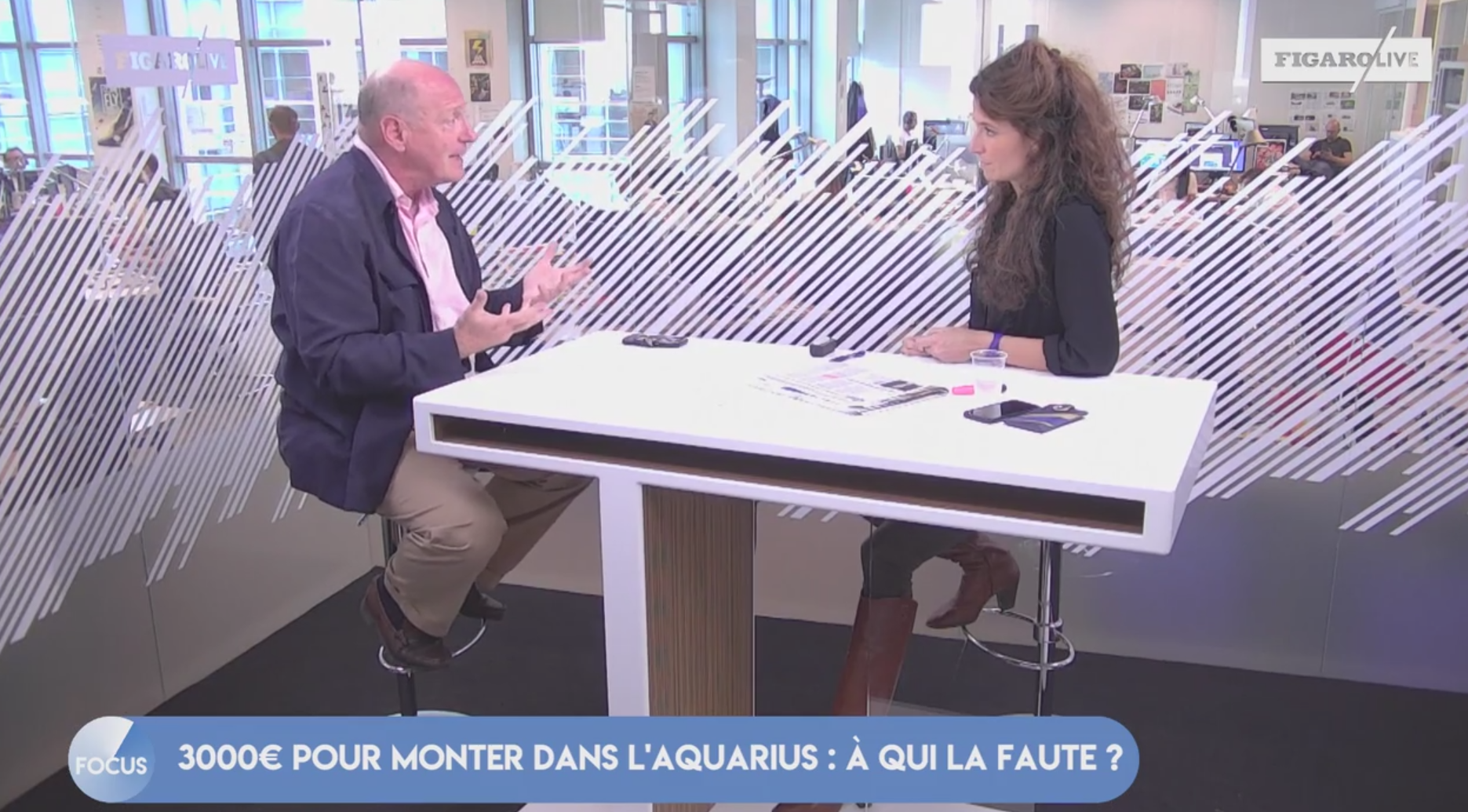
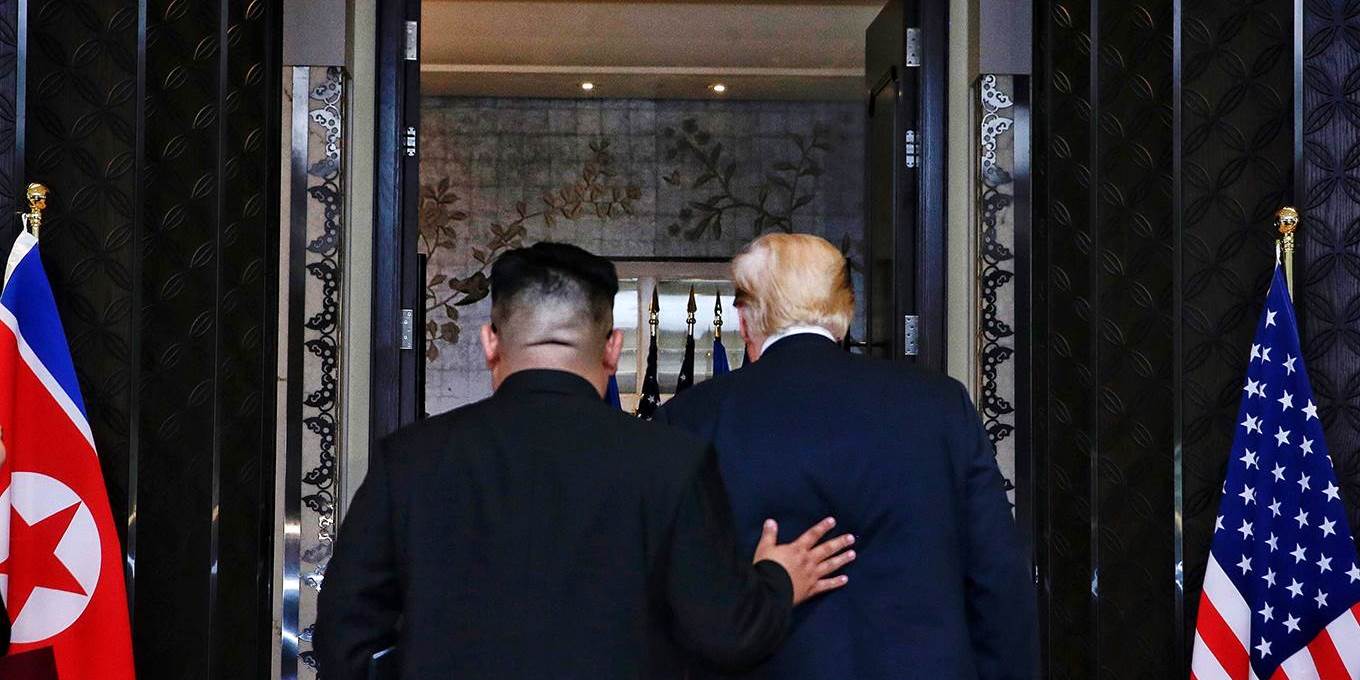
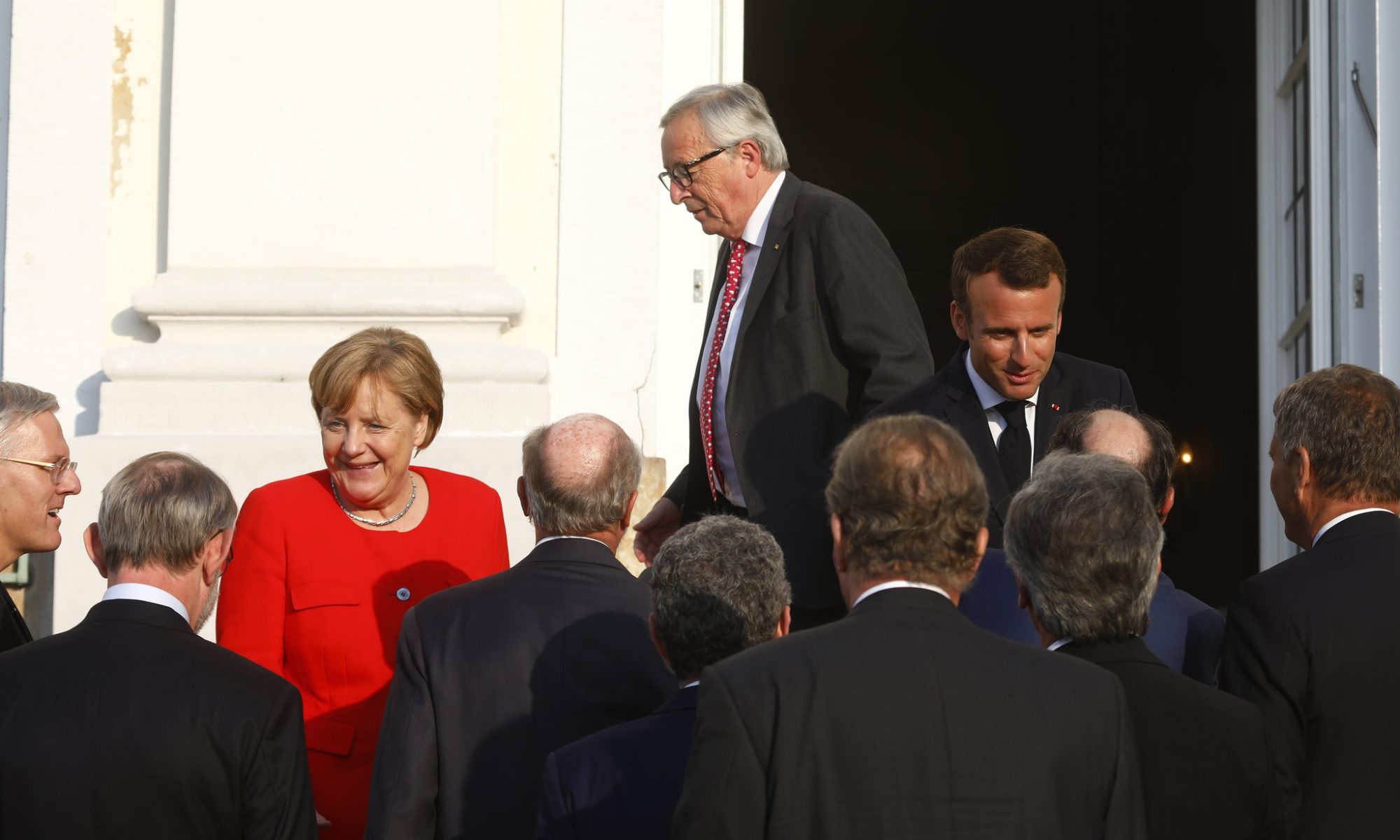
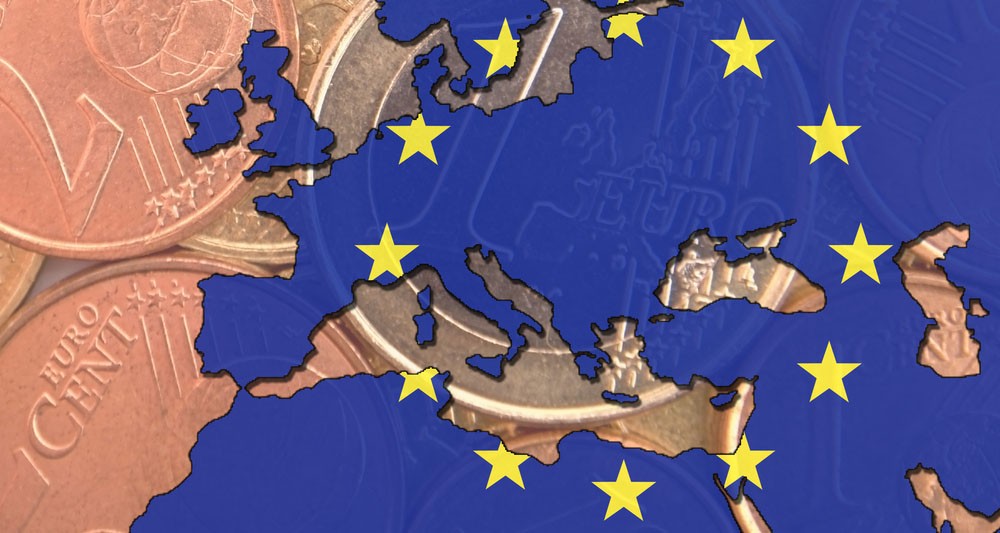
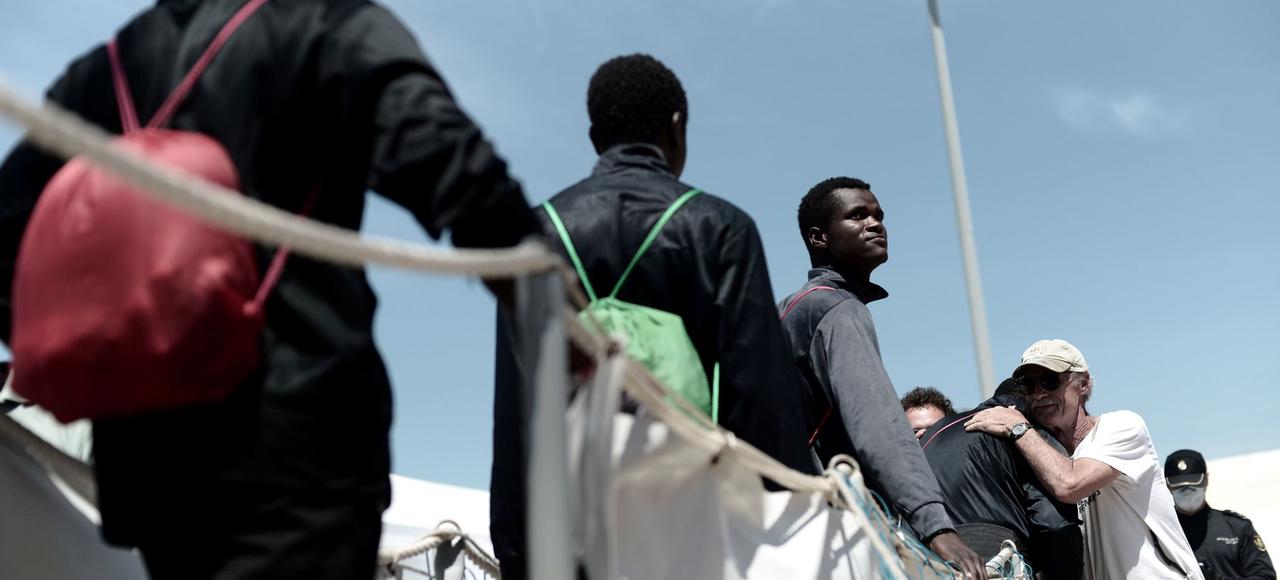


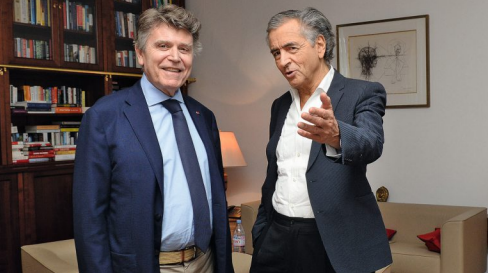
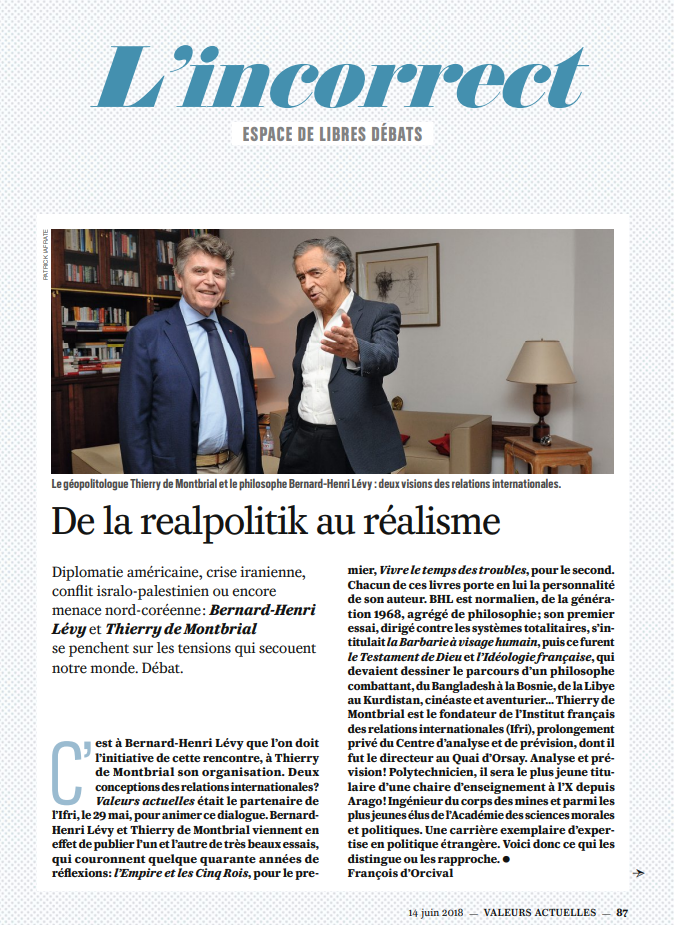
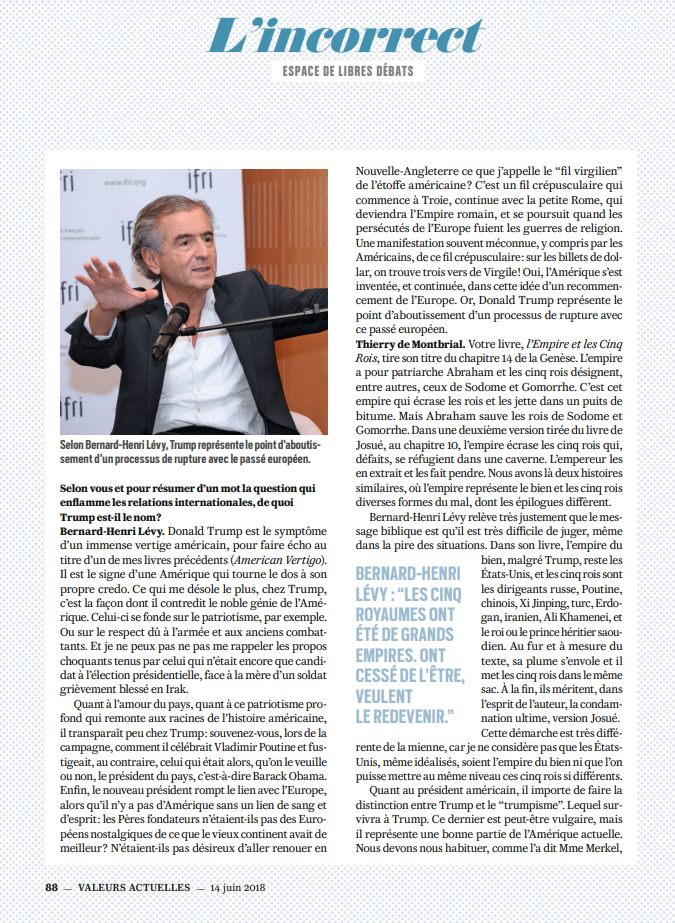
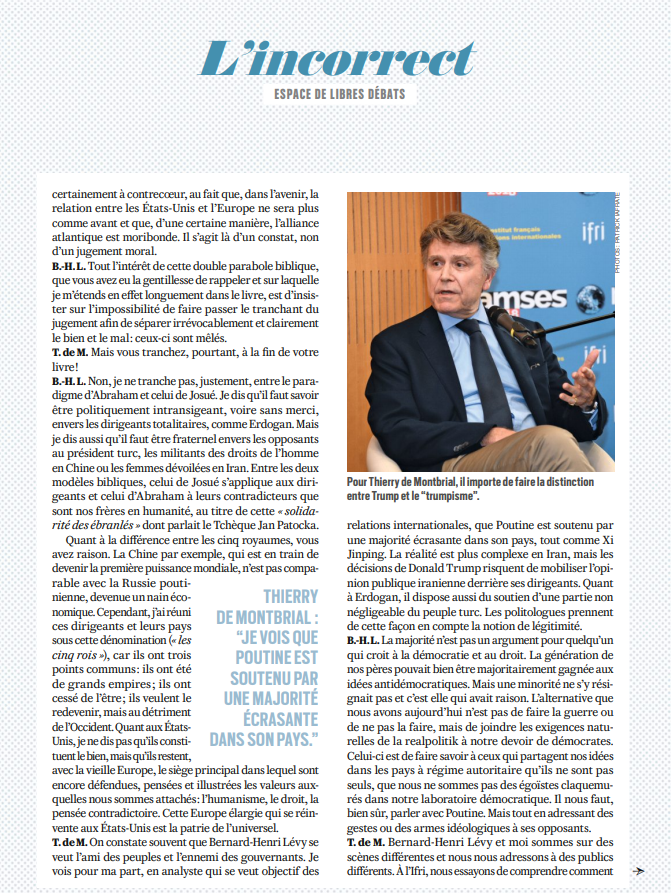
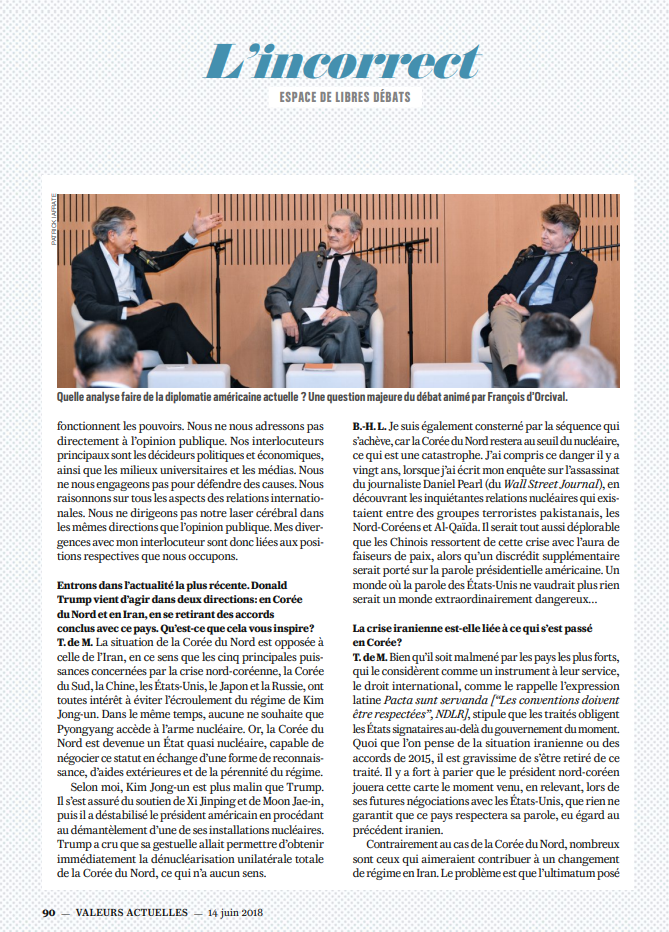
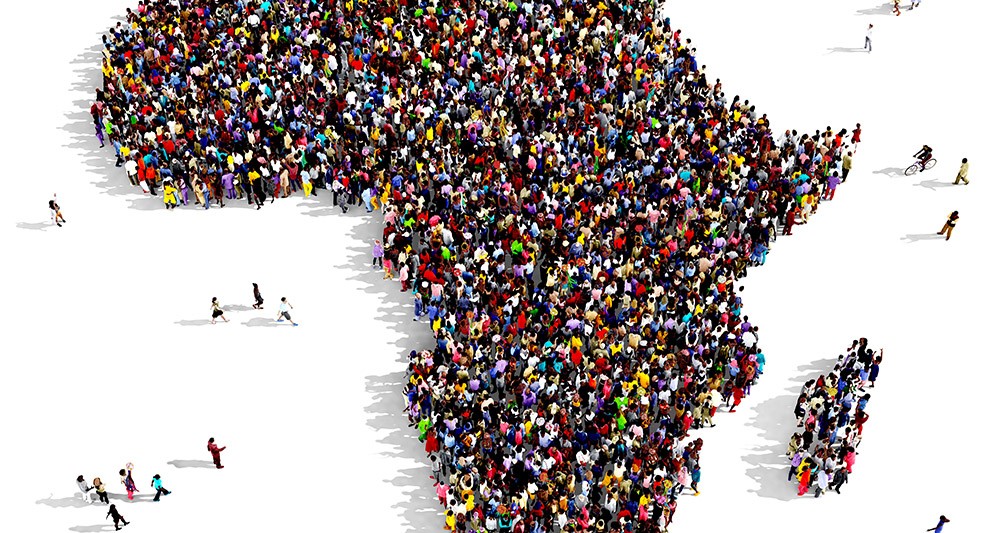
 France and Germany wrapped themselves in the flag of liberal democracy and started a ‘value-driven’ crusade
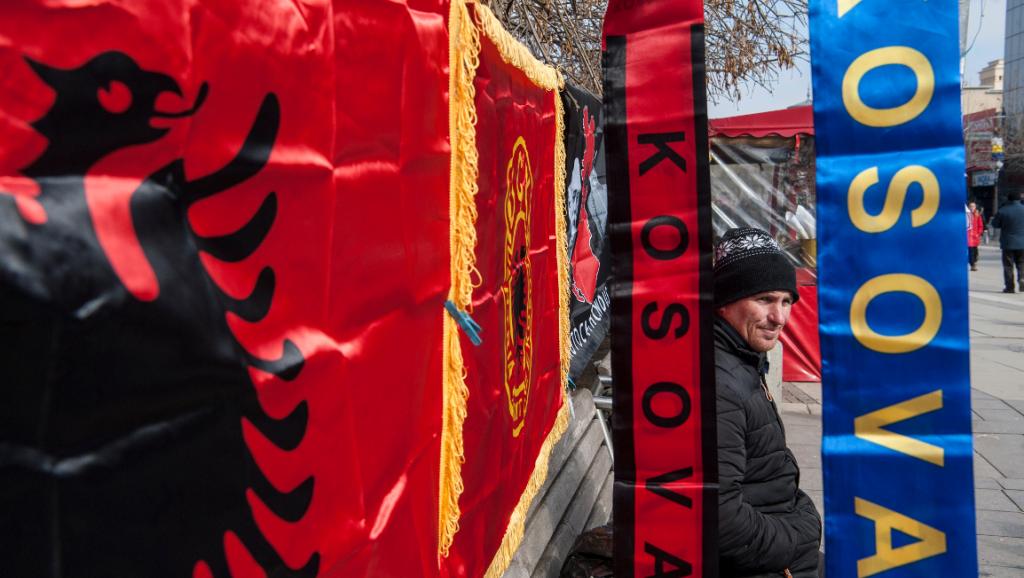

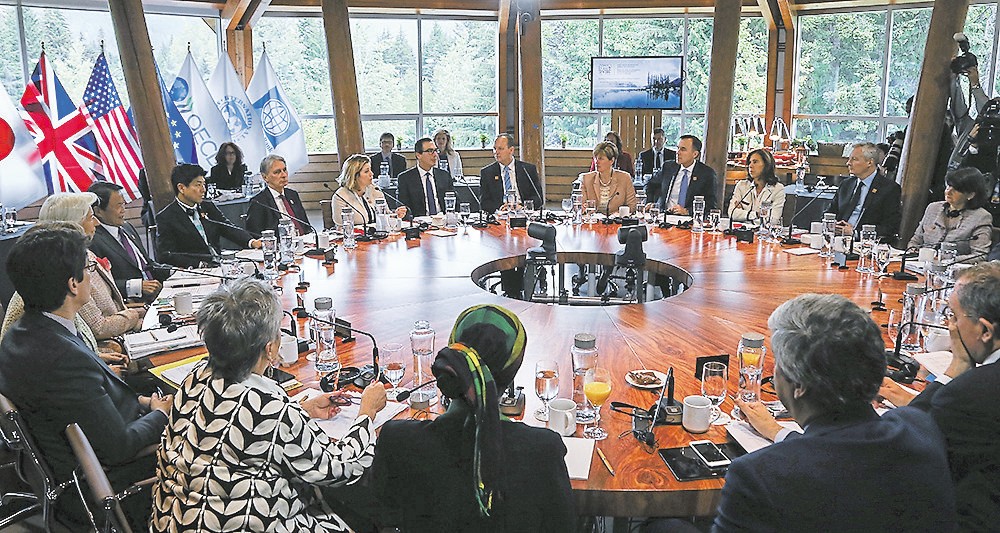
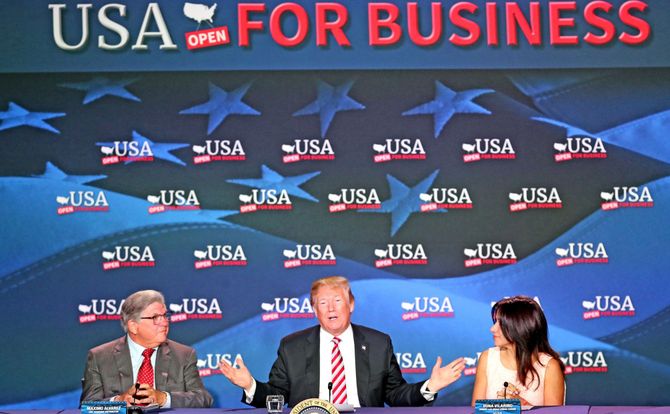


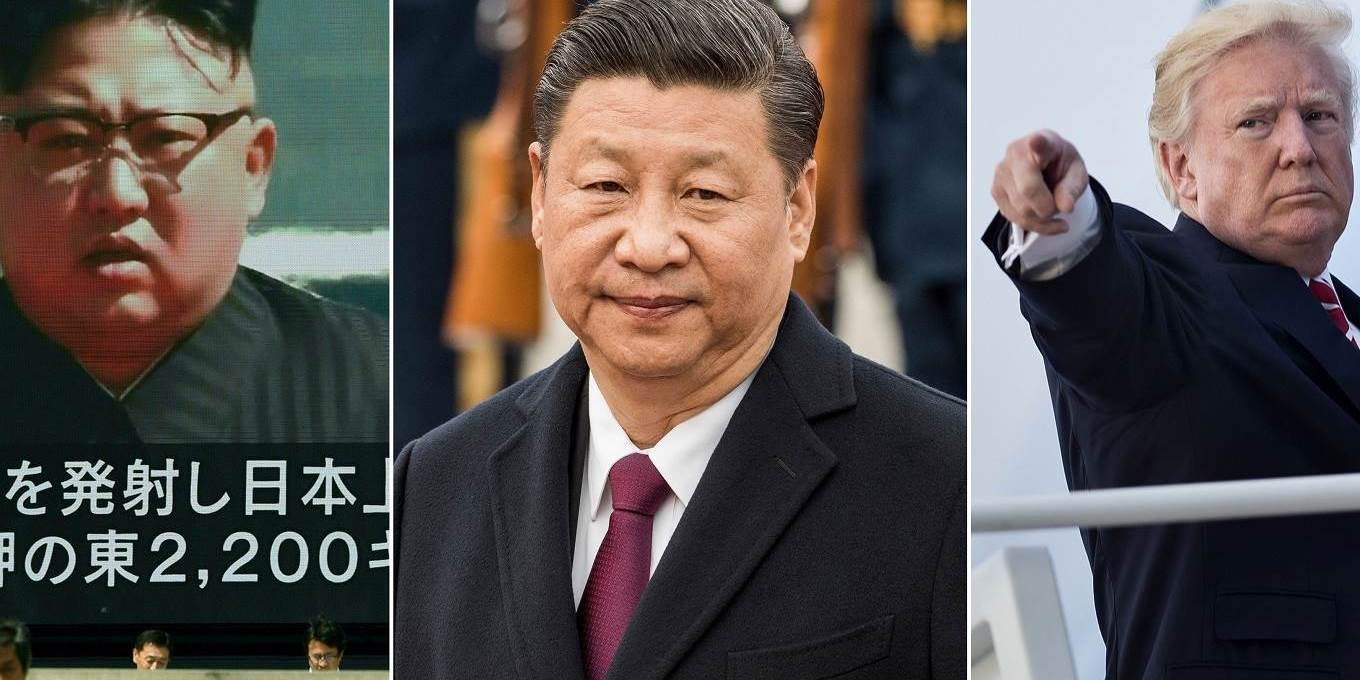
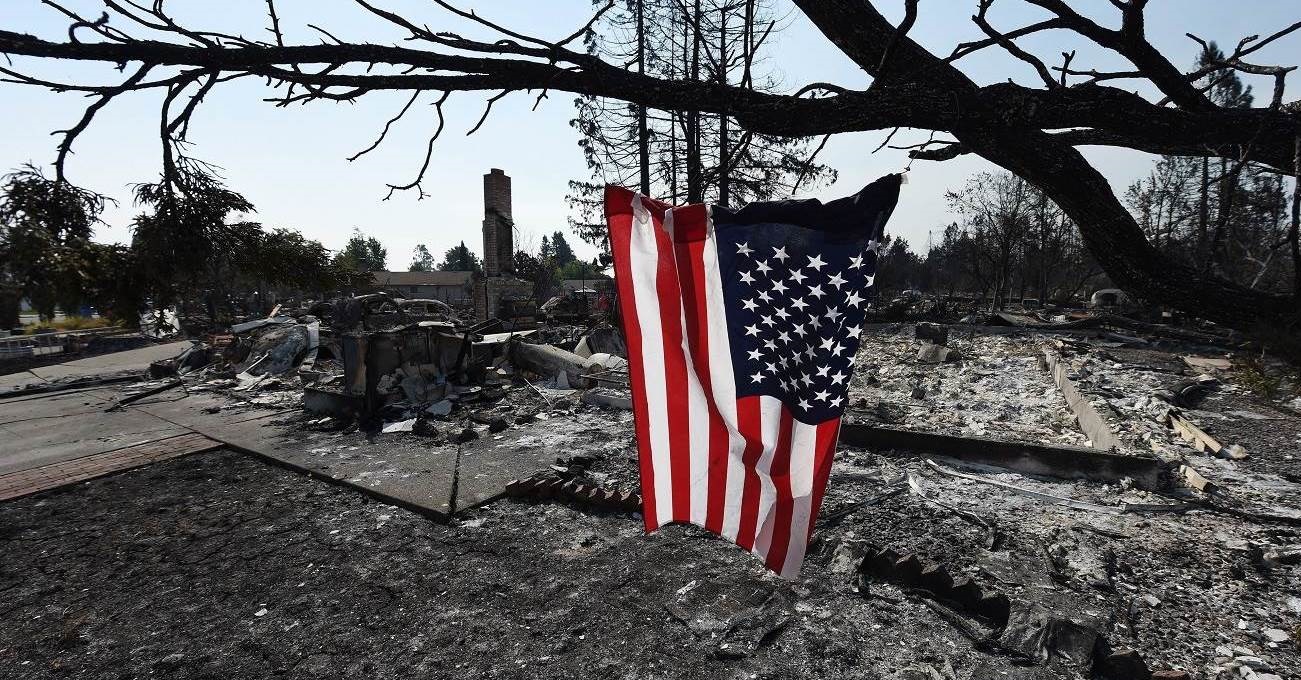
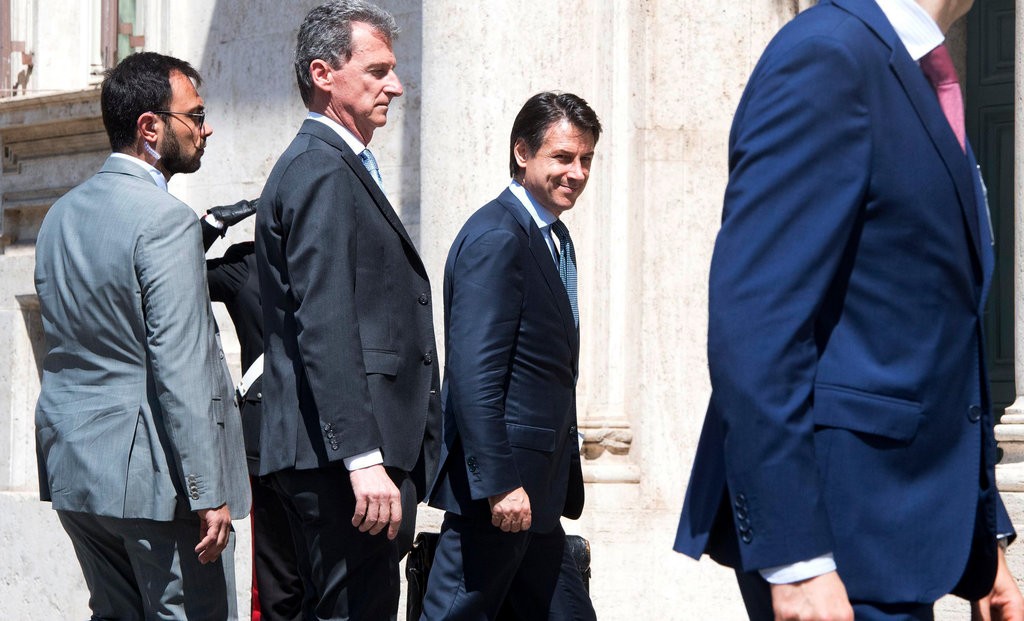


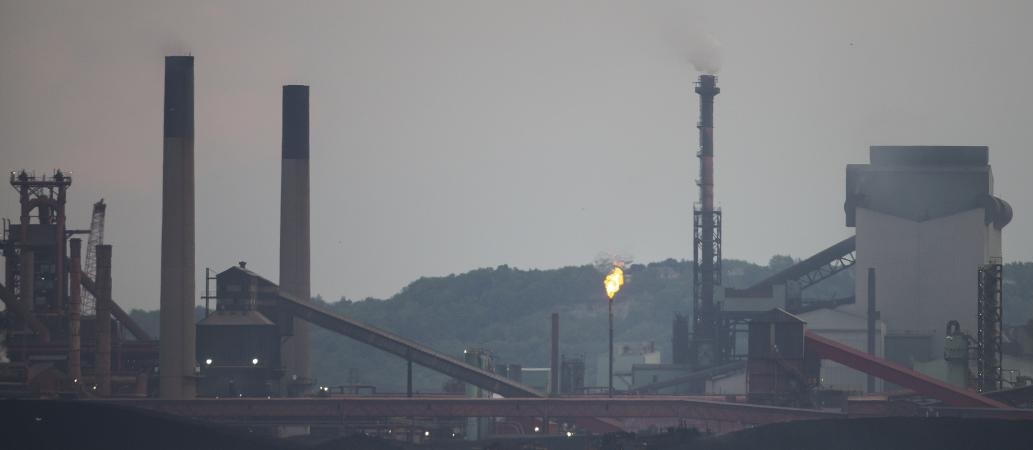
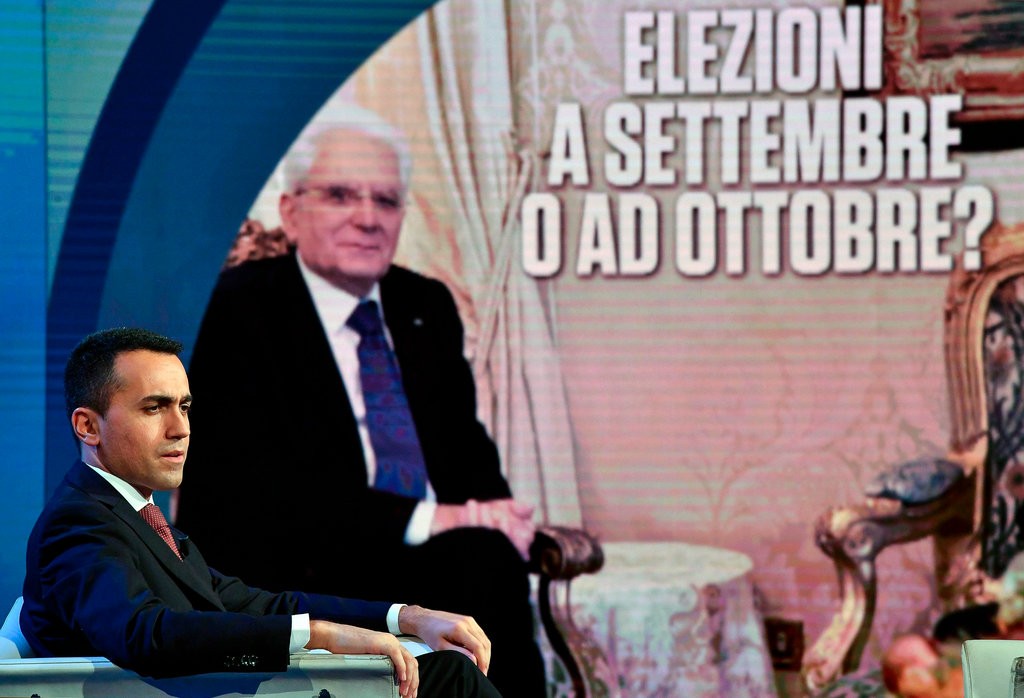


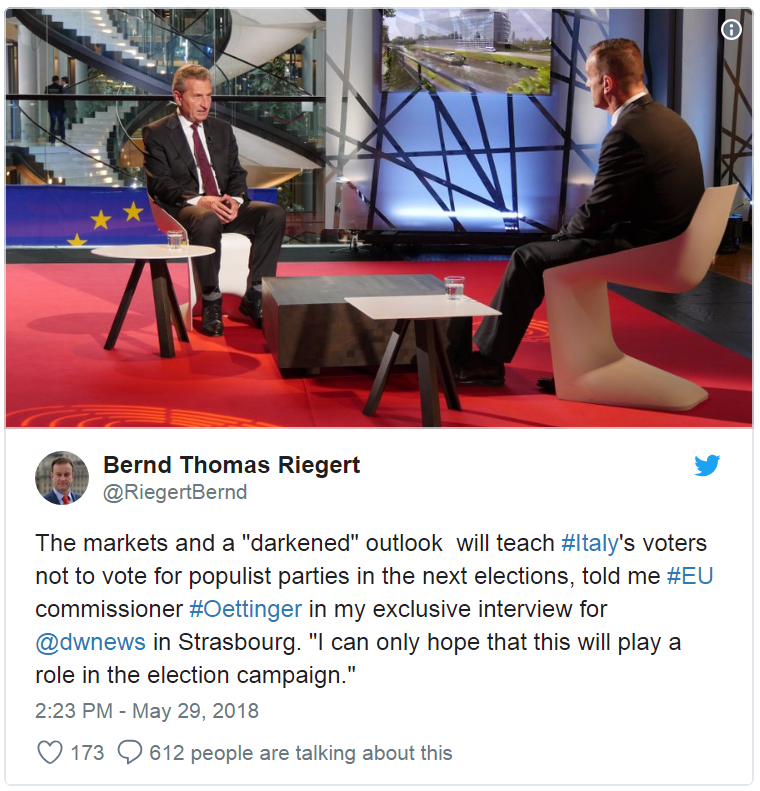
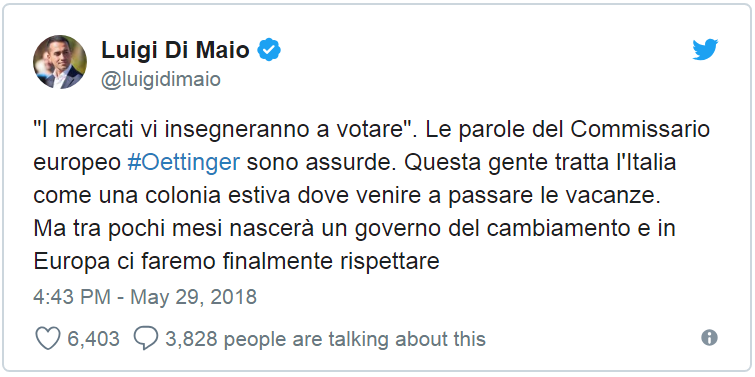
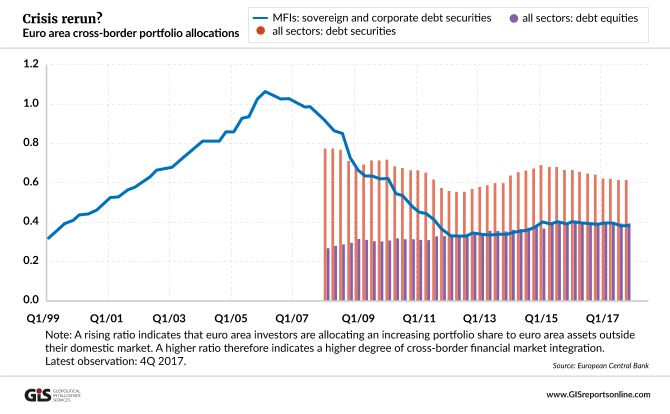
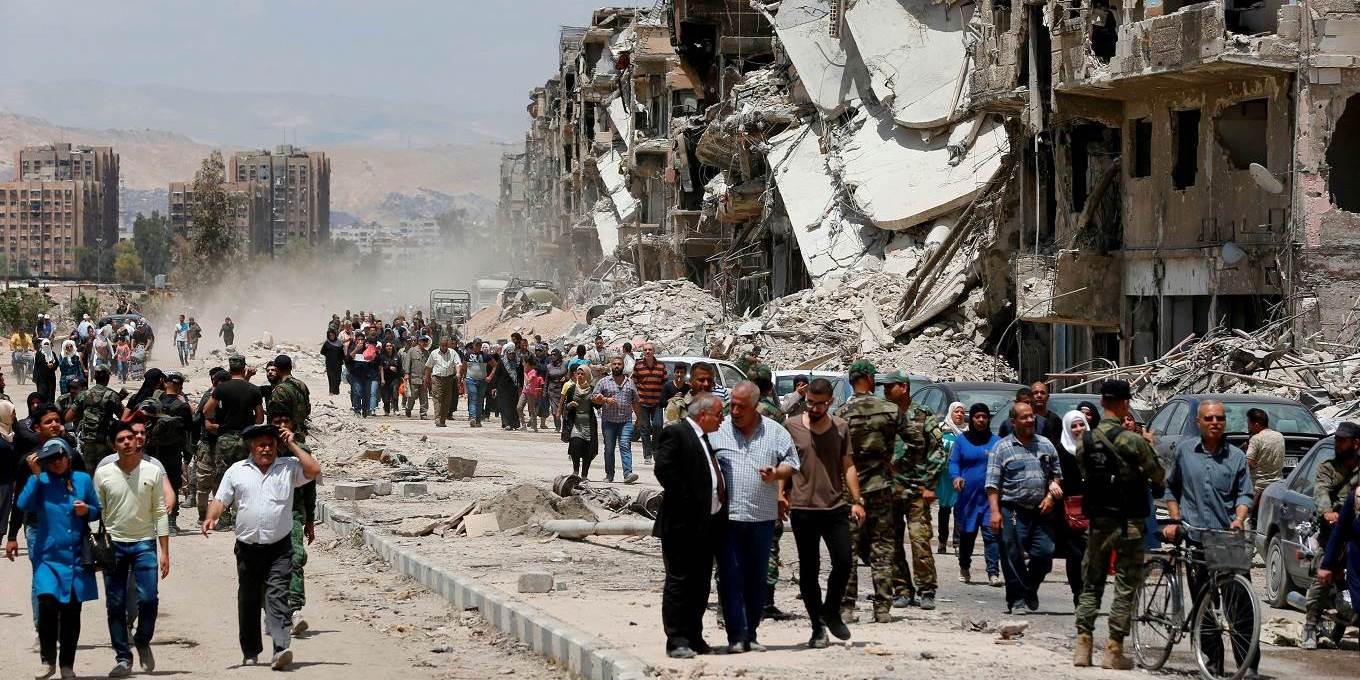
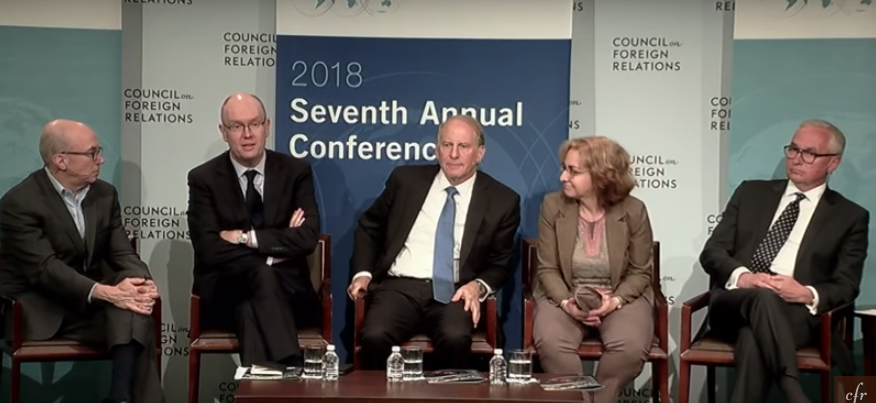
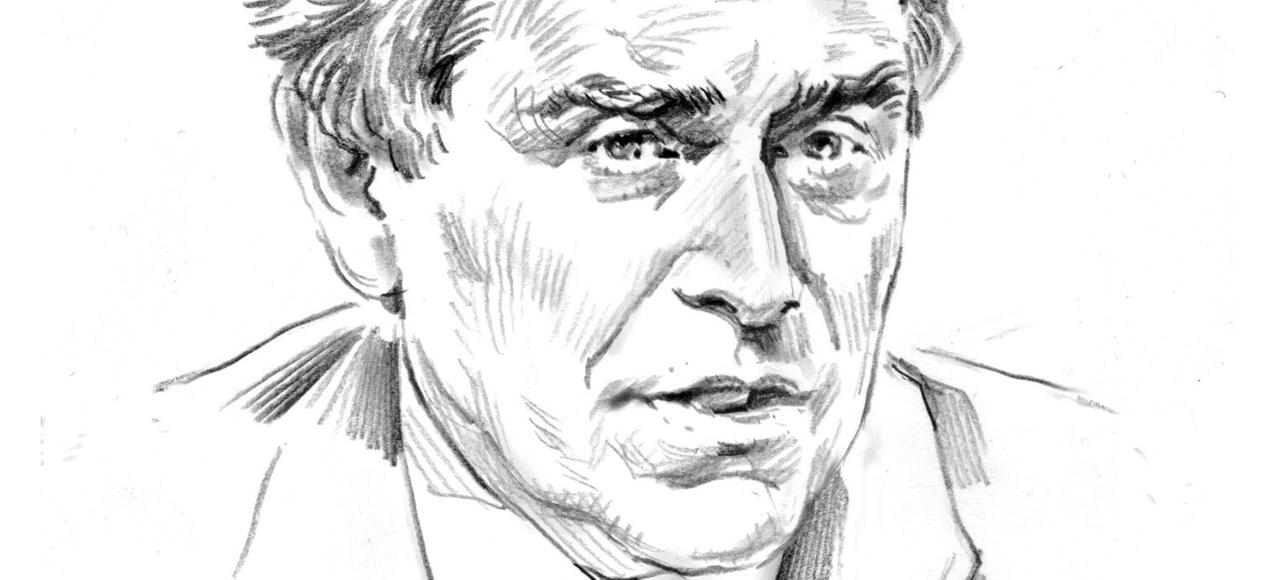

NEW YORK – US President Donald Trump returned from his short summit meeting in Singapore with North Korean leader Kim Jong-un in an exultant mood. “Everybody can now feel much safer than the day I took office,” Trump tweeted. “There is no longer a Nuclear Threat from North Korea.” He subsequently told reporters, “I have solved that problem.”
There is only one catch: what Trump claimed was untrue. The nuclear threat posed by North Korea remains undiminished. The joint statement issued by the two leaders was as brief – just 391 words – as it was vague.
The statement was far more about aspirations than accomplishments. North Korea committed only “to work toward complete denuclearization of the Korean Peninsula.” Missing was any definition of what denuclearization might entail, a timeline for implementation, or a reference to how any actions would be verified. Other issues related to nuclear weapons, including ballistic missiles, were not even mentioned. Thus far, at least, the agreement with North Korea compares unfavorably to the Iran nuclear deal that Trump denounced – and then renounced a month before meeting Kim.
This is not to argue that the Singapore summit had no value. At least for now, bilateral relations are in a better place than they were a year ago, when North Korea was conducting nuclear and missile tests, and observers (including me) were busy calculating the chances that the two countries would be making war rather than peace. And, looking forward, there is, in principle, the possibility that the United States and North Korea will be able to reach agreement on the many relevant issues and details that the Singapore summit statement left out.
But turning this possibility into reality will be extraordinarily difficult. There are many reasons to doubt whether North Korea will ever give up weaponry that, more than anything else, explains America’s willingness to take it seriously and treat it as something of an equal. In addition, the experience of Ukraine, a country that gave up its nuclear weapons, only to see the world do nothing when Russia annexed Crimea, hardly provides a reason for Kim Jong-un to follow suit. Much the same could be said of Libya, given Colonel Muammar el-Qaddafi’s fate.1
There is also good reason to doubt that North Korea, arguably the world’s most closed and secretive country, would ever permit the sort of intrusive international inspections that would be required to verify that it had complied with undertakings spelled out in some future pact.
Trump seems to think that Kim can be swayed not simply by threats and pressure, but by flattery and promises as well. The White House released a four-minute video that showcased Kim as someone who could be a great historical figure if only he would fundamentally change. The video also went to great lengths to show what North Korea could gain economically were it to meet US demands. The president even spoke of the North’s potential as a venue for real-estate development and tourism.
What seems not to have occurred to Trump is that such a future holds more peril than promise to someone whose family has ruled with an iron grip for three generations. A North Korea open to Western businessmen might soon find itself penetrated by Western ideas. Popular unrest would be sure to follow.
Trump emphasizes the importance of personal relationships, and he claimed to have developed one with Kim in a matter of hours. More than once, he spoke of the trust he had for a leader with a record of killing off those (including an uncle and a brother) he deemed his enemies. All of this turned Ronald Reagan’s maxim – “trust, but verify” – on its head, to something like “Don’t verify, but trust.”
In fact, some of Trump’s post-summit remarks have actually weakened the prospect of achieving his goals. His depiction of the summit as a great success that solved the nuclear problem will make it that much tougher to maintain international support for the economic sanctions that are still needed to pressure North Korea. Trump also did himself no favor by unilaterally announcing that the US would no longer conduct what he described as “provocative” war games, also known as military exercises meant to ensure readiness and enhance deterrence. In so doing, he not only alarmed several US allies, but also gave away what he could have traded for something from North Korea.
The danger, of course, is that subsequent negotiations will fail, for all these reasons, to bring about the complete and verifiable denuclearization of North Korea that the US has said must happen soon. Trump would likely then accuse Kim of betraying his trust.
In that case, the US would have three options. It could accept less than full denuclearization, an outcome that Trump and his top aides have said they would reject. It could impose even stricter sanctions, to which China and Russia are unlikely to sign up. Or it could reintroduce the threat of military force, which South Korea, in particular, would resist.
But if Trump concludes that diplomacy has failed, he could nonetheless opt for military action, a course John Bolton suggested just before becoming national security adviser. This would hardly be the legacy that Trump intended for the Singapore summit, but it remains more possible than his optimistic tweets would lead one to believe.