Dear Henry,
You were not yet Secretary of State. You had not yet proclaimed the “Year of Europe”, which fired up your French colleague Michel Jobert. However, as National Security Adviser, you were already famous, with Nixon’s trip to China or the Paris agreements with Vietnam. It was not only as an action-focused intellectual that you were a star worldwide, but also because of your natural empathy that carried you successfully into the most diverse circles, even to Hollywood.
Meanwhile, a young Frenchman started his professional life as a mathematical economist. It was in the spring of 1973 that I became immersed in the world of international relations when Jobert – newly appointed French Minister of Foreign Affairs by General de Gaulle’s successor Georges Pompidou – asked me to set up and then run a “Centre d’Analyse et de Prévision” (CAP) (Center for Analysis and Forecasting) under his authority, and in fact, not very far from that of the President of the Republic.
At my level at the time, my team and I first turned to the National Security Council – that you had imposed a new working method on – in order to build our “CAP”. My first major reading in the field of international relations was A World Restored: Metternich, Castlereagh and the Problems of Peace 1812-1822. I was all the more sensitive to your approach to the problem of peace because, as an economist, I was a theorist of the equilibrium concept. From a philosophical point of view, I found the same paradigm in your Harvard thesis, and derived immense intellectual satisfaction from it. I have always believed that your doctrine, so decried by ideologues of the right and left, in the United States and abroad, has always been aligned with the path of wisdom. The principle underlying the equilibrium concept is that no lasting peace – and therefore one that can be adapted to changing circumstances – is possible if the main players in the international system do not agree to make room for the interests of their competitors or adversaries. This remains true even if they disagree on the nature of these interests. In other words, the ideological heterogeneity of the international system must be acknowledged. An international or even regional equilibrium is not just a balance of power but a balance of interests, supported by rules of the game. This duality must therefore be constantly adjusted through “perpetual negotiation”, as Richelieu said. I see in this approach a form of realism not to be confused with cynicism, as your opponents and those who have sought to counter you have done, not through reflection and arguments, but with hatred and violence.
You have always found yourself, as those who share your way of thinking, faced with a dilemma that is difficult to overcome: the natural tendency of those who speak of international relations is to follow the slope of the ethics of conviction rather than the ethics of responsibility (Max Weber). You have always put into perspective the temptation for everyone to try to impose their interests by hiding them behind the cloak of morality.
Some have criticized you for scorning international law and for taking little interest in what, since the 1980s, has been called “global governance”. Indeed, nothing predisposed you to Wilsonianism. Nevertheless, it seems to me that while the idea of universal peace through law remains an illusion, the ideal of global governance within the framework of the UN Charter is compatible with the concept of a balance of interests stabilized by rules of the game. I say ideal, because in this area the path can only be long, very long. This is the path we have taken with the construction of the European Union. It is also the one I think I can discern in the evolution of your thinking in the digital age. In any case, this is a path that people of good will, everywhere on the planet, must explore further, both theoretically and practically.
Back to my younger days. As soon as you were appointed Secretary of State, we established a link with your Policy Planning Staff and its director, Winston Lord, one of your closest collaborators, as well as with your special adviser Helmut Sonnenfeldt. I quickly developed a friendly and productive relationship with both of them, as well as with Winston Lord’s deputy, Reginald Bartholomew. Thanks to them, I was under the impression that I had crept into your way of thinking, which fascinated me.
My admiration has never been restricted to the extraordinary synthesis of thought and action that you embody. I remember your speech at the United Nations General Assembly in September 1974. Sitting in an armchair before the front row of the audience was a frail, elderly man, whom I could see from behind. You were addressing the world, but only looking at him. This man was your father. This scene moved me deeply. A long time later, I told you about it one evening at a Bilderberg meeting. I thought I saw a few tears in your eyes.
Our first real meeting, thanks to Winston Lord and Helmut Sonnenfeldt, was around a small “working dinner” on September 30th, 1976. I was captivated by the weight and coherence of your analyses, but also by your indulgence towards the beginner that I still was. It was then that I understood you had not become intoxicated by fame. For example, I have never heard you speak of Jobert in any way but with kindness. Born in Germany and now a leading figure in the United States and around the world, I have always seen you respect my country. As humor always had its place around you, on this day at the end of September 1976, I passed this note to Helmut: “HK would have been a very good Director of your Planning Staff”. Helmut’s reply: “He will be available to you after January 20th“. Indeed, a few weeks later, Jimmy Carter was elected president of the United States.
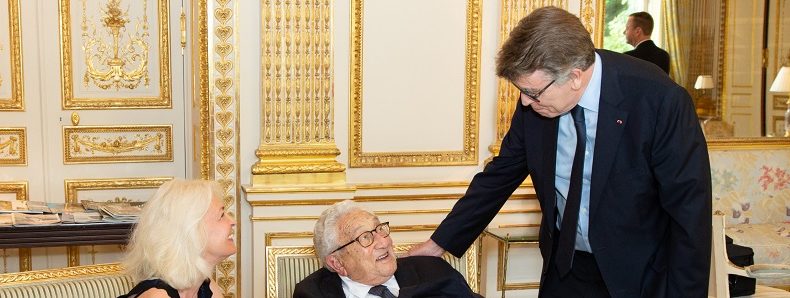
Almost half a century has passed since then, during which time, sometimes with our wives Nancy and Marie-Christine, we have never stopped seeing each other and exchanging views on the world’s problems, big and small, in Washington, New York or Paris. But also on the occasion of international conferences such as, some 35 times, the all too famous Bilderberg. I have never ceased to admire your ability to listen, a form of humility and sensitivity that is surprising for those who do not know you. Also, your exceptional loyalty to your friends is not the least of your character traits. Marie-Christine and I have very fond memories of your visit to Paris to celebrate the centenary of our mutual friend, the great French ambassador François de Rose. It was on October 13th, 2010. You and Nancy had organized a dinner – also a very small one – in honor of our friend. It was an emotionally intense evening. David Rockefeller, with whom I have many wonderful memories, came in from New York as you had. In 1974, at Bilderberg, he had introduced me to his brother Nelson, an important figure in your own history. You gave a dazzling speech. With regard to China, you observed that the difficulty stemmed from its lack of experience in the wider world. Marie-Christine and I also remember Nancy’s charm and kindness.
As we celebrate your own 100th birthday, you continue to scrutinize global developments and inspire those who seek to understand them so they can act more wisely to avoid a return to the great tragedies of history, such as the one that marked your childhood. May the authority that your career gives you help us avoid the worst.
I gladly join your friends and admirers in wishing you well.
Thierry de Montbrial
Founder and Executive Chairman of Ifri
Member of the “Institut de France”

PARIS – In recent weeks, there has been no shortage of speeches by prominent leaders discussing their countries’ relationships with China and the potential economic fallout of geopolitical fragmentation. This is a welcome, if much-belated, discussion. But it must address a fundamental question: Can rivalry and economic integration coexist and, if so, under which terms? The answer will determine the fate of the global economy.
In February 2020, Jennifer Harris and Jake Sullivan published an article highlighting the need for a shift in economic thinking. When it came to managing globalization, they noted, foreign-policy professionals have largely deferred to the “small community of experts who run international economic affairs.” They urged national-security specialists to step up, recommended a proactive stance on public investment, and advocated a more guarded approach to trade opening.
Geopolitics and international economics have long operated under two distinct paradigms. Foreign-policy experts often see global politics as a zero-sum game in which one country’s gain is another’s loss. By contrast, economists tend to focus on the potential for mutual gains from multilateral cooperation and market-led integration. These contradictory paradigms were married to each other by the shared belief that trade and openness were in the best interest of the United States. America’s hegemonic status had its drawbacks, but the benefits outweighed the costs.
[…]
Read the article written by Jean Pisani-Ferry on the Project Syndicate website.