Les Cahiers du Cercle des Economistes – La France est-elle toujours dans la course technologique ?
Article de François Barrault, président Idate DigiWorld
Pendant des années les innovations technologiques ont été rythmées et cadrées par les fameuses ‘lois de Moore’ : à savoir, on double la puissance informatique des processeurs tous les 18 mois. Cette référence, admise par tous les professionnels, a ainsi cranté le développement des systèmes et leur financement tout en permettant de budgéter l’évolution du parc informatique d’ailleurs souvent orchestrée par les géants américains de l’époque au rythme de leurs annonces.
Mais les choses changent et s’accélèrent à une vitesse folle : on parle de facteur 10 000 voire d’un million pour les 8-10 prochaines années. Nous sommes à l’aube d’une révolution industrielle sans précédent qui va bouleverser le monde moderne déjà fortement ébranlé depuis plus d’un an maintenant par la Covid 19. La 5G en est un des piliers, mais pas le seul.
Tout d’abord, la nouvelle la Loi de Moore 2.0 va s’appliquer à l’ensemble de la chaine de création et de traitement des données : ‘sensors’, caméras, ‘Edge Computing’ ou informatique embarquée localement, stockage infini et gratuit et enfin processeurs quantiques. Bien sûr chaque maillon se verra enrichi par de l’IA – Intelligence Augmentée et non Artificielle – qui traitera un nombre croissant d’opérations localement sans avoir à faire appel à des ressources décentralisées : les chips seront de plus en plus miniaturisés avec de grandes capacités
de stockage et traitement et, enfin, une très faible consommation énergétique et une connectivité en continu entre eux (IOT, internet des objets) et avec le cloud.
Les objets de la vie courante, nos environnements personnels ou professionnels seront des machines à collecter des données, à les traiter, les comparer et a priori à nous fournir une meilleure qualité de vie, une sécurité renforcée et pourquoi pas une porte d’entrée au ‘bonheur numérique’ ? Les nouveaux processeurs quantiques développés notamment grâce au plan ‘Quantique’ du gouvernement français avec 1,8 milliards d’Euros investis, vont augmenter considérablement les vitesses de calculs dans un rapport jusqu’alors jamais égalé.
La deuxième révolution est portée par les données et leur traitement : ‘Data is the new Gold’ !. Le premier pilier technologique va créer des trillions de données tous les jours et pour qu’elles soient vivantes et exploitables, il faut les rendre pertinentes, intelligentes, corrélées et surtout prédictives. Cela vaut non seulement pour les comportements des consommateurs mais aussi par exemple pour la maintenance qui se
doit de ne plus être seulement curative mais aussi prédictive comme pour les centrales nucléaires ou les robots des marchés financiers.
Enfin, le troisième pilier, le lien essentiel entre la technologie et les données, la 5G dont les enchères de la première allocation de fréquences en 3,5 et 3,71 Ghz ont été attribuées aux 4 opérateurs français. Il était temps car la 5G est déjà opérationnelle dans 60 pays et territoires depuis 2018 ! Quel bonheur d’avoir vu s’allumer le petit icone ‘5G’ sur nos smartphones dernier cri.
Ce triptyque, technologique, données et 5G va transformer notre quotidien et la compétitivité des entreprises et l’IA au coeur de notre vie.
Les exemples sont nombreux ; l’un d’entre eux est particulièrement pertinent pour illustrer cette accélération : la voiture connectée ou bientôt autonome.
Les ‘sensors’ ou caméras embarquées pourront identifier instantanément les obstacles rencontrés (piétons, voitures, vélos..), iront chercher dans l’ordinateur embarqué (Edge Computing) les données manquantes (tracteurs, side-cars) et, si aucun élément n’est répertorié – un éléphant rose par exemple – chercheront dans le Cloud (grâce à la 5G) et ainsi contextualiseront, analyseront puis renverront à la voiture un ordre validé par tous les spécialistes ou leurs avatars (avocats, assureurs, vétérinaires, dresseur d’éléphant etc..). La voiture s’arrêtera ou contournera l’obstacle en fonction des milliards d’opérations effectuées et ce, en quelques millièmes de seconde.
C’est exactement ce qui se passe avec l’être humain : en 4 itérations notre oeil voit un éléphant rose (au lieu de 4000 pour la machine) analyse la situation et prend la bonne décision instantanée (reflexe) ou réfléchie si le temps le permet.
Sommes-nous égaux avec la machine ?… Pas vraiment ! Nous avons 5 sens, la machine 2, la captation visuelle des évènements se fait à 300 000 Km/s et auditive à 340 m/s mais une fois dans notre cerveau, la transmission ralentit à.. 100 m/s et nos capteurs transmettent à 60 m/s les informations ou les ordres physiques à nos muscles.
Certes nous avons 3 ‘sensors’ en plus (gout, odorat, toucher) mais dans ce cas de figure notre temps de réaction à l’évènement va de 50 ms à 300 ms (de l’activité neuronale visuelle à la réponse motrice). Ce qui explique le faux départ au 100 m qui est déclaré en dessous d’un temps de réaction de 100 ms. Pendant ce temps-là, l’information dans la voiture et dans le cloud se déplace à des vitesses allant jusqu’à 300 000 km/s.
Cette accélération technologique basée sur la vitesse et la puissance, souvent assimilée à tort à l’IA, est en fait un temps de traitement de l’information très accéléré qui vient concurrencer l’être humain dans des taches d’abord basiques puis très sophistiquées ou critiques au fur et à mesure du déploiement de ces technologies.
Or la 5 G est vitale avec son débit (X5) et son temps de réaction (latence) divisé par 100.
Le déploiement de la 5G sur notre territoire suscite beaucoup de questions et réactions anxiogènes.
On lui reproche des impacts environnementaux, sanitaires et comportementaux. Si on exclut la théorie conspirationniste qui accuse la 5G de diffuser le covid-19, trois thématiques sont au cœur des débats, en plus de celui de la souveraineté nationale et de la cyber-sécurité.
• Une exposition aux ondes électromagnétiques (comme avec la 3G ou 4G) plus importantes avec l’utilisation des bandes millimétriques et une multitude d’objets connectés
• Une consommation énergétique importante (objets, capacité de stockage et de transmission)
• L’obsolescence prématurée de milliards de terminaux 4G
Ces annonces perturbent fortement les citoyens et nos élus : il faut faire preuve de beaucoup de prudence et surtout de pédagogie plutôt que de se livrer à des joutes verbales stériles sur les plateaux TV : ‘tough with fact, nice with people’
Concernant l’aspect sanitaire et pendant les 3 prochaines années, les fréquences utilisées sont très proches des existantes (3G,4G, Wifi) voire au-delà (Wifi 2,4 Ghz, 5 Ghz) à la maison. Donc pas de panique. Il nous reste 5 ans pour étudier l’impact des très hautes fréquences déjà utilisées dans certains pays.
Sur le terrain très glissant de la consommation énergétique, de nombreux efforts ont été demandés aux constructeurs, équipementiers et operateurs pour la réduire de manière très significative (facteur 100 à débit égal). L’apport de l’Intelligence Augmentée (IA !) à chaque niveau de la chaine de valeur, la miniaturisation des éléments vont contribuer à ces économies vertigineuses. Les constructeurs de mobiles travaillent
aussi d’arrache-pied sur l’obsolescence prématurée et programmée des milliards de terminaux 4G et 3G notamment sur leur recyclage ou de leur mise à jour.
En 2020, la Commission Européenne a publié une boite à outils « cyber sécurité » : son objectif est de définir une approche européenne coordonnée, fondée sur un ensemble commun de mesures qui visent à atténuer les principaux risques en matière de cyber sécurité des réseaux 5G.
La cyber sécurité doit aussi être prévue dès la conception des systèmes, des objets connectés qui coexisteront par milliards et encadrée pour assurer la sécurité des réseaux. La France a répondu aux inquiétudes par une loi (« Loi Huawei ») qui prévoit que toute entreprise qui veut mettre en place un réseau 5G devra obtenir une certification validée par l’ANSSI.
En parallèle de ces 3 révolutions technologiques concomitantes, phénomène unique depuis le début des technologies de l’information, s’accélère le cercle vertueux de l’innovation ou plus exactement du progrès. : la technologie change les usages qui changent les business models et les vecteurs d’investissement.
Le premier confinement a été d’une grande brutalité et vécu par beaucoup comme un traumatisme (on change d’état quasi instantanément). Avec le confinement forcé et grâce aux Zoom, Teams et autres outils collaboratifs, nous avons pu continuer à travailler, produire, échanger, vendre… et comme toujours, l’adaptabilité du genre humain a été remarquable. Si de nouveaux usages se sont installés très rapidement, de nouvelles questions ont émergé.
Le bureau, sanctuaire physique du travail (« je vais au bureau ! ») a été dématérialisé, les réunions « distancielles » sont devenues plus courtes, plus percutantes, les décisions plus rapides. Dès lors, dans l’après pandémie, pourquoi aller au bureau, qu’y faire ? Un grand patron du CAC 40 m’a confié que désormais les 6000 employés de leur siège à la
Défense qui arrivent dans une tranche de 45 mns, qui suivent les mêmes rituels (pauses cigarette, déjeuners…) et qui augmentent les transhumances pendulaires du matin, soir, weekends et vacances, tout cela était devenu absurde même si bien sûr demeure l’immense besoin de contacts et de liens physiques.
Tout un pan de l’économie s’est trouvé arrêté – les services divers à l’entreprise (cantines, nettoyages, transports…)- et en même temps, grâce à la technologie, on découvre une nouvelle forme de liberté où le bureau se déplace à la campagne, au domicile … De nouveaux concepts, comme les ’15 minutes cities’ émergent pour que les personnes puissent choisir entre leur maison, le ‘bureau’ et une structure hybride
près de chez eux (15 mns à pied ou à vélo) où se conjuguent convivialité et environnement de travail. Après quelques cafouillages, un nouvel ordre s’est établi. Ce nouvel ordre laissera des traces indélébiles dans nos modes de fonctionnement professionnels et privés.
Une réflexion s’impose donc sur l’organisation des grandes sociétés où le courant mondialiste a entrainé un découpage géographique/taylorien des activités en fonction des seuls critères de coût : production en Chine, centre d’appels en Inde, ingénierie en Europe..
Aujourd’hui s’ajoutent de nouveaux critères de choix, qu’ils soient écoresponsables, souverainistes ou encore cloisonnement et indépendance des sites de production. L’augmentation très significative des coûts des terres rares, chips, acier etc… va d’ailleurs accélérer la refonte du modèle : je produis où je consomme. Et en même temps, le nouvel ordre géopolitique mondial suppose que la communauté européenne se consolide afin de rester dans la compétition internationale.
Se pose aussi la question de l’organisation du travail : comment mettre en place des nouveaux modes d’organisation apprenantes, des nouveaux modèles de soutien et d’accompagnement managériaux à distance, quel rôle pour le management intermédiaire… ? Ce sujet prend d’autant plus d’acuité qu’il se conjugue avec l’irruption de la data, de l’IA, de la robotisation qui entraine une substitution des machines à l’homme pour les taches à faible valeur ajoutée ou encore dangereuses. La compétitivité économique repose sur la capacité des nations ou régions à embarquer les apports des nouvelles technologies pour bâtir une industrie 4.0 plus agile, plus fiable, plus productive. Dès lors la question de l’accompagnement du développement des compétences, de la formation aux métiers de demain est cruciale. L’Allemagne qui veut garder son industrie lourde compétitive et haut de gamme a investi massivement dans les outils 4.0 pour produire moins cher, avec la qualité que l’on connait tout en accompagnant et formant le personnel de son industrie.
Ce pivot ou le coût n’est plus le seul critère de choix est une chance pour l’Europe et en particulier la France pour nous permettre de ré-industrialiser intelligemment notre pays.
La fusée à 3 étages est partie et nous allons être les témoins vivants d’une révolution technologique et industrielle sans précédent où j’en suis sûr, l’homme trouvera sa place … ‘Stay tuned ‘ !!
Téléchargez le Cahier du Cercle des Economistes.




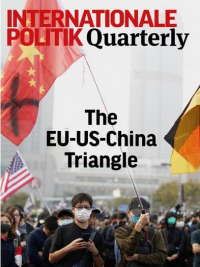 When Angela Merkel became chancellor in 2005, the world could still be called unipolar, at least at first glance. The geopolitical consequences of China’s rise seemed abstract. The issue was raised only in small circles. China’s leaders tried to seduce the West, which in turn was preoccupied with how it could benefit from the new division of labor. In fact, the West viewed China mainly as a huge pool of cheap labor and an almost inexhaustible outlet for its products. That is why China was admitted to the WTO. The idea that the Chinese were taking advantage of the West’s ambient liberal ideology to methodically implement a power policy, based on acquiring technological world leadership, did not worry Westerners much, who thus showed themselves mainly interested in the short to medium term.





/outremer/2021/03/20/605656e443669_000_96b6lp-1618880.jpg)
/outremer/2021/03/20/605657b362764_000_14s25m-1618884.jpg)
/outremer/2020/09/08/5f5730ab77bd8_5e32ff47aa50d_058_2397241vale-1271517-1467958.jpg)



PARIS – Finance is evolving in a more sustainable direction, and just in time. Pension funds, insurance companies, and sovereign wealth funds have made multiple commitments on climate change, biodiversity, and economic inclusion. In each case, the aim is to treat finance as a tool, not an end in itself, and to adopt objectives that go well beyond financial returns.
Today, more than $40.5 trillion globally is invested according to environmental, social, and governance principles. But who defines what constitutes an ESG investment, and how far can we trust ESG statements issued by corporations? We need a set of genuinely global ESG standards – and Europe can, and should, play a leading role in formulating and implementing them.
Far from being a purely technical matter, assessing firms’ non-financial performance is a deeply political issue. The first step is the choice of indicators to measure a company’s environmental or social performance. Then there is the question of establishing baseline ESG standards that Europe, the United States, or China will require from all firms that want to do business in their market, as well as a frame of reference that will directly influence financial and investment flows.
Designing such indicators is an invaluable instrument for building sovereignty. Europe, in many respects a global leader in the environmental and social domains, should therefore seize the opportunity, and advance the case for a different kind of sovereignty that serves as a launchpad for global initiatives.
Since French President Emmanuel Macron advocated building European sovereignty in a 2017 speech, the European Union’s view on the issue has evolved significantly. Nowadays, member states are far less ambivalent about defending European sovereignty, whether in response to emerging digital monopolies, the economic risks of Brexit, or the public-health threat posed by COVID-19.
To safeguard its model and values, Europe can no longer just respond to events, but needs to be proactive in identifying and initiating measures that will spread beyond its borders. Assessing corporations’ non-financial performance can form part of a more assertive sovereignty that also enables Europe to address equally urgent issues such as climate change, social problems, and shifting geopolitical alignments.
For example, the EU has set itself far-reaching environmental goals, starting with achieving carbon neutrality no later than 2050. To that end, it recently developed a so-called green taxonomy, a standardized classification that enables assessment of the sustainability of 70 economic activities that together account for 93% of the EU’s greenhouse-gas emissions.
On the social front, the EU established the Charter of Fundamental Rights in 2000, and in 2017 proclaimed the European Pillar of Social Rights – granting its citizens new and more effective means of ensuring equal access to the labor market, fair working conditions, and increased social protection. And in October 2020, the European Commission proposed an EU directive to ensure adequate minimum wages for workers in member states.
But here, too, Europe is trapping itself in a defensive situation. Although Europe is protecting its sovereignty by building such an environmental and social framework, it has no desire to introduce these ideas elsewhere. But in a global economy where each country is trying to shape standards to its own advantage, the key is not merely to defend a model, but to present it to the world as a basis for further discussion.
Since its inception, the EU has frequently been criticized for its sluggishness and bureaucratic red tape. But in a union of 27 sovereign states, every decision is necessarily the result of negotiation and compromise. Moreover, decisions about what constitutes good or bad behavior relative to a norm should not be made lightly. Ironically, therefore, Europe’s inclusive governance model may give it a competitive edge in shaping global ESG standards.
With its large and prosperous single market, high savings rate, and powerful financial sector, Europe can potentially influence these standards through what Zaki Laïdi calls “norms over force.” This is the exact opposite of traditional political and military power, or, as Laïdi puts it, the “ability to produce and set up a worldwide mechanism of norms able to structure the world, to curb unruly behavior from entering players, to offer those who abide by the rules, particularly the less powerful, ample opportunity to make the norms stand against all, including the powerful.”
Furthermore, because measuring non-financial performance goes well beyond simple accounting, the transition to a more ecologically and socially sustainable capitalism through participants’ transparency and shared responsibility may become the polestar of a new European identity.
At a time when Europe is seeking to outgrow its internal political divisions, the EU has an opportunity to reiterate its environmental and social values without requiring member states to support a particular economic model, but rather by simply sticking to a results-based approach. Despite their historical and cultural differences, member states have many shared values that enable them to agree on the basics on issues such as gender equality or environmental protection.
One of the founding fathers of European integration, Jean Monnet, believed that sovereignty declines when it is entrenched in old patterns. Having designed a sovereignty that differs fundamentally from previously tested governance models, the EU must now demonstrate its vitality by extending its power beyond its single market.
More than any other jurisdiction, the EU should embrace new norms, not fear them. By requiring an evaluation of a firm’s environmental and social impact before granting access to its market, the EU would have a unique opportunity to assert both the singularity and the extent of its sovereignty.
In doing so, Europe would contribute to a necessarily global debate regarding the transition toward a sustainable, resilient, and inclusive capitalist economic model. This goal was implicit in the Sustainable Development Goals and Paris climate agreement that the world adopted in 2015. We now have a duty to make it overt.